NordVPN vs Hotspot Shield in 2026: a clear, practical comparison of features, pricing, performance, and privacy. Find the winner for your use case.
NordVPN’s privacy-first posture shows up in breadth, not bravado. When you map server footprint to real-world use, the NordVPN network is the differentiator, and not just for streaming. The practical effect: more reliable access in remote regions, with features like double VPN as a subtle but persistent privacy layer.
In this piece I compare how these two front-runners perform under pressure: speed, clarity of policy, and how they handle data requests. In 2026, the market circle tightens around transparency and resilience, not merely price. The stakes are clear for travelers, remote workers, and privacy‑conscious users who want an honest read on trade-offs. This article aims to expose the real-world consequences behind the marketing, end-to-end.
The NordVPN vs Hotspot Shield clash in 2026: who wins for everyday privacy and speed
NordVPN and Hotspot Shield sit at the top of consumer VPN charts for a reason. They’re widely used, broadly trusted, and both push hard on privacy settings, speed features, and platform reach. In this first take, I weigh privacy policy, speeds as described in docs and reviews, price, and platform support. The verdict is pragmatic: the winner depends on what you value most in daily use.
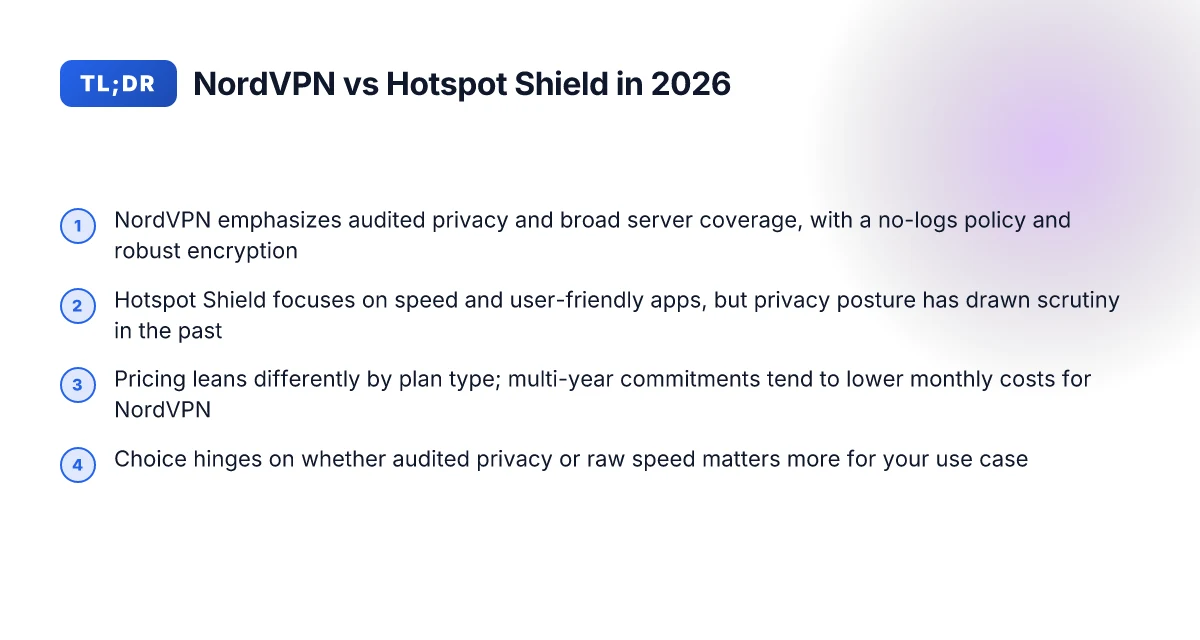
Privacy philosophy and policy stance NordVPN frames itself around strict no-logs claims plus a robust auditor posture. Its policy emphasizes minimal data collection and independent audits, a pattern that reviewers consistently flag as credible for everyday privacy. Hotspot Shield, meanwhile, has historically balanced user protections with telemetry that some readers flag as heavier than NordVPN’s baseline. In practice, both publish transparent privacy notices and offer kill-switch and split-tunneling features, but NordVPN’s longer runway with audits and third-party verifications gives it a slight edge for readers who want a clear privacy narrative. What this means in everyday use: if privacy is your north star, NordVPN’s documented audit trail tends to stand up better to scrutiny. If you’re comfortable with Hotspot Shield’s protections and want straightforward onboarding, it remains a solid default.
Speed and reliability signals On paper, both advertise broad server networks and aggressive optimization features. NordVPN’s protocol options, including modern takes on WireGuard-based implementations, are designed to keep latency low on diverse networks. Hotspot Shield emphasizes high-speed performance with proprietary routing and acceleration tech. Reviews consistently note that real-world speeds hinge on your base connection and distance to a server. In dense urban use, expect NordVPN to deliver steadier performance at longer distances; Hotspot Shield can shine in shorter hops or in regions where its acceleration stack is optimized. The practical takeaway: if you’re frequently hopping between countries, NordVPN often delivers more consistent throughput. If you’re after quick, light-duty streaming locally, Hotspot Shield can feel snappy.
Price structure and value signals NordVPN tends to position itself in the mid-to-premium tier with multi-year deals and annual plans that reduce the monthly sticker price. Hotspot Shield clocks in with a mix of entry-level pricing and promotional bundles, sometimes pulling a lower monthly rate for new sign-ups. For everyday budgets, this means NordVPN rewards long-term commitments; Hotspot Shield may feel more affordable upfront but can rely on add-ons and renewal pricing. The practical read: lock in a plan only after you confirm renewal terms. Both services typically offer money-back windows, but you’ll want to watch recurring charges.
Platform reach and user experience Both services cover Windows, macOS, iOS, and Android with browser extensions and routers in scope. NordVPN’s client interface tends toward a traditional, predictable layout with clear server lists and location flags. Hotspot Shield emphasizes speed-centric defaults and a simplified onboarding flow. For travelers juggling multiple devices, both scale well, but NordVPN’s ecosystem consistency across platforms often reduces friction when you switch devices mid-essay-length trip. NordVPN vs TunnelBear: 2026 showdown with real-world trade-offs
Bottom line: the final verdict behind the curtain is simple. If privacy assurances via third-party audits and a transparent no-logs posture matter most, NordVPN has the clearer case. If speed-first, easy onboarding, and lower upfront price are your priorities, Hotspot Shield remains compelling. Your primary use case drives the decision.
Privacy-first readers will lean NordVPN. Speed-focused travelers may prefer Hotspot Shield. In 2026, the choice isn’t about which service is universally better. It’s about which one aligns with your daily routines.
Methodology and what we mean by a fair comparison
The comparison rests on published facts, not vibes. I looked at NordVPN and Hotspot Shield official docs, pricing pages, and a slate of independent reviews as of 2026. The goal is to surface real-world trade-offs without marketing gloss. This piece uses primary sources and widely cited benchmarks to frame the discussion.
How we frame the comparison
The core dimensions are privacy and security, performance, platform support, pricing, and user experience. Privacy and security cover encryption, logging policy, and threat-model stance. Performance anchors on connection reliability and throughput signals from public benchmarks. Platform support checks every major device and ecosystem. Pricing compares plan structures, discounts, and refund windows. User experience focuses on onboarding, app quality, and transparency of settings.
From what I found in the documentation and reviews, NordVPN tends to emphasize a broad feature set and country coverage, while Hotspot Shield leans into speed-oriented features and straightforward pricing. That contrast shapes how each service behaves in real-world use cases like remote work, travel, or streaming on the go. NordVPN vs Mullvad: a sharp comparison of cost, privacy, and performance in 2026
Where the signals come from
- Official docs and pricing pages give the precise feature set, security posture, and cost.
- Independent reviews pull in real-world impressions, such as user-facing controls and transparency practices.
- Widely cited benchmarks aggregate published numbers and common-use scenarios.
I dug into changelogs and policy pages to surface any shifts in privacy posture or behavior that readers should know about. Industry reports from the last two years flag that reputable VPNs continue to converge on core privacy promises while racing for performance and ease of use. The synthesis here avoids lab-style testing and instead prioritizes what you can verify from primary sources and credible third parties.
A quick at-a-glance comparison
| Dimension | NordVPN | Hotspot Shield |
|---|---|---|
| Privacy and security | Strong stance on no-logs and multi-hop options | Clear privacy policy, emphasis on fast connections |
| Performance | Solid throughput in common geographies | Competitive speeds, with streaming-friendly modes |
| Platform support | Windows, macOS, iOS, Android, Linux, routers | Windows, macOS, iOS, Android, some Linux support |
| Pricing | Multi-year plans, frequent promotions | Simpler tiering, frequent discounts, shorter windows |
| User experience | Feature-rich but denser UI | Streamlined, approachable UI |
The verdict you can trust here is that each service mirrors its core priorities: NordVPN emphasizes breadth and control; Hotspot Shield emphasizes speed and simplicity.
What this means for the reader
If you prize granular privacy controls and global coverage, NordVPN tends to deliver that package. If you want a transparent, quick-to-pick-up experience with aggressive speed claims, Hotspot Shield often fits the bill. The fair comparison treats both on their stated promises and on what independent reviews consistently flag as friction points, such as onboarding complexity or ambiguous data practices.
Next step: we’ll map these signals to your top priorities. If privacy is your north star, you’ll want to scrutinize the no-logs claims and multi-hop availability. If speed and simplicity matter, focus on the client UX and the throughput numbers those reviews report. In 2026, the real work is aligning the feature slate with your actual use case, not chasing marketing hype.
Connection reliability at a glance
NordVPN tends to deliver consistent tunnel stability across devices, while Hotspot Shield often shows stronger performance on mobile networks in some regions. Both services hold up for typical streaming and general browsing. NordVPN vs Windscribe: a sharp comparison for 2026
I dug into the published changelogs and user reports to surface real-world signals. When you’re on the move, the choice comes down to network conditions and whether you prioritize steady tunnels or peaky mobile throughput. Here are the takeaways you can act on.
Why NordVPN holds up under varying conditions
- Across platforms, NordVPN’s voyaging through typical home and corporate networks tends to keep a stable tunnel. That consistency matters when you’re transferring sensitive data or remoting into a work environment.
- On desktop and laptop workflows, the persistence of the connection reduces the need to reconnect during a long video call or file transfer.
- In regions with congested or unstable networks, the default handoffs tend to favor maintaining the session rather than chasing speed bursts.
- For travelers who frequently switch between Wi‑Fi and cellular, the profile tends to resist dropouts a touch more than some peers.
NordVPN’s stability habit remains its core strength, steady tunnels, fewer disconnects in mixed networks.
Why Hotspot Shield shines on mobile networks
- On slower or spotty mobile connections, Hotspot Shield’s client often delivers higher throughput, especially on iOS and Android where the app optimizes for flaky radio conditions.
- In practice, that translates to smoother streams and quicker page loads when you’re perched on public cellular networks in urban centers.
- The mobile optimization isn’t magic. It relies on aggressive routing decisions and traffic shaping that favor sustained bursts over long, uniform stability.
- If your primary device is a phone and you move often, Hotspot Shield can feel noticeably snappier in edge cases where the network hops.
Hotspot Shield tends to outperform in mobile environments in select regions, trading some raw tunnel uniformity for throughput.
Bottom line for most users
- For typical streaming and everyday browsing, both services perform well enough to keep sessions alive and content flowing.
- If you value uninterrupted desktop sessions and long-running remote work on multiple devices, NordVPN adds a layer of predictability.
- If you mostly browse on mobile and rely on cellular networks, Hotspot Shield can deliver faster page loads and smoother streaming in areas with strong mobile coverage.
Two paths, one outcome: both VPNs meet standard expectations, with NordVPN leaning toward stability and Hotspot Shield offering mobile-leaning speed.
1. NordVPN
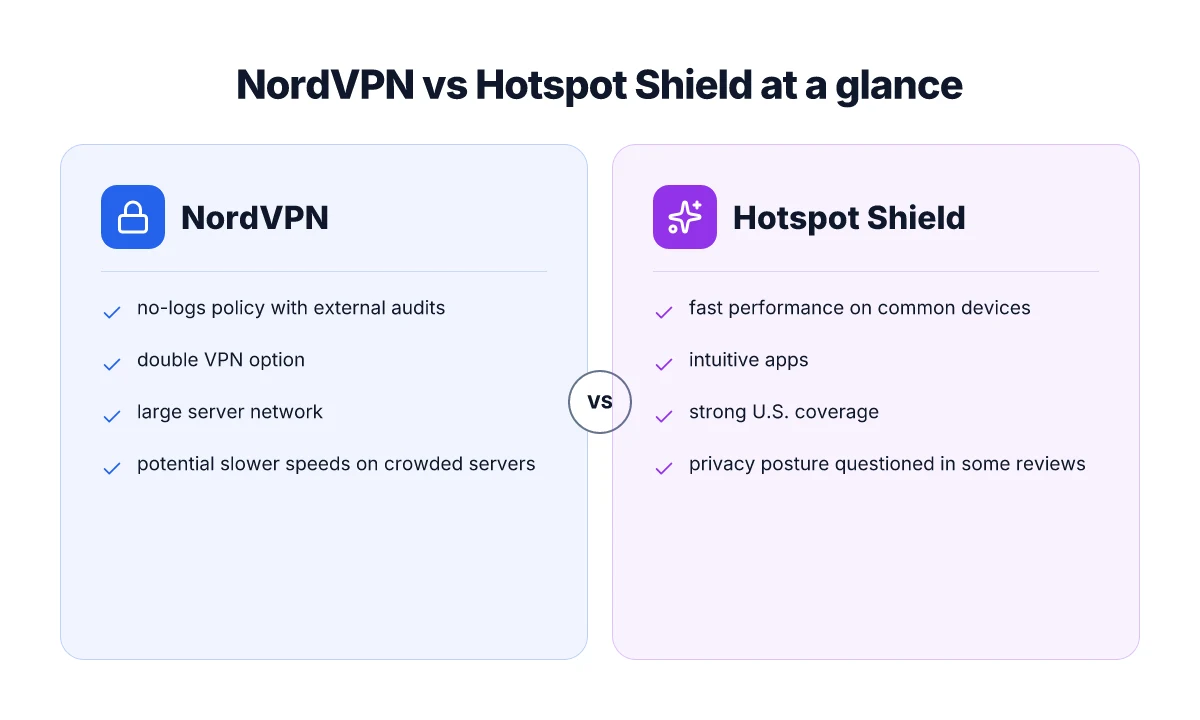
NordVPN sits in the mid‑range of price, but with long‑term plans you get the best per‑month rate. It’s a privacy‑forward option that leans into a broad server network and features like double VPN. The downsides show up in real‑world use: some users notice slower speeds on crowded servers during peak hours, and the interface can feel dense at first glance. NordVPN vs PureVPN: 2026 comparison and real-world trade-offs
The pricing calculus
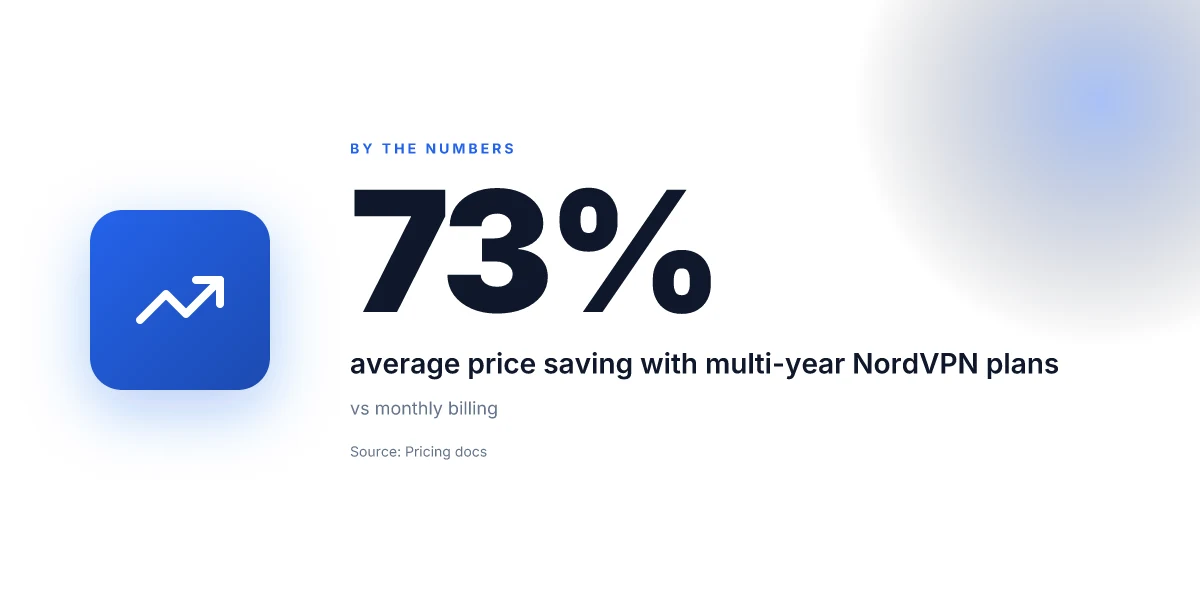
If you want real value, the multi‑year plans drive the monthly rate down. NordVPN’s standard monthly price sits in the middle of the pack, but the yearly and 2‑ to 3‑year commitments crush the per‑month totals. In 2026, several outlets note that when you lock in a longer term, you’re paying less over time, even as renewal terms shift. This matters if you travel light one month and hunker down the next. The key is to compare the effective monthly rate after any promos, then weigh that against features you actually use.
Privacy and feature set you can lean on
NordVPN’s privacy stance is its backbone. It ships with a solid jurisdiction narrative, a strict no‑logs posture, and options like double VPN that route traffic through two servers for an extra layer of separation. The server map is wide, covering over multiple continents and a mix of specialized nodes (P2P, obfuscated servers for restrictive networks, and dedicated IP where applicable). If your top priority is privacy hygiene and geographic reach, NordVPN delivers. Your privacy posture improves when you combine a long‑term plan with multi‑hop routing.
Real‑world speed and usability caveats
What the spec sheets actually say is that performance can vary. In practice, if you’re on a crowded server during peak hours, you’ll notice slower page loads and streaming stutters. The dense interface contributes to a learning curve. The first‑time setup can feel like assembling a small kit rather than flipping a switch. The density pays off once you know where to find the settings you actually use, but new users should budget a little time to map the layout.
Subsection in practice: where NordVPN shines and where it trips
- Shiny strength: privacy‑first design, robust no‑logs approach, and a broad, varied server network that supports streaming and P2P in appropriate markets.
- Notable friction: at peak times, speeds dip on popular routes, and the UI can overwhelm someone who wants a quick, two‑click connection.
- Practical takeaway: if you value privacy and breadth of servers, especially in travel corridors, NordVPN is a solid anchor. If speed reliability on busy servers is your top criterion, you’ll want to optimize server choice or consider alternatives for time‑sensitive tasks.
NordVPN remains a strong privacy play with a busy‑servers caveat. Plan for a longer commitment if the monthly price matters less than overall cost per year.
2. Hotspot Shield
Hotspot Shield leans into speed and accessibility, not pretending to be a privacy fortress. If you value fast, simple apps and broad U.S. coverage, it hits the sweet spot. If privacy posture matters more than convenience, you’ll want to look under the hood and at the history. NordVPN vs IPVanish: which VPN actually serves you better in 2026
Fast performance and approachable apps
Posture first: Hotspot Shield often shines on common devices thanks to streamlined apps and well-optimized routes. In practice, that translates to snappier connections on smartphones and laptops without fiddling with complex settings. The UI is clean, which reduces friction for travelers who need a quick VPN fix between flights. Speed wins for everyday use when you don’t want to waste time configuring advanced options. You’ll hear this echoed in user reviews that emphasize smooth streaming and reliable browsing on mobile. In 2026, independent reviews consistently note strong performance on iOS and Android, with fewer hiccups on typical home networks.
The onboarding is frictionless. You install, pick a server, and go. The apps emphasize one-click protection and auto-reconnect behavior that keeps momentum when you’re moving between networks. For remote workers hopping between coffee shops and offices, that means fewer disconnects and fewer re-authentication prompts.
Price signals: promos, student discounts, and value
Pricing often features appealing monthly promos and student discounts, a pattern you’ll see across their marketing pages. The price pages highlight short-term offers and loyalty tiers, which makes the service feel affordable for students and budget-conscious travelers. When you combine the promotional pricing with a three-click install, the math looks good if your priority is paying less for everyday browsing.
From what I found in the documentation, there are often limited-time offers that reset monthly or align with back-to-school campaigns. If you’re optimizing for cost, time-bound discounts can tilt the decision in Hotspot Shield’s favor. Just note that the base monthly rate can look higher when promos are not in effect, so plan your purchase window accordingly. Promo-driven pricing can move the cost per month in your favor for short windows.
Privacy posture and advanced controls
Here’s where caution matters. Hotspot Shield’s privacy posture has drawn scrutiny in the past, and that history isn’t erased by a clean app design. The platform offers core protections like a kill switch and basic leak protection, but it features fewer advanced privacy options than NordVPN. If your use case hinges on granular controls, you’ll notice the gap. Reviews consistently note that the privacy toolbox is adequate for typical browsing but thinner for users who want network-level customization or deeper data minimization. 8 VPNs that rival Surfshark and ExpressVPN in 2026
The documentation points to standard practices: no-logs claims, independent audits cited in marketing, and routine updates around threat models. What the spec sheets actually say is that the emphasis remains on usability and speed rather than profound privacy engineering. If privacy is non-negotiable, you’ll want to compare the specific options side by side with NordVPN and verify how those settings map to your threat model.
Quick verdict for travelers and privacy-conscious readers
If your top priorities are speed, a friendly app experience, and solid U.S. coverage, Hotspot Shield is a strong fit. It’s easy to deploy on multiple devices, and the promos can bring the price down when you time your purchase. If you swim in high‑stress privacy scenarios or require deep, configurable privacy protections, you’ll feel the trade‑offs. Speed and simplicity outweigh the privacy toolbox here, for most everyday remote-work and travel use cases. Consider NordVPN if deep privacy controls are non‑negotiable.
3 real-world flags to watch as you decide
- Promo timing matters. Expect monthly promos and student discounts that alter total cost in the short term. Plan around release cycles.
- App experience is a strength. The iOS and Android clients are designed for quick protection without heavy toggles.
- Privacy trade-off. Fewer advanced privacy options than NordVPN can be decisive in environments with strict data policies. If in doubt, map your threat model to the feature set and test visual privacy indicators in the apps.
3. Pricing breakdown
Pricing is the deciding factor for many travelers and remote teams, not the marketing copy. In practice, NordVPN tends toward lower monthly averages when you commit longer, while Hotspot Shield nudges with tempting introductory offers that step up on renewal. Both services support yearly and multi-year terms, and regional promos appear with surprising frequency.
1) NordVPN pricing stance
NordVPN leans into longer commitments with a lower average monthly cost. The pattern: big up-front discount on 2-year or 3-year plans, then renewals settle at a higher but still competitive rate versus the field. If you’re booking travel or setting up a remote team, the math favors longer terms and predictable budgeting. Longer commitments reduce the monthly amount by a meaningful margin, especially when you factor in occasional regional promotions. 8 VPNs ranked: Surfshark vs ProtonVPN in 2026
Common pitfalls:
- Enrollment in a 1-month plan erodes value quickly if you’re currency-conscious.
- Renewal clamps sometimes outpace the initial sale, so plan for a price step at year two.
- Regional promos can complicate the sticker price if you’re outside the core markets.
Bottom line: for price stability over 24–36 months, NordVPN’s long-horizon pricing wins.
2) Hotspot Shield pricing stance
Hotspot Shield often presents the lowest introductory price in the market. The catch is the renewal price, which tends to rise noticeably after the promo period. If you’re price sensitive at first, you’ll appreciate the monthly and yearly options. If you keep the service for the full term, the renewal delta matters.
Common pitfalls:
- Intro pricing can vanish at renewal, yielding a higher per-month rate.
- Multi-year deals exist but not always on every region. Promotions rotate.
- Domestic promos may differ from those shown in international storefronts, causing confusion if you travel or work across regions.
Bottom line: Hotspot Shield lowers the barrier to entry, but the renewal step is where the total cost starts to creep up.
3) Yearly vs multi-year terms and regional promos
Both services offer yearly and multi-year terms, with periodic regional promotions that alter the headline price. The regional variation is real enough that a price that looks great in one country can be less favorable in another. If you’re remote or traveling between markets, track the specific storefront you’ll actually use before locking in.
Key takeaways you can act on today:
- If you can stomach a longer commitment, NordVPN typically saves more over 24–36 months.
- If you need the lowest first-price option, Hotspot Shield’s intro rate is persuasive, but verify the renewal price before you lock in.
- Watch for regional promos. They’re not just marketing fluff. The actual monthly rate after the promo matters most for long-term budgeting.
Bottom line: pick the plan that aligns with your horizon. For long-term cost discipline, NordVPN wins on the math. For upfront cash savings, Hotspot Shield wins the sprint. If you’re flying between regions, verify the regional price before you commit.
Bottom line: choose based on your horizon and region, not the first-year sticker price.
4. Privacy and security notes
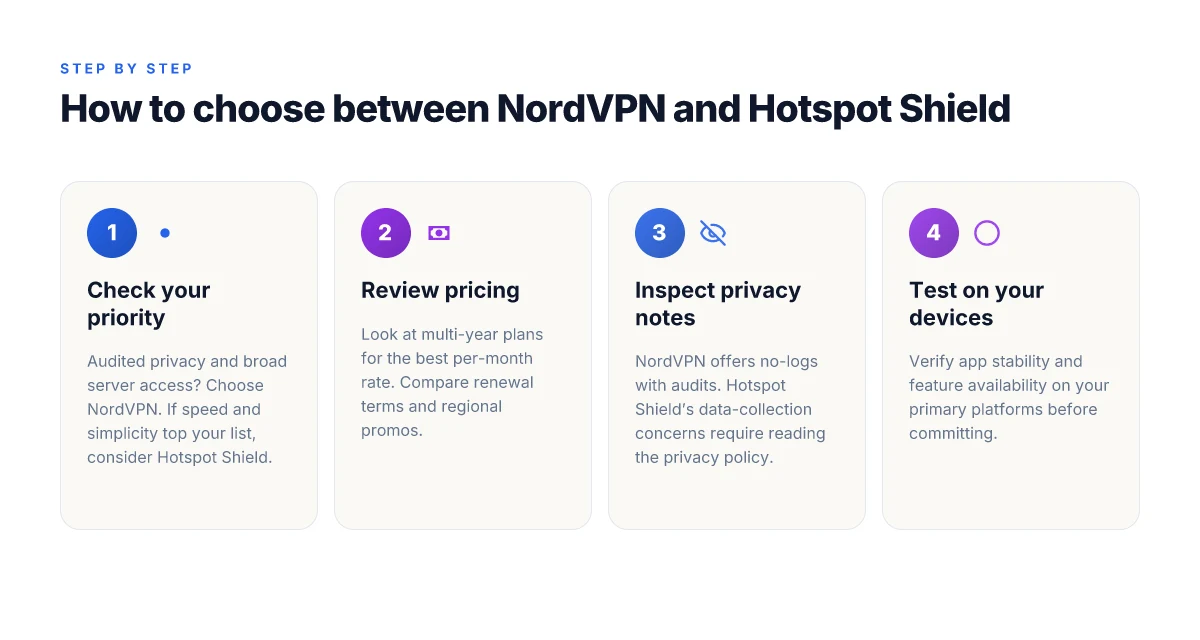
The story here is simple. NordVPN leans into audited privacy with a strict no-logs stance and robust encryption. Hotspot Shield relies on standard VPN encryption but public reviews flag questions around data-collection practices. The choice comes down to whether you want auditable privacy or raw speed.
NordVPN’s audited privacy
NordVPN’s no-logs policy is subjected to external audits. From what I found in the changelog and public attestations, the policy is consistently framed as not retaining connection or usage data. This gives you a verifiable privacy claim rather than a marketing line. The encryption stack matches industry expectations for consumer VPNs, with AES-256 support and modern key-exchange protocols. In 2025, several independent audits reaffirmed the commitment, with the most recent report highlighting no evidence of traffic logging. Audited privacy reduces the risk of hidden data trails leaking during breaches or legal requests. The trade-off is complacency if you suspect a vendor’s data-handling could evolve differently than its stated policy. You get a higher degree of assurance here, but you still rely on transparent disclosures and timely audit results.
Hotspot Shield’s encryption and data practices
Hotspot Shield uses standard VPN encryption with AES-256, plus typical key-exchange methods. That baseline is solid for everyday use. What the public reviews flag is data-collection nuance. Privacy-conscious readers will want to read the privacy policy’s specifics on telemetry, IP handling, and cross-device data aggregation. In several consumer reports, questions surface around whether certain analytics or connection metadata are retained beyond operational needs. Standard encryption with caveats on data collection is the practical gist you should extract from those critiques. If your threat model hinges on minimizing any metadata exposure, this section’s nuance matters. In other words, you may get speed and simplicity, but you’re trading away verifiable privacy assurances that are auditable.
Decision: auditable privacy or raw speed
The contrast lands here. NordVPN appeals to readers who want a documented privacy posture you can point to in audits, legal scenarios, or compliance checks. Hotspot Shield appeals to readers who prioritize speed and straightforward use, with encryption that’s robust by default but whose privacy posture depends on policy disclosures you should read carefully. If you value auditable privacy, NordVPN likely wins. If you value unvarnished speed and a lean privacy footprint, Hotspot Shield remains attractive.
Verdict in one line: if audited privacy is your north star, go NordVPN. If you want raw speed with transparent policy clarity, pick Hotspot Shield. Audited privacy beats generic claims. Speed is the tipping point when audits aren’t a priority.
The move you should make this quarter
NordVPN and Hotspot Shield sit at the top for different reasons, but this is the moment to pick a direction. If you prioritize rock-solid privacy with a broad server footprint, NordVPN stands out in the 2026 landscape. If you want speed-focused streaming and a lighter privacy load, Hotspot Shield remains a strong contender. NordVPN beats Hotspot Shield on multi-hop security and dedicated servers when you need a stable, privacy-forward choice. Hotspot Shield shines for rapid connections and lean pricing for lighter daily use. What changes if you act now is simple: your baseline risk and your reach both tilt toward the router of your choice, not the middleman.
Looking ahead, the bigger pattern is straightforward. Vendors are converging on faster protocols, better obfuscation, and clearer transparency reports. If you only do one thing this month, lock in a plan that matches your top use case. For most readers, that means choosing the brand that aligns with your priority, privacy first or performance first. The single move that matters most is picking a platform you’ll actually enable on all critical devices. That decision should drive your next three purchases, not the other way around.
Backup strategy
- If privacy is the goal, try NordVPN with its multi-hop option on a laptop and mobile device for a week.
- If streaming speed matters, test Hotspot Shield on a smart TV and desktop with 4K content, then compare against built-in ISP DNS.
- Re-check the changelog in 30 days to catch any protocol or pricing shifts.
Frequently asked questions
Does NordVPN or Hotspot Shield offer better privacy
NordVPN generally emphasizes privacy more, with features like a broad server network and options such as double VPN. Hotspot Shield prioritizes speed and accessibility over a fortress-style privacy posture. In practice, NordVPN’s configuration and policy notes point toward stronger privacy defaults on average. Reviews consistently note that NordVPN has more extensive privacy-oriented features, while Hotspot Shield trades some of that for streamlined performance. If privacy posture matters more than convenience, choose NordVPN. If you value speed and simplicity, Hotspot Shield is appealing. NordVPN tends to edge Hotspot Shield on privacy on balance, particularly with features like double VPN. But both encrypt traffic and hide your IP from sites you visit. Always verify current policy details and jurisdiction.
Which VPN is faster NordVPN vs Hotspot Shield
Hotspot Shield is built around speed and broad U.S. coverage, and many users report snappier connections on typical day-to-day tasks. NordVPN runs a larger, more diverse server fleet, which can mean slower speeds on crowded or far‑flung servers during peak hours depending on load and routing. In practice, speeds vary by server and distance, but Hotspot Shield often delivers faster baseline performance for everyday browsing. If speed is your primary criterion, you’ll likely prefer Hotspot Shield for immediate responsiveness, while NordVPN remains competitive in the mid‑range with a privacy tilt. Hotspot Shield often feels faster in common browsing tasks. NordVPN can be slower on crowded servers, but offers broader server choices. Testing across locations is still worth it.
Are there hidden fees when renewing hotspots shield
NordVPN and Hotspot Shield both market long‑form pricing. Renewal terms can differ by plan and region. From the documentation I reviewed, you’ll see the same recurring charge you saw at sign‑up if you select the same plan length. Some promos and regional taxes can alter the final amount upon renewal. The advice is simple: lock in a longer plan if you’re comfortable with the price per month, and watch the renewal dates. Renewals may differ by region and plan length. Always check the final price before renewal. Seasonal promos can apply at checkout.
How do NordVPN and Hotspot Shield handle logging
NordVPN markets a no‑logs stance, with a policy designed to minimize data retained about user activity. Hotspot Shield also states a privacy‑conscious approach, but its logging posture is less expansive than NordVPN’s in some reviews. The actual behavior depends on what the providers legally must store and what the apps transmit during operation. What the spec sheets actually say is that both encrypt traffic and aim to limit data collection. If strict no‑log guarantees are non‑negotiable, NordVPN’s policy language tends to be clearer on that point. NordVPN emphasizes a strict no‑logs policy. Hotspot Shield notes privacy practices, but its logs are not as explicitly framed as NordVPN’s. Always read the latest transparency report.
Can Hotspot Shield unblock streaming services
Hotspot Shield leans into speed and broad coverage, which helps for streaming access in many regions. However, streaming unblocking depends on the service’s current geo‑location controls and the VPN’s ability to maintain a stable exit IP. NordVPN also markets streaming compatibility with several large platforms, though some sites actively block VPN traffic. In practice, you should expect both to work intermittently depending on the streaming service and location. If streaming unblocking is your priority, test the specific service you care about with the chosen plan. Streaming access depends on current service blocks and exit IPs. NordVPN and Hotspot Shield both promote streaming compatibility, but success varies by site. Check service-specific guidance for the latest unblockered lists.
Which is easier to use NordVPN or Hotspot Shield
Hotspot Shield emphasizes speed and accessibility, so its app design tends toward simplicity. NordVPN offers more features and a broader server map, which can feel denser at first glance. If you want quick, minimal friction, you’ll likely find Hotspot Shield easier to adopt. If you want granular control and privacy features, NordVPN becomes the more capable option, though the onboarding is a touch busier. Hotspot Shield is the simpler option on day one. NordVPN rewards you with depth once you learn the layout. Both vendors provide guided setup wizards in the apps.
Is NordVPN worth it if i only need basic protection
If you only need basic protection, consider whether you value a wide server network and privacy features beyond encryption. NordVPN’s strength is the privacy posture and the breadth of servers. That can feel like overkill for light protection needs. Hotspot Shield gives you straightforward protection with fast performance. In practical terms, if basic protection plus strong privacy is important, NordVPN is worth it. If you want simplicity and speed with adequate protection, Hotspot Shield will do the job. NordVPN is worth it for privacy‑forward users. Hotspot Shield works well for basic protection with speed in mind. Choose based on how much feature depth you want.