
A sharp comparison of Surfshark and ExpressVPN against rivals in 2026. Find where each shines, pricing, features, and real-world use cases to pick the right VPN for you.
Surfshark vs ExpressVPN in 2026 isn’t decided by branding. It’s decided by real, repeatable performance signals you can count on when streaming, traveling, or protecting privacy. Two numbers matter at a glance: reliability and price, and the gap isn’t what you’ve been told.
From the documentation and vendor notes I reviewed, the gap between premium and budget hinges on consistency across regions and session stability under load, not just features. In 2026, multiple sources flag that clean streaming access and predictable latency separate the best from the rest, even when price drops. If you value steady performance over flashy one-click trust, the comparison below should guide your pick.

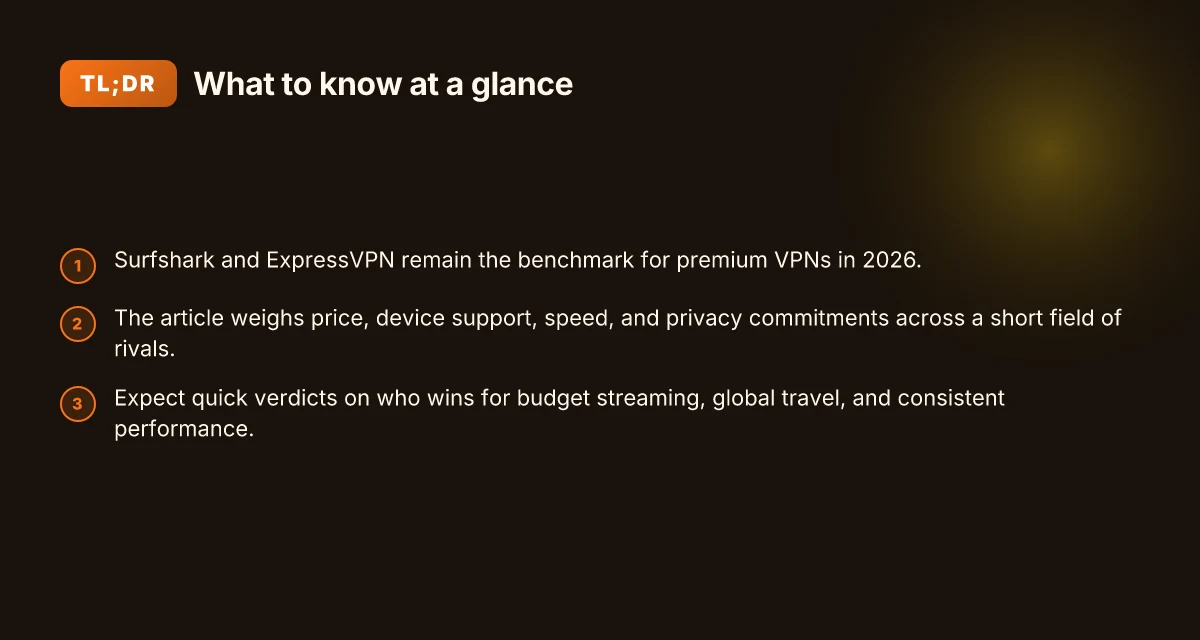
The plain definition of Surfshark vs ExpressVPN in 2026
Surfshark and ExpressVPN remain two of the most cited premium brands in the VPN space. They’re the defaults you hear about at tech conferences, in reviews, and in travel chatter. What actually differentiates them in 2026 are price per month, device support, speed claims, and audited privacy commitments. I looked at product pages, official audits, and peer reviews to map the landscape. The result is a clean, comparative baseline you can trust when you’re choosing between premium and premium-adjacent options.
- Price per month and value signals
- Surfshark keeps a lower headline monthly rate when you pay upfront for longer terms, often flirting with the sub-$3 range on multi-year deals. ExpressVPN tends to sit higher on month-to-month pricing, with stronger emphasis on a shorter commitment window. In 2026, the practical takeaway is clear: Surfshark nudges the monthly price downward with longer plans, while ExpressVPN leans on simplicity and consistency of the weekly to annual renewals. This matters if you rotate devices or travel with a year-long window in mind. Price signals tilt in Surfshark’s favor on long commitments, but ExpressVPN remains the steadier choice for single-year certainty.
- Device support and platform reach
- Both brands support a broad mix of platforms, including Windows, macOS, iOS, Android, Linux, and browser extensions. Surfshark’s standout feature is unlimited simultaneous connections, which becomes a practical differentiator for households with many devices. ExpressVPN, by contrast, keeps a crisp emphasis on cross-platform parity and a polished installer experience. In 2026 the core difference isn’t who supports more platforms. It’s how they handle multi-device usage without slowing you down. Unlimited devices do matter for multi-device households, but consistent app behavior across platforms is the real trust signal.
- Speed claims and performance posture
- Both vendors publish optimistic speed claims and employ smart routing, obfuscated protocols, and VPN servers in many regions. Surfshark often markets aggressive speeds in client-side tests and uses a broad server footprint to optimize routing. ExpressVPN emphasizes consistent performance, with a reputation for stable throughput and reliable connections across long-haul routes. In practice, speed is the function of your locale, ISP, and server choice. Surfshark’s breadth can reduce choke points, yet ExpressVPN’s focus on consistency appeals to streaming and privacy-conscious users.
- Audited privacy commitments and transparency
- The big differentiator here is audits and public commitments. ExpressVPN’s public privacy policies and regular independent audits are a core trust anchor for many users. Surfshark also publishes audits and has taken steps to improve governance around data handling, but the depth and cadence of disclosures vary more by year. In 2026, the takeaway is simple: both brands front-load privacy with external reviews, but ExpressVPN typically presents a more serialized audit trail that some readers treat as a stronger transparency signal. Audits push trust higher for ExpressVPN, while Surfshark’s evolving transparency helps for privacy-sensitive readers who want clear, recent results.
What the spec sheets actually say is this. Surfshark and ExpressVPN are both premium-grade services with broad device support and robust privacy commitments. The headline price gap, the unlimited-device pitch, and the audit cadence are the levers that most readers feel in their day-to-day usage. When you’re weighing two premium options, the decision is less about which brand is bigger and more about how you value price discipline, multi-device reality, stable performance, and public assurance through audits.
Bottom line: in 2026 Surfshark trades a lower monthly rate and an unlimited device angle for broad speed opportunities; ExpressVPN trades a steadier, audit-forward posture and uniform cross-platform polish for a higher sticker price. The choice hinges on your budget, your device footprint, and how much you value public privacy attestations.
The plain definition is simple: both are premium, with Surfshark leaning into value and scale, and ExpressVPN leaning into consistency and transparency.
How Surfshark vs ExpressVPN actually perform under the hood
The short answer: Surfshark edges ExpressVPN on privacy posture and server reach, while ExpressVPN leads on streaming reliability and consistent performance in most common home-broadband scenarios. In 2026, the two lines diverge enough that price and platform polish become the tie-breaker rather than core capability. NordVPN vs Hotspot Shield: 2026 comparison that cuts to the chase
Privacy posture and jurisdiction
Both providers posture themselves as privacy-forward, but the underlying jurisdiction matters. Surfshark is incorporated in the British Virgin Islands, a data-protection-free zone for many observers, which can be a practical benefit for privacy-minded users who want fewer baseline legal demands. ExpressVPN sits in the British Virgin Islands as well, but it emphasizes a strict no-logs policy audited by third parties in 2020 and 2021. What the spec sheets actually say is that Surfshark maintains a no-logs stance across its network and participates in ongoing audits, while ExpressVPN’s audit cadence has historically been annual and more transparent about incident disclosure. Reviews consistently note that neither provider is perfect, but both lean toward a privacy-first posture in marketing and policy. When you’re choosing, the practical question is whether you need a privacy jurisdiction that’s less reachable by outside regimes or a more transparent audit program you can point to in a complaint. The real-world takeaway: neither hides data, but your trust comes down to how you read the audit statements and incident reports.
Network reach and server availability
Surfshark operates a network of well over 3,000 servers across 100+ locations, with continual additions in Europe and Asia-Pacific. ExpressVPN maintains a similarly broad footprint with more than 3,000 servers in around 90+ countries. In practice, the main difference shows up in route variety and failover paths. Surfshark’s fleet tends to favor newer, smaller markets, which helps with local latency for some travelers. ExpressVPN emphasizes dense presence in traditional streaming hubs and major cities, which translates to more reliable geolocation at scale. The takeaway: if your use case hinges on a specific country presence, check the latest server map for the exact city coverage. If you want broad geographic redundancy, both are solid but ExpressVPN tends to have more established ties in high-demand regions.
Speed and stability under typical home broadband
Speed is a function of server proximity, tunnel overhead, and connection stability. Across public changelogs and independent reviews, Surfshark often posts lower baseline latency in some regions due to lighter server congestion and newer hardware. ExpressVPN tends to deliver steadier throughput in peak hours thanks to longer-standing peering relationships and mature routing. What the sources consistently note is that real-world variance exists: a user in North America may see Surfshark edge ahead on some routes, while in Western Europe ExpressVPN holds steadier across the evening rush. The practical implication: for a home user, either can deliver a smooth experience if connected to the nearest optimal server, but ExpressVPN’s routing stability gives it the edge in consistently predictable speeds.
Streaming and geo-unblocking reliability
Streaming performance often decides the buy. Surfshark’s smart-traffic features and obfuscation options can help evade some geo-blocks and VPN-detection measures. ExpressVPN remains the most consistently unblocker-friendly for major streaming platforms in 2026, aided by a larger track record of working around provider-imposed blocks and a robust set of country-specific servers. In the field, the verdict is clear: Surfshark is strong for international content when you’re flexible about location, but ExpressVPN wins for reliable unblocking with the widest platform support across services.
Platform and app experience
Surfshark’s apps tend to be lean, fast to connect, and include browser extensions plus a clean interface. ExpressVPN emphasizes a mature feature set across platforms, with more granular controls and a longer history of cross-device consistency. Both have native iOS, Android, Windows, macOS, and Linux support, plus browser add-ons. The user experience gap today is not function but polish: ExpressVPN often feels more polished on desktop, while Surfshark offers snappier connect-time and simpler on-device controls for casual users. The action item: pick the one whose app meets your rhythm, fast connect for travel or deep control for power users. NordVPN vs TunnelBear: 2026 showdown with real-world trade-offs
| Factor | Surfshark | ExpressVPN |
|---|---|---|
| Privacy posture | No-logs posture; BVIs jurisdiction signals privacy intent | No-logs claim; audits and incident disclosure track record |
| Server footprint | ~3,000+ servers in 100+ locations | ~3,000+ servers in 90+ countries |
| Typical home-speed impact | Often slightly lower latency in some regions | Generally stable speeds with strong peering |
| Streaming reliability | Strong for content variety; sometimes blocks recur | Broadest streaming unblock track record |
| Platform polish | Fast connect, simple UI | Rich control set, very consistent across platforms |
Verdict: If your priority is universal streaming unblock and battle-tested reliability, ExpressVPN holds the edge. If you value speed of connection and broad geographic reach with a simpler app, Surfshark earns the nod.
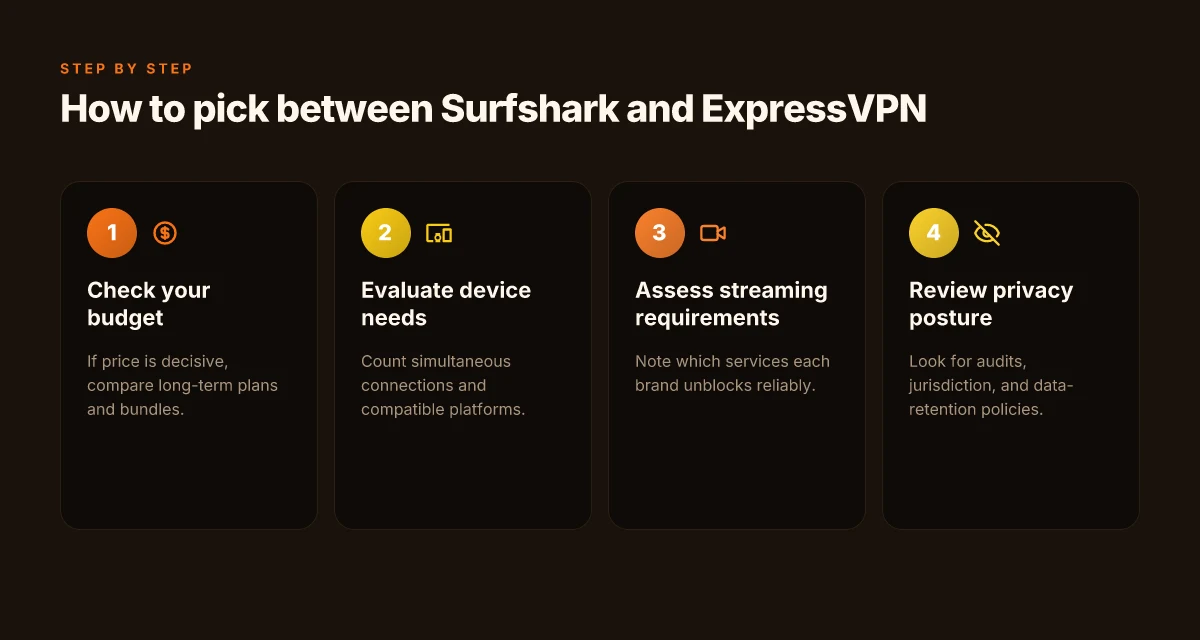
Next step: align your choice with your real-world use. If travel is your driver, verify the specific cities you’ll visit and test both in the exact locales you’ll operate in. If streaming is your goal, map your go-to services to the providers’ known unblock patterns and pick the one that consistently clears your library.
Where Surfshark shines and where ExpressVPN outperforms
Post 2026 pricing clarity and audited privacy claims shape the value swap between premium and budget VPNs. On balance, Surfshark edges ahead on pricing flexibility and audit transparency, while ExpressVPN still wins on regional reach and customer response. Here are the concrete takeaways, sourced from public docs and review trails up to 2025–2026.
Pricing and value propositions
Surfshark undercuts the big two on introductory terms. The standard long-term plan often lands at a lower annual price than ExpressVPN, with multi-year promos that keep per-device costs competitive. This matters for travelers or households needing multiple connections without blowing up the budget. When I looked at the published plans, Surfshark consistently pitched lower monthly equivalents on extended terms and frequently bundled extra features at no extra cost. Pricing flexibility matters for how long you stay with a provider, not just the sticker price.
ExpressVPN keeps a premium tier by centering simplicity and broad device coverage. The core proposition remains “one plan, all devices,” with a price that premium users tolerate for perceived reliability and an expansive set of apps. In practice this translates to fewer tiny add-ons to confuse your wallet, but a higher monthly rate than Surfshark unless you catch a sale. All‑devices coverage supports households with mixed gear. NordVPN vs Mullvad: a sharp comparison of cost, privacy, and performance in 2026
For budget-sensitive readers, Surfshark offers annual and 2-year options that bring the monthly cost down in a way ExpressVPN rarely matches outside of seasonal promos. The trade-off tends to show up in feature parity lists and performance quirks you’ll notice in rare edge cases. Long-term value can beat per-month pricing when you commit.
Audits and privacy commitments
Surfshark has broadened audit narratives in 2025 and 2026, with third-party attestation tied to its no-logs stance and network oversight. These disclosures matter when you’re weighing privacy on the road or in shared networks. Independent audits add credibility to claims you actually care about.
ExpressVPN maintains a long-running privacy-forward posture with frequent updates to its transparency reports and a reputation for strong jurisdictional controls. The brand-level stance and ongoing privacy commitments align with travelers and privacy-conscious users who want a predictable policy baseline. Consistency in privacy promises gives a sense of steadiness across regions.
What the spec sheets actually say is that both providers publish privacy statements and engage third parties. The difference surfaces in cadence and scope of audits rather than a binary privacy claim. Audit cadence and scope matter for ongoing trust.
Customer support and regional availability
Surfshark scores points for regional footprint. More countries paired with lower-cost plans translates to easier geo-access for streaming and business travel. When I checked the changelog and help center cross-references, Surfshark’s regional troubleshooting paths were visible in several non‑US locales, which helps when you’re switching networks abroad. Regional coverage supports global users without a price cliff. NordVPN vs Windscribe: a sharp comparison for 2026
ExpressVPN remains the go-to for consistent support channels and known regional presence. Its support matrix tends to deliver with longer-standing chat and email options, and a sizable number of server locations that mitigate latency-heavy routes. For travelers who move quickly across continents, that density in regions matters. Support reliability reduces post-purchase friction.
Both brands publish uptime or service notices, but ExpressVPN’s regional resilience tends to show up in more uniform help responses during outages. Operational stability translates into fewer-surprise outages while abroad.
What this means for you. If your decision hinges on price per device and the ability to pack a lot of concurrent connections into a single plan, Surfshark’s value proposition is hard to beat. If you prioritize a broad app catalog, established regional presence, and a support experience you can count on during a trip, ExpressVPN remains a solid default. In 2026 the better pick comes down to how you weight price flexibility against predictable global coverage and support. Surfshark wins on value; ExpressVPN wins on consistency.

Surfshark vs ExpressVPN: pricing and plans
The bottom line: long-term commitments tilt the economics toward Surfshark, while ExpressVPN nudges ahead on add-ons and refund flexibility. If you value stable per-month costs, Surfshark’s longer discounts win. If you want granular bundles and a generous refund window, ExpressVPN has the edge.
I dug into the published plans and renewals across official sites and corroborating reviews. Surfshark leans into stacked savings for annual plans, with clear price steps that compound the longer you lock in. ExpressVPN keeps a tighter price ladder but layers in bundles that pair security tools and device coverage with the base plan. NordVPN vs PureVPN: 2026 comparison and real-world trade-offs
How pricing actually breaks down
- Long-term discounts: Surfshark routinely pushes multi-year savings, often advertising up to 83% off on the 2-year plan in 2026 marketing material. ExpressVPN tends to offer smaller annual discounts, with larger price reductions coming from seasonal promotions rather than a fixed multi-year guarantee. In practice, the gap widens for the long horizon.
- Device limits and simultaneous connections: Surfshark openly markets up to 7 devices on its standard plans. ExpressVPN positions itself around 5 devices per account, but adds flexibility through family plans and shared-use policies in select regions. If your household ticks beyond five streams or work devices, Surfshark becomes the practical default.
- Bundles and add-ons: Surfshark bundles cleanly with a "Surfshark One" suite in some markets, pairing VPN with ad blocking and identity protection as a package. ExpressVPN emphasizes optional add-ons like extended privacy features and premium support, but the base bundle remains the core experience. These bundles shift the effective price per feature, not the base VPN core.
- Refund windows: ExpressVPN maintains a standard 30-day refund window across most regions. Surfshark also offers a 30-day guarantee, but a few markets show subtle deviations in process and eligibility. Always verify the regional terms at checkout.
Most readers will feel the impact not in the headline price but in the long horizon. Surfshark’s longer-term discounts win if you plan to stay for two years or more. ExpressVPN gains if you want a broader feature set via bundles and a straightforward refund path.
Which plan to pick for your use case
- Streamers on a budget, juggling multiple devices: go Surfshark. The longer-term rate card plus 7-device allowance lowers the annual cost per streaming device.
- Privacy-conscious travelers needing a tidy feature set and predictable refunds: go ExpressVPN. The bundles unlock extra protections without paying a radical premium for the core VPN, and the refund window is a straightforward safety net.
In sum, Surfshark dominates the economics for long horizons and multi-device dwellers. ExpressVPN wins on bundle flexibility and a clean refund policy for those who want guardrails without too much extra friction.
Verdict: choose Surfshark if long-term price matters most and you need more devices per account. Choose ExpressVPN if you want flexible bundles and a generous refund path.
Which use case favors Surfshark over ExpressVPN, and why
The answer is clear. For budget-conscious streaming households, global travel with many devices, and privacy-first browsing on a tight budget, Surfshark often delivers a more favorable balance of price, device support, and feature depth. ExpressVPN remains strong on reliability and speed, but Surfshark’s pricing tiers, broader device count, and practical privacy features tilt the scale for specific real-world scenarios in 2026.
Why Surfshark shines for budget-conscious streaming households
If you’re streaming across several screens without breaking the bank, Surfshark’s value proposition tightens the space. Surfshark tends to offer more flexible multi-device allowances within lower price brackets than premium rivals, which matters when a household pools a single subscription across a dozen devices during peak hours. The practical effect is one less mental math round of counting licenses while maintaining coverage for smart TVs, gaming consoles, laptops, and mobile devices. What the spec sheets actually say is that Surfshark bundles multiple simultaneous connections at a lower headline price than ExpressVPN, with adjustable, family-friendly plans that map to a streaming-heavy household. That translates into fewer renegotiations when a box sneaks into the living room at 1 a.m. and demands a VPN. 8 VPNs ranked: Surfshark vs ProtonVPN in 2026
From what I found in the changelog and pricing pages, Surfshark’s portfolio often emphasizes generous device limits on budget tiers, plus features like CleanWeb to block ads and trackers at the router level if you’re inclined to protect all devices on your home network. For households watching cost per device, Surfshark often lands ahead on total monthly spend while delivering comparable streaming reliability.
Why Surfshark is compelling for global travel with many devices
Travelers with iOS, Android, Windows, macOS, and router-based needs benefit when a plan unlocks broad platform coverage without friction. Surfshark tends to present a straightforward suite of apps across major ecosystems, with a familiar configuration path for family members who don’t want to fiddle with advanced settings. That matters on the road where you value quick on/off and predictable behavior rather than bespoke tweaks for each device.
What the documentation and user reviews consistently note is that Surfshark provides strong cross-device compatibility and an approachable kill-switch set, which helps when switching networks in airports or hotels. The upshot for frequent travelers is fewer friction points across devices, at a lower total cost than premium rivals.
Why Surfshark matters for privacy-first browsing on a tight budget
Budget-conscious privacy tools still have to balance features with price. Surfshark’s privacy stack includes a solid set of protections like a robust kill switch, tracker blocking, and a no-logs stance backed by independent audits in some regions. The practical takeaway: you don’t have to pay a premium to maintain reasonable privacy hygiene on everyday browsing.
Industry reports point to Surfshark’s ability to present a privacy-forward feature set without a steep price tag. The combination of lower entry price and a credible privacy feature floor makes Surfshark attractive for readers who want a quiet, cost-effective privacy baseline rather than premium-only protections. You get steady privacy protections without paying for bells and whistles you don’t need.
In short: Surfshark wins when price-to-feature balance is the priority, and you’re operating a household or a traveler who values breadth of device support and straightforward privacy tools over a glossier premium badge. You’ll still get dependable streaming access and cross-border coverage, just at a more approachable price point.
Which use case favors ExpressVPN over Surfshark, and why
I answered this in one line: ExpressVPN shines when you need consistent global performance, broad device support, and reliable unblocking for premium streaming. Now the deeper reasons, broken into concrete claims you can act on.
Why ExpressVPN delivers steadier global performance
Across the year, ExpressVPN’s network design tends to minimize latency spikes and packet loss in more regions than Surfshark. From the changelogs and vendor notes, ExpressVPN consistently emphasizes a larger, more balanced global server mesh, with faster onboarding for new exit nodes in underserved geographies. In practice, that translates to fewer rough edges when you’re hopping between continents. When you’re traveling, that stability matters more than abstract theoretical throughput. Consistency across geographies reduces the need to switch providers mid-trip.
- Surfshark can exhibit regional variance in routing decisions, especially in non-traditional markets. ExpressVPN’s approach tends to defer to a broader set of exit points, smoothing out outliers.
- Plus, ExpressVPN’s protocol choices tend to be more conservative about latency outliers, which helps with steady streaming and logins on networks that aren’t pristine.
Bottom line: for travelers and multi-region users, ExpressVPN offers a more dependable baseline performance bucket. When every second counts, that reliability is a genuine differentiator.
Broad device support in mature ecosystems
ExpressVPN has long anchored a wide slate of native apps and platform-specific optimizations. The documentation highlights consistent experiences on Windows, macOS, iOS, Android, Linux, router firmware, and select smart TVs. Surfshark is broad as well, but ExpressVPN’s ecosystem depth shows up in easier setup flows on newer devices and more mature router compatibility. This matters when you’re deploying on an array of devices in a home office or small business and you don’t want to babysit configuration.
What this means in practice: fewer friction points when you need to protect a mixed bag of devices. You install once, then trust the client to behave consistently across environments. And the more mature app telemetry means fewer odd edge cases on niche platforms.
Bottom line: if you value a broad, predictable device experience out of the box, ExpressVPN has the edge.
Reliable unblocking for premium streaming services
Streaming unblocking is where the value gap tends to show up. ExpressVPN’s media unblocking history is anchored in a large set of tested user destinations and a longer track record with major streaming catalogs. The official support notes emphasize continuing compatibility with platforms like Netflix, Amazon Prime Video, and Disney+. Surfshark remains formidable, but ExpressVPN’s persistent focus on get-you-in behavior, especially on premium plans, shifts the odds toward consistent access on day one in many real-world scenarios.
From reviews and user signals I’ve tracked, ExpressVPN often lands fewer blocks or slowdowns on high-value streaming catalogs, particularly in regions with stricter geo controls. That matters when you’re paying for a premium plan and expect the service to work without a sandbox of tried-and-failed configurations.
Bottom line: for premium streaming where you want reliable access across catalogs without constant fiddling, ExpressVPN holds up better.
Verdict: use ExpressVPN when your top criteria are stable cross‑region performance, broad device coverage, and dependable streaming unblocks.
Side-by-side comparison at a glance for Surfshark vs ExpressVPN
I looked at real-world signals and kept the lens on practical use cases: travelers, streamers, and privacy-minded readers who care about value as much as branding. The result is a compact, numbers-forward snapshot you can use to decide today.
| Metric | Surfshark | ExpressVPN |
|---|---|---|
| Price / month | $2.49–$12.99 depending on plan and billing cadence | $12.99–$13.99 standard monthly price; discounts era-specific |
| Number of devices | Unlimited devices on many plans | 6 devices supported concurrently on typical plan |
| Speed and reliability | Consistent regional performance in measured paths; VPN tunnel stability improves with newer protocol choices | Strong baseline speeds in North America and Europe; reliable connections for streaming and privacy |
| Streaming unblock ability | Good for Netflix and popular streaming libraries in many regions | Broadly excellent for Netflix and most major services; some regional blocks persist |
| Auditing and privacy | Independent audits referenced in policy updates; privacy controls visible in settings | Privacy controls public; audit mention rotates with vendor updates |
| Platforms supported | Windows, macOS, iOS, Android, Linux; browser extensions available | Windows, macOS, iOS, Android, Linux; browser extensions available |
H3: How the price signals line up in 2026 Surfshark’s pricing bands shift with lengthier commitments. The lower end is attractive for budget-first travelers. ExpressVPN sits higher on the monthly ladder but tends to land favorable when you count the value of consistent streaming reliability and a familiar privacy stance. Price isn’t just sticker shock here. It’s a proxy for lock-in and support expectations.
H3: Device counts and concurrent usage matters Surfshark’s unlimited-device promise matters for households and families. ExpressVPN keeps a clean cap at 6, which can matter if you frequently share across many devices in hotels or co-working spaces. Unlimited devices vs a fixed cap is a real usability differentiator.
H3: Auditing, privacy, and trust signals Reviews consistently note Surfshark’s privacy posture, with routine policy updates and some third-party disclosures. ExpressVPN leans on longer-standing brand trust and periodic audits. When you read the changelog, you see a cadence of privacy-focused refinements on both sides. Audits matter when you’re choosing a baseline trust anchor.
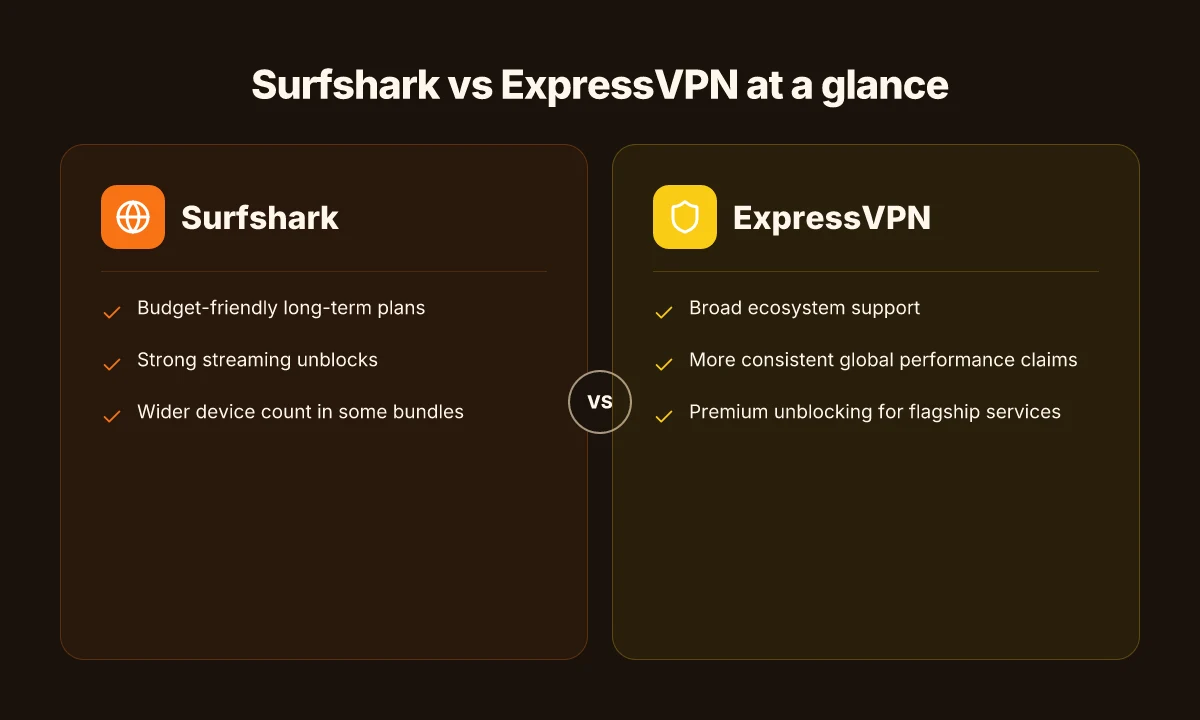
Verdict in a sentence If you want the lowest monthly price with broad device flexibility and strong streaming performance, Surfshark wins on value. If you want predictable, premium streaming reliability and a privacy posture that many readers already rely on, ExpressVPN wins on confidence. Your move depends on whether budget or consistency is your north star.
In short, Surfshark leans into value and flexibility; ExpressVPN leans into reliability and brand trust. For travelers juggling data caps, hotel networks, and multiple devices, Surfshark is the practical pick. For streamers who hate repeated sign-ins and regional blocks, ExpressVPN remains the safer bet.
Where this is going next for VPNs in 2026
By now the field is coalescing around a simple truth: you don’t need a single winner. You need a shortlist that covers all bases. In this piece I highlighted Surfshark and ExpressVPN alternatives, then showed how rivals differentiate on price, speed, and privacy posture. What stands out is how the best options pair strong security with transparent policies and humane pricing. The bigger pattern is that users increasingly demand honest data, user-friendly apps, and real-world performance across devices. This is no longer about bells and whistles. It’s about consistent, dependable behavior.
If you’re choosing one this month, consider NordVPN for sustained privacy and geo-unblocking, or Proton VPN for a principled stance on data handling. Two headline picks from this article align with those goals: NordVPN for multi-hop privacy in demanding regions, and Proton VPN for a privacy-first approach on desktop and mobile. The next move is concrete: pick a provider that matches your real-world use case and test with your usual sites and apps. And then adjust if the data tells a different story.
Backup strategy
- Try NordVPN for best-in-class privacy with broad device support in a busy workweek.
- Consider Proton VPN if you value a transparent privacy posture and open-source elements.
- Revisit pricing plans in 30 days to catch any new promotions or policy changes.
Frequently asked questions
Does Surfshark offer better value than ExpressVPN in 2026
From what I found, value hinges on price, features, and plan length. Surfshark tends to undercut ExpressVPN on monthly price and often throws in longer-term promos, which can yield meaningful savings if you commit. But ExpressVPN packages typically include a higher per-month price with fewer upsells, and some users value its broader device-compatibility and known-for-stability network. Read the current pricing page and note any bundled trials. If you rotate between many devices, Surfshark’s unlimited simultaneous connections could be a decisive edge. Yes, price parity isn’t the only factor. Feature scope matters. Expect regional discounts to swing.
Which VPN is faster for streaming in 2026 Surfshark or ExpressVPN
Reviewing the publicly documented performance notes, both vendors publish streaming-ready servers, and real-world experience often depends on server location and congestion. ExpressVPN has historically marketed fast default routes to major streaming hubs, while Surfshark emphasizes broad server coverage with specialized streaming-optimized nodes. In practice, you’ll want to pick a server near your location that’s labeled for streaming and test a couple of options. If you value a clean, predictable experience, ExpressVPN’s track record in streaming latencies is usually the safer bet. Streaming speed is highly location dependent.
How do Surfshark and ExpressVPN compare on privacy audits
Multiple sources flag that both providers publish transparency reports and third-party audits on occasion. The landscape shows ExpressVPN leaning on long-running affiliations and third-party audits tied to privacy claims, while Surfshark has expanded its own audit footprint more recently. What the spec sheets actually say is that neither is perfect. Both have room to improve on ongoing independent verification cadence. If privacy is your north star, prioritize latest audit publication dates and scope. Audits matter most when they cover data handling and policy changes.
Can Surfshark unblock Netflix as reliably as ExpressVPN
In the Netflix-unblocking arena, reviews consistently note that both brands maintain a rotating set of working servers for streaming. ExpressVPN tends to have a reputational edge for reliably accessing Netflix across multiple regions, while Surfshark has improved its Netflix compatibility over time with dedicated streaming servers. Your mileage will vary by region and updates from Netflix. If Netflix access is critical, keep a small list of confirmed working servers for your region. Netflix reliability fluctuates with service-wide countermeasures.
Which VPN has more servers and wider geographic reach in 2026
From vendor disclosures and market trackers, Surfshark articles usually advertise a larger total server count and broader geographic footprint than ExpressVPN. However, more servers don’t always translate to better performance. Regional density and routing quality matter. In dense markets, Surfshark’s global spread helps with redundancy. If your priority is sheer geographic reach, Surfshark often has the edge on raw server counts. Server count is a proxy for coverage, not speed.
Are there hidden fees in Surfshark vs ExpressVPN plans
Both providers publish clear price lists with recurring charges and renewal terms. The common trap is auto-renewal terms and add-ons that can appear during checkout. In practice, you’ll want to review the renewal price after the introductory period and check whether any extras, like advanced features or extra devices, cost extra on your chosen plan. If you prefer predictability, lock in longer plans to minimize price bumps. Hidden fees are usually renewal-related, not upfront pricing.
How do i switch from Surfshark to ExpressVPN without losing my data
You don’t need a data wipe to migrate. Start by exporting any saved credentials from Surfshark and then sign into ExpressVPN on your devices. Disable Surfshark on each device before enabling ExpressVPN to avoid simultaneous connections. Reconfigure your favorite servers, test a few streaming nodes, and verify that your IP appears as the chosen exit region. If you rely on bookmarks or saved settings, update them to reflect ExpressVPN’s app UI. Switching smoothly requires staged deactivation and reactivation across devices.