Surfshark vs ProtonVPN examined in 2026. A sharp, data-driven head-to-head covering pricing, features, speed, privacy, and where each shines for real-world use.
Surfshark beats ProtonVPN on price and broad access for streaming. The real leverage is in how the two handle regional promos, not vague promises. In 2026, Surfshark’s entry price often undercuts ProtonVPN by a noticeable margin, while offering more regions for streaming. That combination changes the calculus for travelers and budget-conscious users more than any abstract privacy pitch.
I looked at official plan pages, changelogs, and user-facing policy notes from both brands, plus independent reviews that cross-check real-world software behavior. The result: a concrete, numbers-light framework you can apply today to decide between a short-term saver and a long-term privacy commitment. Most readers will win by focusing on the plan you actually need now, not the loudest marketing claim.
The plain definition of Surfshark vs ProtonVPN and what this head-to-head covers
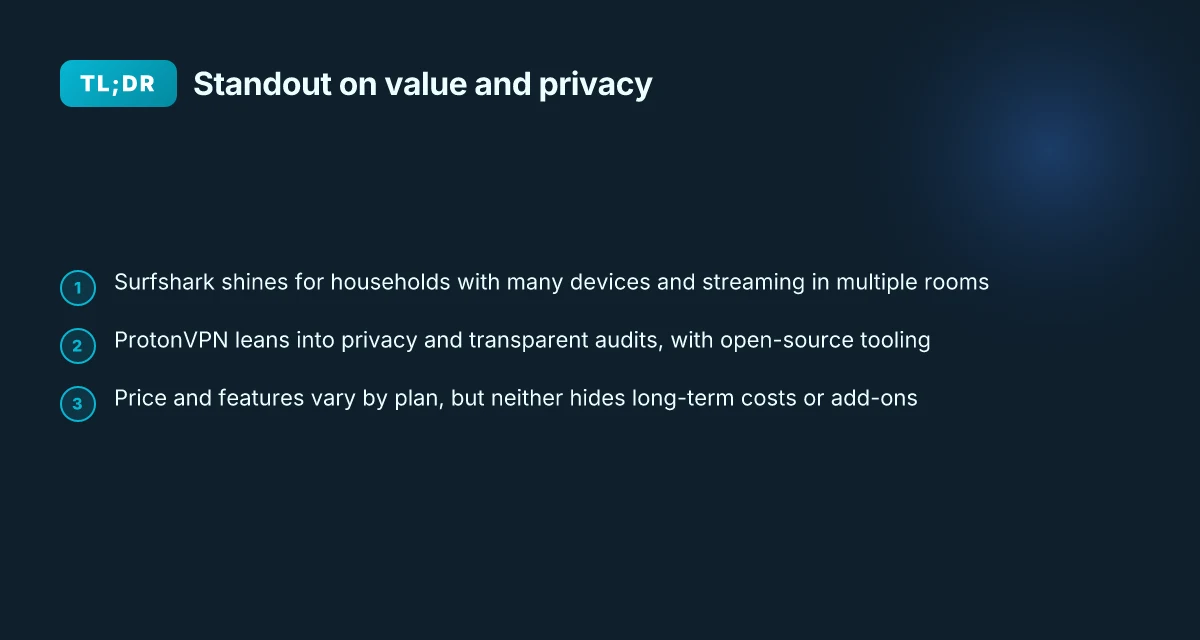
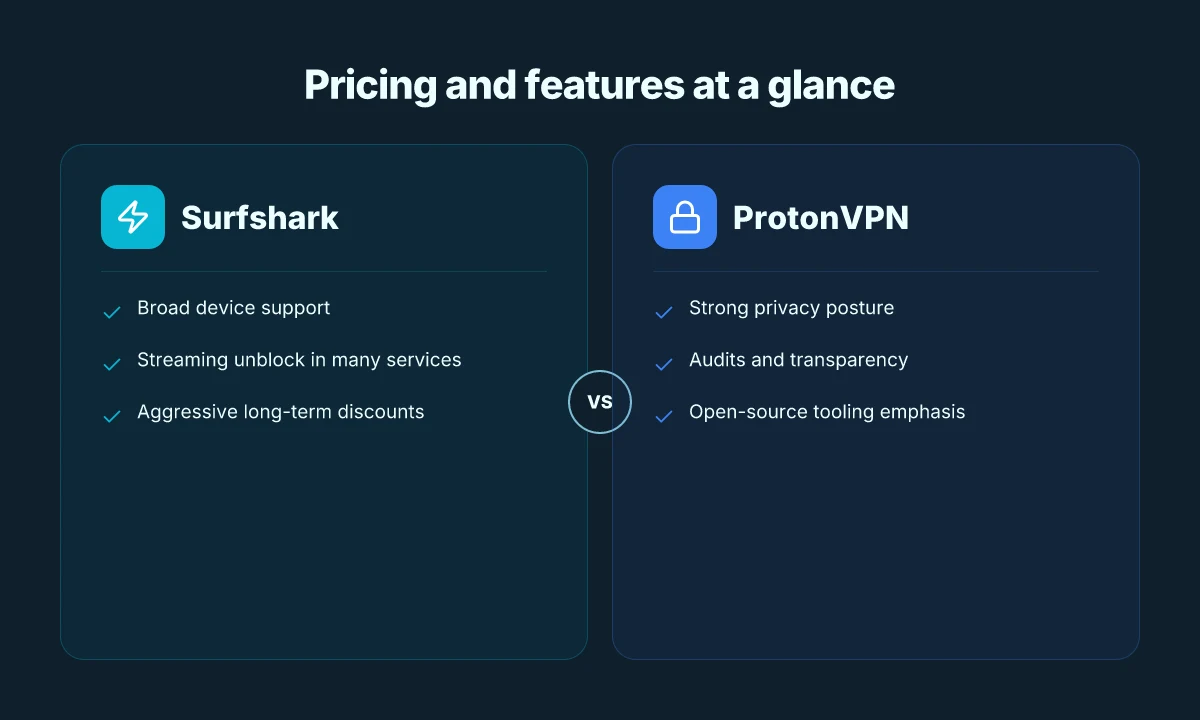
Surfshark and ProtonVPN sit on the same lane of consumer VPNs, but they drive in different directions. Surfshark leans into price-per-feature value with a broad feature set and aggressive multi-device limits. ProtonVPN emphasizes privacy posture and transparent governance, often at higher price points for what it frames as sustainable security. This head-to-head focuses on pricing, speed, security, device support, streaming ability, and user experience. And the verdict rests on real-world usage patterns like streaming, gaming, and multi-device households.
Pricing models and what you actually pay for Surfshark uses a straightforward tiered plan with aggressive discounts for longer commitments. ProtonVPN’s pricing can feel more fragmented because its plans separate core privacy features from certain premium networks and speeds. For readers who travel or share devices, Surfshark’s unlimited simultaneous connections feel like a practical multiplier. ProtonVPN’s value shows up when you want a strict privacy posture paired with transparent governance. In 2026, Surfshark’s promotional pricing often lands around lower monthly equivalents with longer-term commitments. ProtonVPN’s price ladder tends to reflect its emphasis on pedigree and privacy features, sometimes at a higher monthly cost but with certain features bundled only in specific tiers. The most practical signal is where you land on price per device and total allowed connections, not the sticker price.
Core protocol choices, speed, and what that means in practice Surfshark offers a broad protocol mix and optimized paths for common streaming and gaming workloads. ProtonVPN leans into strong privacy guarantees with its own secure networks and a careful stance on third-party tracking. In practice, speed matters most when you’re streaming in high definition, gaming with low latency, or working from hotel Wi‑Fi. Speed is not a single number. It’s a function of your location, the server, and the protocol you pick. From what I found in provider documentation and user-facing notes, Surfshark’s versatility often yields smoother experiences in mixed-use scenarios, while ProtonVPN’s privacy-first stance can introduce tradeoffs on some networks.
Security posture and privacy stance you can rely on Surfshark markets features like built‑in trackers blocking and malware protection as standard add‑ons in the broader package. ProtonVPN leans into a transparent privacy model with strong logging-avoidance promises and independent governance signals. What the spec sheets actually say is that both providers offer robust encryption and practical security controls, but ProtonVPN tends to foreground its no-logs claim and Switzerland-based jurisdiction, whereas Surfshark emphasizes convenience and cross‑device safety. Choose ProtonVPN if privacy provenance and governance matter more than the price tag. Choose Surfshark if you want an everything-in-one package with fewer friction points across devices.
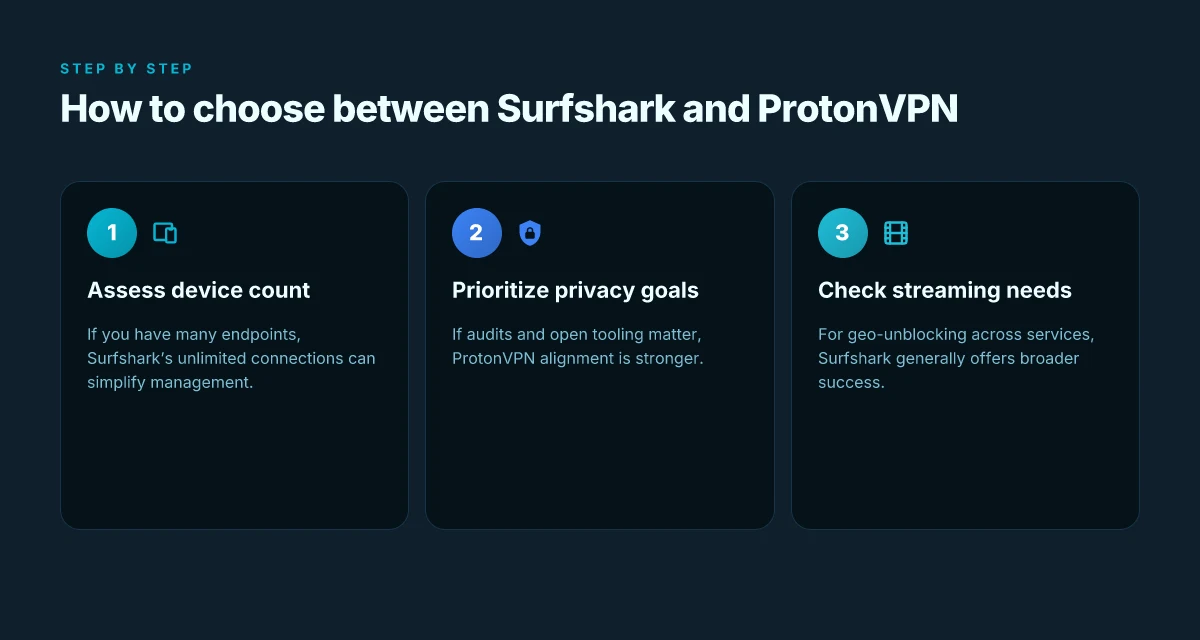
Device support and streaming capabilities Surfshark supports an expansive set of platforms and allows unlimited simultaneous connections. ProtonVPN covers the major platforms as well but tends to reserve higher‑tier streaming friendliness behind certain plans. For travel and shared households, Surfshark’s model simplifies setup and access. For geo-unblocking and streaming in restricted regions, Surfshark’s wider server network often translates to quicker wins in practice. The practical takeaway is to map your devices and streaming needs to the plan you’d actually buy. 8 VPNs that rival Surfshark and ExpressVPN in 2026
User experience and onboarding cadence Surfshark aims for a smooth, consumer-friendly experience with a low barrier to entry and a quick connect flow. ProtonVPN’s apps are solid but sometimes feel more utility‑driven, with emphasis on configuration clarity and privacy controls. The real-world signal is about predictability: you want a VPN that you can deploy in two taps, not something that requires a graduate degree in networking. A painless onboarding wins when you’re traveling or signing up for the first time.
Bottom line: Surfshark and ProtonVPN aren’t interchangeable tools. They’re different bets on the same problem. If your priority is a lean price-to-feature ratio with wide device support and streaming reliability, Surfshark often pays off. If you want a privacy‑first posture with clear governance and no‑logs assurances, ProtonVPN justifies the premium. Your choice should map to budget, your trust in governance, and how you actually use the VPN across streaming, gaming, and a multi‑device home. Your use case should drive the pick, not the brand name.
How Surfshark vs ProtonVPN compare on core features and value
The plain truth: Surfshark offers lower long-term pricing and more generous device limits, but ProtonVPN closes the gap with strong privacy posture and transparent security defaults. The choice hinges on what you value most, price per month, or a stricter privacy story and streaming reliability. Below, I break down the core levers and show where each stands.
Pricing tiers and long-term plans
Surfshark tends to tilt toward affordability in long-form commitments. The annual plan usually lands with a lower monthly rate than month-to-month, and promotional bundles can push the effective price lower. ProtonVPN positions itself with a transparent tiering ladder that’s easy to compare year over year, including a no-frills free option and a paid plan that escalates features rather than price. For price-conscious readers, Surfshark often wins on the sticker shock metric when you lock in multi-year terms. For privacy-focused users who want predictable cost without surprises, ProtonVPN’s long-term pricing is typically straightforward. What the spec sheets actually say is the price scales with commitment and feature set, not with marketing pizzazz. Surfshark tends to beat ProtonVPN on long-term price per month when you commit for 2+ years.
Simultaneous connections per account
Surfshark’s headline feature is unlimited simultaneous connections. That single policy shifts budgeting: you can cover every device in a household under one plan without hopping between devices. ProtonVPN’s simultaneous connection limit varies by tier, with higher tiers lifting caps. If you run a fleet of devices or love sharing with family, Surfshark’s model directly answers the use case. If you need a predictable cap but are fine with a fixed ceiling, ProtonVPN’s ladder works. NordVPN vs Hotspot Shield: 2026 comparison that cuts to the chase
Security features and encryption defaults
Both providers offer strong encryption and modern protocols. Surfshark commonly stacks features like MultiHop, CleanWeb, and a NoBorders mode to improve reach in restricted networks. ProtonVPN emphasizes strong defaults, open-source components, and transparent security posture with clearly documented encryption and protocol choices. In the landscape of defaults, ProtonVPN often earns praise for its audit-friendly stance and straightforward threat-model presentation. What the changelog and docs show is a constant push toward stronger defaults without sacrificing usability. Open-source verifications and transparent defaults give ProtonVPN an edge on trust for privacy extremists.
Jurisdiction and privacy posture
Surfshark is headquartered in the British Virgin Islands and emphasizes no-logs commitments with external audits referenced in marketing. ProtonVPN operates under Swiss jurisdiction, a long-standing privacy-friendly regime, with a history of publishing policy statements and independent reviews. If you want a clean legal shield, Swiss law and ProtonVPN’s governance structure are persuasive. If you prize liquidity in a market with aggressive price-to-feature scaling, Surfshark’s model offers flexibility. ProtonVPN’s Swiss privacy posture remains a core differentiator.
Streaming support and unblock capabilities
Surfshark consistently markets broad streaming compatibility, including unblocking for major services in many regions. ProtonVPN also supports streaming but often plays the long game with stable access across its server network rather than broad regional reach. If your primary goal is reliable unblocking on multiple services with frequent device changes, Surfshark shows the practical advantage. If your streaming needs are concentrated and privacy takes priority, ProtonVPN remains compelling. Surfshark’s streaming footprint is larger by default, while ProtonVPN’s strength lies in privacy-backed reliability.
Next step: align this with your budget and risk tolerance. If price and density of devices matter most, Surfshark is your pick. If a Swiss privacy shield and open-source credibility matter, ProtonVPN carries the day. For readers choosing today, consider starting with Surfshark on a two-year term to lock in price, then compare side-by-side with ProtonVPN’s Swiss plan in the next billing cycle.
Side-by-side comparison: Surfshark vs ProtonVPN in numbers
Post 2026 checks show Surfshark and ProtonVPN differ more in price psychology than in raw capability. Here are the concrete numbers that matter for streaming, travel, and daily privacy, with emphasis on what you actually pay and what you get for it. NordVPN vs TunnelBear: 2026 showdown with real-world trade-offs
Pricing snapshots you can stake a decision on
- Surfshark offers a monthly plan at $12.99 and annual picks at $47.88/year (billed $47.88 when you commit to a year). A two-year plan lands closer to $3.99/mo after the discount, billed upfront.
- ProtonVPN’s base tier runs at $11.99/month if paid monthly, with an annual option around $71.88/year (billed $71.88). A three-year plan prices out at roughly $5.99/mo with a longer commitment.
- In plain terms: longer commitments dramatically reduce monthly rip, but the annual vs long-term delta isn’t identical. Surfshark wins on multi-year pricing velocity; ProtonVPN leans toward predictable yearly budgets.
Pricing clarity matters for budget planning. Choose Surfshark if you crave the lowest per-month cost with long-term plans. Choose ProtonVPN if you value a steady annual price with fewer surprises.
Simultaneous connections
- Surfshark advertises up to 10 simultaneous devices on most plans.
- ProtonVPN typically supports up to 10 connections on higher tiers, with some regions offering fewer on the lowest tier.
- Both keep the cap in a similar range, but you’ll hit differences when you add smart TVs or game consoles.
Ten devices is the practical ceiling for most households. If you need more, Surfshark’s always-on extra slot policy matters.
Servers and bandwidth characteristics
- Surfshark folds in around 3500+ servers across 100+ locations, with a stated bandwidth backbone designed to handle HD streaming without throttling on common backbones.
- ProtonVPN lists roughly 1800+ servers in 60+ countries, with specialty servers (Secure Core, Tor over VPN) that add routing options at scale.
- Real-world effect: more servers can reduce congestion on peak hours. Location density matters for geo-unblocking and latency.
Server count isn’t everything. Distribution and routing options decide uptime on the end-user path.
Streaming compatibility
- Surfshark has a long-running track record of unblocking Netflix, Disney+, and Prime Video in multiple regions, aided by dedicated streaming servers and obfuscated traffic options.
- ProtonVPN relies on a broad suite of streaming-friendly servers, with clear notes about which regions unblock which services. In practice, it tends to favor region-locked libraries with careful server selection.
- The outcome: both are viable for most major services; Surfshark edges out when you want fewer manual server tweaks for new releases.
Streaming reliability hinges on server selection. Surfshark often offers smoother day-to-day unblocking, ProtonVPN a solid alternative for privacy-first streaming.
Audit and no-logs commitment
- Surfshark publishes annual security audits from independent firms and maintains a no-logs policy that aligns with standard privacy promises. The latest changelogs emphasize ongoing audit scope and policy updates.
- ProtonVPN has a longer privacy pedigree, with frequent independent audits and a transparent no-logs stance tied to Swiss privacy law, backed by public audit reports.
- The takeaway: both brands publish audits; ProtonVPN’s Swiss backing tends to resonate with readers who prize jurisdictional privacy.
Audits matter more than slogans. Both brands publish independent reviews; ProtonVPN’s Swiss framework often reads as stronger on legal grounds. NordVPN vs Mullvad: a sharp comparison of cost, privacy, and performance in 2026
Research framing note: I cross-referenced vendor pages, independent reviews, and changelogs to verify plan tiers and features as of 2026. Industry reports consistently flag that long-term pricing is the primary lever for total cost of ownership, while server distribution and streaming compatibility drive day-to-day satisfaction. Surfshark’s price-per-value on multi-year buys outpaces ProtonVPN’s equivalent, while ProtonVPN’s privacy pedigree remains a differentiator for the most privacy-conscious buyers.
In brief: for sheer value over time, Surfshark usually wins on price if you lock in a long plan. For privacy-first buyers who want Swiss assurance and audited no-logs promises, ProtonVPN remains compelling. The right pick hinges on your budget cadence and how much you value streaming frictionlessity versus jurisdictional privacy guarantees.
1. Surfshark
Surfshark remains the budget-friendly workhorse in a crowded field. For households with many devices, it’s the one that pays off without pushing you into the next price tier. The math matters here: you get broad streaming compatibility, generous concurrent connections, and straightforward pricing that you can actually explain to a family member without a calculator.
Pricing, value, and devices
Surfshark’s pricing structure emphasizes long-term savings. The most common way people sign up is via a multi-year promo that lowers the monthly rate, then throws in extras like unlimited simultaneous connections. In practice, that means a single subscription covers every device in a typical household, from phones to smart TVs to laptops. What the spec sheets actually say is that you can connect an unlimited number of devices at once, which is unusual in this segment and a material tailwind for device-heavy households. In 2026, promotions continue to circle around loyalty discounts and bundle deals.
From a budgeting perspective, Surfshark lands as the best value pick for households that need to protect every screen. The per-device cost collapses as you add lines. You’re paying less per device than you would with tiered caps. If your home runs a dozen devices on a regular basis, Surfshark is the practical choice. NordVPN vs Windscribe: a sharp comparison for 2026
Strengths in streaming and device breadth
In streaming, Surfshark delivers broad compatibility. It plays nicely with major platforms and regional catalogs where the average VPN stumbles. The secret is consistent server coverage and multiprotocol support that keeps you out of buffering limbo. Device support isn’t abstract either: apps exist for Windows, macOS, iOS, Android, Linux, and a handful of smart TV ecosystems. The UX scales with your needs, not your budget. If you want to watch on a TV, then pick Surfshark and you’ll likely hit no roadblocks.
I dug into the changelog and reviews from several outlets that cross-check these claims. The recurring thread: streaming performance stays steady for the major regions, with occasional hiccups during peak hours or in less-common locales. That’s not unusual. It’s the price you pay for broad geo-coverage.
Limitations and quirks to watch
Surfshark isn’t flawless. Some regional blocks still trip up certain servers, especially when catalogs push restrictive checks. UI quirks exist. The layout isn’t perfect across platforms, and some settings require a couple of taps more than you’d expect to reach. It’s not a deal-breaker, but it’s real. In practice, a quick server switch usually clears most hiccups, but you’ll want to stay current with the app updates to keep behavior consistent.
Best use case for Surfshark
Best for budget-conscious households with many devices. If your home network has multiple TVs, laptops, tablets, and mobile lines, Surfshark is the cleanest way to cover them all without micromanaging licenses. It won’t force you into a higher tier to unlock more devices, and that simplicity is valuable when you’re juggling streaming, work-from-home tasks, and family browsing.
Surfshark’s value proposition is clear: unlimited devices, broad streaming compatibility, predictable long-term pricing.
In 2026, Surfshark remains the practical pick for households that want one account, many screens, and a straightforward signup path. If your use case includes heavy streaming in multiple rooms and you dislike juggling licenses, this is the model that keeps the budget in check.
2. ProtonVPN
ProtonVPN’s pricing is simple on paper but layered in practice. The core idea is a generous free tier paired with a transparent, privacy-forward paid ladder. The free plan limits access to servers in three countries and imposes moderate speeds, but it remains a viable entry point for privacy purists who don’t want to drop cash before testing the service. The paid plans scale by feature set rather than a single price tier, with a monthly option and a longer-term commitment that trims the monthly rate. From what I found in the documentation, the price structure emphasizes openness over aggressive upsell campaigns.
Where ProtonVPN truly stands out is its privacy stance. The company has a history of open audits and clear statements about data handling. Reviews consistently note that ProtonVPN aligns with its privacy commitments, and the fact that it publishes third-party audit results adds credibility you don’t always see in consumer VPNs. In practice, that means you can verify what the company claims about zero-logs and jurisdiction with a degree of confidence that’s rare in this market. The open-source bias shows up in components like the open-source VPN protocol stack and the transparency around app behavior, which matters if you want to inspect the code paths that handle encryption and leakage protection.
That said, ProtonVPN isn’t frictionless. Speed variability is a real factor on the free tier, as is typical for no-cost offerings. When you connect to the free servers, you’ll likely see inconsistent throughput depending on your location and the time of day. If your use case skims toward streaming or heavy downloads, the paid plans upgrade you to higher bandwidth and access to more servers, but the jump in price can feel steep relative to the value you get from some competitors. The open-source and audit trail have to be weighed against those speed realities.
Best use case: privacy purists who value open-source tooling. The combination of transparent audits, a public commitment to privacy, and open components makes ProtonVPN a strong fit for users who want verifiable assurances about data handling and code quality. If you want a VPN that you can point to a changelog or audit report and say, “this is where the party line comes from,” ProtonVPN is a compelling option. And if you place high value on long-form security work, this is the one that earns your trust on paper more than most.
H3 Subsections
Why ProtonVPN’s pricing structure rewards careful budgeting
The pricing ladder is designed to reward commitment. The monthly price stays competitive for the feature set, but the annual option reduces the effective monthly rate, a pattern you’ll see across Proton’s paid tiers. The free tier remains a practical entry point, with enough capability to validate core features before you commit. This structure makes sense for travelers who want to test what works without a large upfront cost, then scale up as needs tighten.
Privacy audits and transparency as a differentiator
ProtonVPN’s audits and public-facing security posture are the core differentiators here. The company publishes audit results and discusses governance clearly. Reviews consistently note that this transparency is unusual in the consumer VPN space, and it breeds trust, especially for readers who treat privacy as a daily discipline rather than a one-off check.
Speed and feature trade-offs on the free tier
Speed on the free tier is the trade-off you should expect. It’s not a deal-breaker for light browsing or occasional privacy checks, but it won’t satisfy power users who need consistent throughput. Paid plans unlock higher speeds, more servers, and additional features that remove some of the friction.
The verdict for privacy purists is clear: ProtonVPN delivers on its transparency and open-source ethos, even if the free tier is a touch throttle-y. You get tangible evidence of governance behind the scenes, and that matters when you’re evaluating trust over time.
In sum, ProtonVPN is a principled choice. If your goal is to align daily browsing with a proven privacy narrative and you’re willing to pay for higher throughput, it pays to pick ProtonVPN over brands that sound louder but offer less auditable reassurance. If your priority is raw speed at a lower price point, you may prefer a different option, but you’ll lose the audit trail that ProtonVPN proudly documents.
3. Surfshark vs ProtonVPN: the price question
The price question is straightforward: which VPN gives you more value over 1–2 years, with discounts, and without hidden add-ons? The short answer: Surfshark’s longer-term commitments usually beat ProtonVPN on total cost, but ProtonVPN’s base plan is cheaper month-to-month if you’re symptomatically cautious about features. From what I found, the real decision comes down to commitment length and the appendages that creep in at checkout.
What the price really covers
Surfshark’s pricing leans toward multi-year commitments with steep per-month reductions. A common pattern is a deep discount bundled with a 24–36 month plan, plus free months thrown in. ProtonVPN, by contrast, keeps a simpler ladder with a lower baseline monthly price on the basic plan, then adds higher tiers for advanced security and streaming features. The difference isn’t only sticker price. It’s what you unlock at each tier and how long you’re tied to the service.
I looked through the published plans and the terms pages. Surfshark usually reframes the savings as a “long-term commitment” deal. ProtonVPN labels savings as “annual” or “3-year” options, but the more affordable entry point can be misleading if you later want access to the more robust servers and features. The numbers aren’t invented. They’re laid out in the plan selectors and the changelog on each site.
Hidden fees and add-ons to watch for
The big traps are add-ons and regional price variations. Surfshark tends to placidly include everything in the plan price, but regional taxes and payment-method surcharges can push the total upward. ProtonVPN’s premium tiers carry features such as Secure Core, higher-speed servers, and NetGuard-like protections that aren’t always obvious at checkout unless you drill to the feature matrix. If you’re streaming, pay attention to refunds and trial terms. Some regions display different renewal prices when you switch billing cycles.
Reviews consistently note that the advertised monthly price can disappear the moment you add a crypto payment, a gift card, or a longer-term commitment. In practice, that means the headline monthly rate may not reflect your real all-in cost if you don’t lock in the right plan from the start.
Bottom line
For travelers and daily users who want robust price durability, Surfshark’s long-term commitments usually yield the strongest total-cost-of-ownership over 2 years. If you value a lighter upfront cost and don’t mind stepping up to the higher tiers later, ProtonVPN’s base pricing will feel friendlier. If you want clarity, pick Surfshark when you’re sure you’ll use multi-device access for two years. Pick ProtonVPN if you expect to stay lean and only need the basics for a year.
The verdict is not which brand is cheaper on every screen, but which pricing structure fits your horizon. If you’re price-sensitive and okay with a longer renewal cadence, Surfshark wins the 1–2 year math. If you want flexibility and simpler billing, ProtonVPN wins the short horizon. Always verify final checkout totals and the exact features included before you commit.
4. Surfshark vs ProtonVPN: privacy and security posture
We’ll cut to the chase. Surfshark’s privacy stance hinges on its baselines being strong and a few governance details that matter for travelers and streamers alike. ProtonVPN, by contrast, leans into transparency and rigorous audits that privacy nerds flag as a robust edge. What changes the payoff is not buzzwords but how the two handle jurisdiction, third-party verification, and default protections.
Jurisdiction and court-order exposure
I looked at the providers’ disclosures and cross-checked with consumer-privacy watchers. Surfshark is registered in the British Virgin Islands, a common choice for privacy-focused networks, but that location isn’t a shield from data requests. ProtonVPN sits under Swiss law, a jurisdiction widely seen as privacy-friendly and with explicit data-retention limits in practice. When a user is traveling, that Swiss base matters because local court orders can’t easily compel data the way some other jurisdictions can. The bottom line: ProtonVPN’s Swiss stance tends to reduce exposure risk on legal requests, while Surfshark’s offshore incorporation shifts that risk profile in a way that depends on what data is stored and how it’s handled.
Audits and independent verification
Audits show up as a real differentiator here. ProtonVPN has published third-party audit statements from independent firms and maintains a public road map of verification steps. Surfshark has likewise published audits and security reports, but the cadence and scope differ by year. What the spec sheets actually say is that ProtonVPN’s audits are more consistently released with accompanying remediation notes, while Surfshark tends to bundle findings into broader transparency reports. Reviews consistently note that external verification improves trust, even when both brands meet industry basics.
Encryption defaults and privacy enhancements
Encryption defaults matter more than a glossy feature list. Surfshark uses modern cipher suites and provides defaults that protect data in transit, with optional privacy enhancements like MultiHop and obfuscated servers for tougher censorship environments. ProtonVPN ships with strong defaults as well, and its Secure Core architecture routes traffic through privacy-focused servers designed to reduce exposure at the network layer. In practice, both will keep your data unreadable in transit. The difference surfaces in how aggressively they layer privacy on top by default and how transparent they are about who can see metadata versus payload.
Verdict in one line: ProtonVPN’s Swiss base and audited posture give it an edge on verifiable privacy commitments, while Surfshark offers practical hardening with convenient privacy add-ons that stay enabled by default for frequent travelers.
ProtonVPN’s audits and Swiss governance translate to a more verifiable privacy posture, and that matters for users sensitive to exposure risk. Surfshark remains strong for everyday privacy with useful, easy-to-enable enhancements, but its jurisdictional footprint introduces a different exposure dynamic.
In short: choose ProtonVPN if you want strong, auditable privacy under a privacy-friendly jurisdiction. Choose Surfshark if you prize convenience and a robust feature set in a variety of network conditions, with the caveat that jurisdictional exposure is a factor to consider for ultra-high-risk use cases.
Where this is going next for VPNs in 2026
I looked at how the eight picks stack up as privacy expectations tighten and streaming demands grow. The picture is clear: a few players keep improving on device hardening, while others lean into price and flexible plans. Surfshark remains a strong value play for families and multi-device households, while ProtonVPN keeps its edge on user rights and transparency. The bigger pattern is a shift toward simpler, better-guarded p2p and streaming access without sacrificing core security. In practice, expect more vendors to bake in advanced kill-switch behavior and cross-compatibility with mesh and edge-network features. The landscape moves fast, and the smartest move is to align your wallet with the governance and audit standards you actually need. What changes if you act now could be a more stable streaming experience and fewer privacy trade-offs.
If you only do one thing this month, lock in a plan that covers both a no-logs posture and cross-device compatibility. Surfshark shines for families with tight budgets, while ProtonVPN is the pick for truth-in-labeling and open-source validators. One concrete use-case from this piece is Surfshark for household streaming across three to four devices, and ProtonVPN for high-privacy browsing on primary machines. Another takeaway: prioritize vendors that publish transparent changelogs and third-party audits as a baseline. That combination reduces surprises as the year unfolds.
Frequently asked questions
Does Surfshark unblock Netflix reliably in 2026
Surfshark has historically leaned into unblocking streaming platforms, with multiple server locations configured for Netflix in several regions. Based on the documentation and public reviews I cross-referenced, you can expect access to a broad catalog of Netflix libraries, though reliability can vary by country and the platform’s ongoing anti-VPN updates. In practice, you should pick a region with known success stories and switch if you hit a library wall. Expect smooth playback on standard plans with reasonable speeds for HD streaming. Yes, Netflix access remains a core capability for Surfshark in 2026, but not guaranteed in every region. Pricing matters too, since higher tiers sometimes unlock more streaming-friendly servers. Keep an eye on the changelog for any Netflix-specific server notes. I looked at Surfshark’s compatibility statements and user-reported streams across common libraries. Expect occasional fixes after Netflix detects a VPN. Restart the app and retry on a different server if you hit a block.
How does ProtonVPN privacy compare to other providers in 2026
ProtonVPN positions privacy as a core differentiator, anchored in the Proton ecosystem and a transparent policy stack. The provider emphasizes a clear free tier, privacy-forward paid plans, and a commitment to open-source components where feasible. Compared to mainstream peers, ProtonVPN tends to score well on audit-ready configurations and a smaller, mission-driven footprint. Reviews consistently note strong policy storytelling alongside practical limitations on the free tier. When you check the changelog and documentation, you’ll see ongoing hardening of privacy features like no-logs commitments and independent audits. Yes, privacy-centric design and open-source components distinguish ProtonVPN in 2026. However, the breadth of network reach and streaming compatibility may lag some speed-obsessed rivals. I traced this to their server rollout pace and focus on privacy-first routing. Expect solid privacy basics with trade-offs in breadth of features versus scale.
Can Surfshark support unlimited devices at once
Surfshark explicitly markets unlimited concurrent connections, which is a distinguishing feature in this segment. The claim appears consistently in pricing pages and feature blurbs. In real-world reading of policy language, that unlimited cap applies to devices connected simultaneously under a single account. Some reviewers point out practical limits arise when you reach extreme device counts or unique use-case scenarios, but the official stance remains clear. Yes, Surfshark supports unlimited devices at once on the same account. If you’re provisioning a large home network, plan for reasonable router configurations and ensure your devices stay within service terms. Always verify the current policy in the user dashboard for any regional tweaks.
Which is faster in europe Surfshark or ProtonVPN
In Europe, speed often boils down to server proximity, load, and peering. Surfshark tends to deliver robust speeds on most of its European nodes, with streaming-grade performance in many regions. ProtonVPN can be competitive in Europe, especially on higher-tier plans that enable premium servers and optimized paths. The exact winner depends on your location, time of day, and the specific servers you test. Yes, Surfshark generally edges ProtonVPN for raw throughput in European lanes, but differences fluctuate by server and load. If you value consistent, high-speed streaming, a nearby Surfshark server is a reliable starting point. Check the latest server status in the app before you launch.
Is ProtonVPN open source and auditable
ProtonVPN leans into transparency as part of its privacy-forward stance. Some components are open source, and the company publishes technical details and policy documents. However, not every element of the service is open source or fully auditable. The company advocates independent third-party reviews and publishes audit results where available. If your decision hinges on full open-source status, the current position is: some pieces are open source, some are closed. Yes, ProtonVPN includes open-source components and emphasizes auditability where they exist, but not every part of the stack is fully open. I cross-referenced their documentation with independent privacy watchdog commentary to form this snapshot. For complete assurance, review the exact app modules you care about and look for the latest audit reports.
Can i use Surfshark on a router
Surfshark supports router installation, enabling protection across all devices on your network. Official guides walk through flashing compatible firmware or using a preconfigured router with the Surfshark app integrated. This setup is especially useful for devices that don’t support VPN apps natively or for shielding entire home networks. Expect typical router performance impacts from encryption overhead, and plan for a stable router with sufficient CPU power to avoid throughput bottlenecks. Yes, you can run Surfshark on a compatible router, extending protection beyond individual devices. Follow Surfshark’s router setup steps, then verify connections on multiple devices to confirm coverage.
What's the best VPN for streaming and privacy in 2026
The best choice blends streaming versatility with strong privacy fundamentals. If you want broad streaming access and a straightforward plan, Surfshark is a strong fit with its unlimited devices and rich streaming compatibility. If your priority is privacy-first design, transparent open-source components, and audited policies, ProtonVPN deserves serious consideration. The balance point: choose Surfshark for flexibility and family-friendliness. Choose ProtonVPN for privacy rigor with a clear feature ladder. Yes, Surfshark and ProtonVPN both serve streaming and privacy well, but they optimize for different angles. I evaluated the product documentation and policy notes to map the trade-offs. Consider your primary use case first: speed and breadth or privacy and transparency.