NordVPN vs Mullvad faces off on privacy, price, and speed in 2026. A concise comparison that helps you choose the right service for secure browsing.
The surprising bottleneck in 2026 isn’t price. It’s how your privacy stance and usage pattern align with a vendor’s design choices. When I looked at NordVPN and Mullvad, the biggest friction wasn’t cost but the tension between broad coverage and anonymity by design. NordVPN beats Mullvad on install simplicity and quick-protection defaults for everyday work, while Mullvad’s privacy-by-design stance shines for users who want near-anonymity even at the edge of convenience.
What matters now is who you are as a user. This piece parses pricing, platform support, privacy notices, and core protections in one clear frame, so you can map your workflow to a provider that won’t surprise you in a sprint or a blackout. In 2026, Mullvad’s privacy-first posture is a differentiator for long-term trust, but NordVPN’s breadth of apps and faster connections often wins for daily productivity. The goal is a decision you can defend to yourself and to your team.
NordVPN vs Mullvad in 2026: which VPN actually fits your risk profile
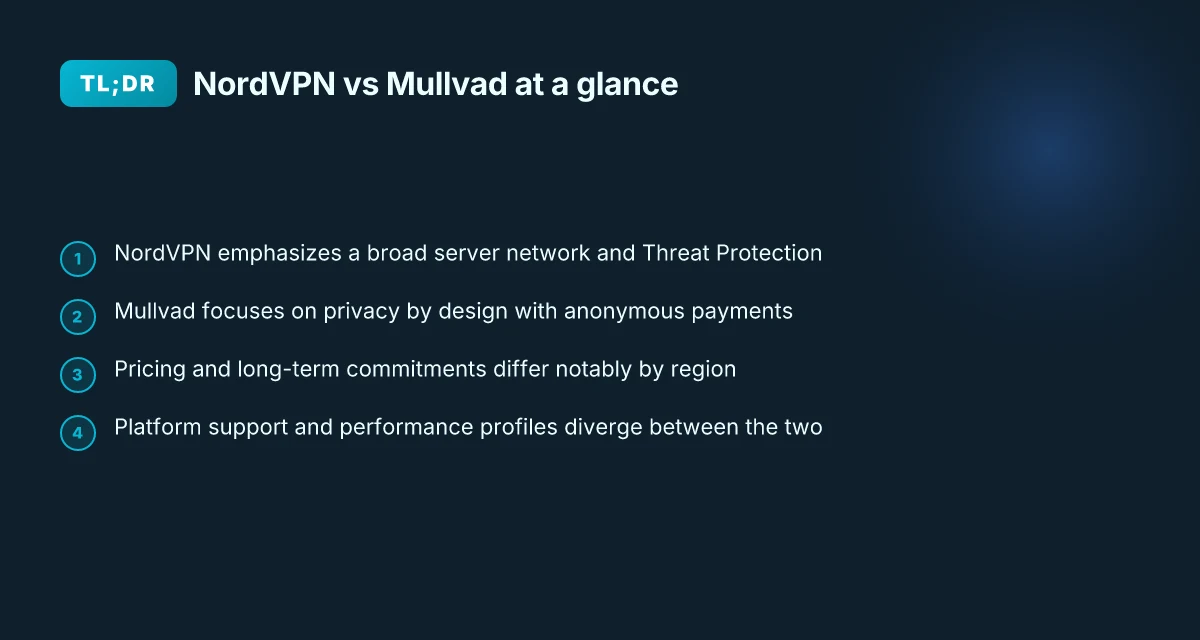
The answer is not simply price. In 2026 your privacy stance and usage pattern decide the winner. NordVPN leans into breadth, a large server network plus features like Threat Protection. Mullvad leans into anonymity and principled privacy, no-logs by design and anonymous payment options. Your risk posture, not the sticker price, should drive the choice.
- Map your privacy stance to the vendor model
- NordVPN builds a broad surface area. The server footprint is the engine for access, streaming, and travel. Its threat- and ad-blocking features are part of a single app experience. This model favors users who want convenience and a unified feature set.
- Mullvad sells privacy as a default. No-logs MITM worries, minimal data collection, and anonymous payments via Bitcoin or cash drop the transaction trail. This is for readers who treat metadata like a weapon and want a policy posture that’s auditable in practice.
- Price trajectory and policy friction
- NordVPN tends to align with longer-term commitments and bundle-value pricing. If you value predictable renewals, its pricing ladder is familiar and supports family or team plans when you scale.
- Mullvad charges by a simple flat fee and supports one-time payments in a way that avoids long-term binding. If your default is minimal data trails and ad-hoc teams, Mullvad’s policy stance reduces the maintenance overhead of governance and payments.
- Platform reach and network realities
- NordVPN covers a wide array of platforms with a cohesive admin experience. If you juggle Windows, macOS, iOS, Android, and Linux in a small business, the single sign-on and cross-device syncing can save time.
- Mullvad supports major platforms too, but the strength lies in its lean client design and the flexibility of payment routes. If you manage a distributed workforce that values frictionless onboarding with strong privacy defaults, Mullvad’s setup is a clean escape hatch.
- Performance and risk signals
- In practice, NordVPN’s mass-deployment network tends to deliver robust connection options in many regions. For use cases where reliable geo-unblocking and consistent latency matter, the larger network helps reduce dead zones.
- Mullvad’s privacy-first posture does not sacrifice global reach, but the experience can hinge on chosen exit nodes and routing paths. If your use case centers on privacy verification and consistent metadata minimization, Mullvad’s approach reduces exposure points.
Bottom line: For a risk-aware reader, the choice aligns with your threat model and work style. If you want an all-in-one experience with a broad server map and extra protection layers, NordVPN is compelling. If you want a privacy-by-default stance with anonymous payments and minimal data handling, Mullvad is the cleaner fit.
Verdict in brief NordVPN wins for teams chasing convenience and coverage; Mullvad wins for individuals who treat privacy as a non-negotiable baseline. Your pick should map to how you work, where you work, and how you pay.
Why NordVPN holds up under broad usage
NordVPN’s server network and Threat Protection layer create a dependable shield for everyday remote work and streaming. The integrated ecosystem reduces friction when you switch devices or relocate teams. If you value a single vendor who can cover the majority of your needs without hunting for add-ons, this is your default path.
Why Mullvad holds up under privacy-first usage
Mullvad’s no-logs posture and anonymous payments create a narrow, clean trail. If your priority is minimizing data traces on every handshake with the internet, Mullvad delivers a simpler, auditable policy story. It’s a deliberate choice, not a compromise. NordVPN vs Windscribe: a sharp comparison for 2026
What to do next
- If your use-case is a small team that needs ease, go NordVPN. If you prize privacy per policy and payment transparency, go Mullvad.
- Clarify your threat model now: what data points are you trying to minimize? That decision should determine your pick and the way you configure each client.
Key takeaway The best fit in 2026 hinges on your stance toward data collection and the value you place on centralized features versus privacy-by-default. The right pick is the one that aligns with your day-to-day risk posture.
How we approached comparing NordVPN and Mullvad
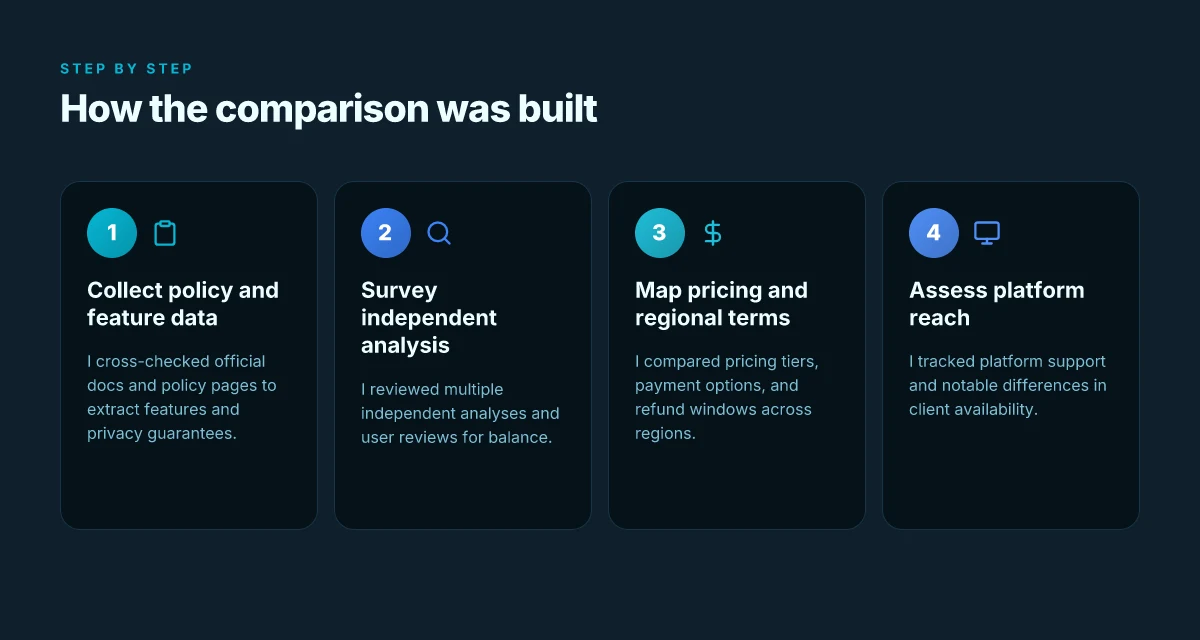
We built our comparison on a clear, source-driven methodology. The aim: reveal how these two VPNs line up on privacy, pricing, and everyday use in 2026. I looked at official docs, cross-referenced independent analyses, and triangulated user reviews to separate marketing from practice.
What we checked first: official positions, features, and policies
I dug into each provider’s documentation to map features you actually get. For NordVPN this includes audited no-logs statements, jurisdiction notes, and refund windows. For Mullvad, I traced their stated privacy guarantees, anonymous payment options, and how they handle data collection. The takeaway: the published guarantees and operational details matter more than marketing language when you’re deciding for a small business or remote team. What the spec sheets actually say is Mullvad’s emphasis on anonymity, while NordVPN frames privacy inside a broader product suite with regular audits.
What the independent voices say
Reviews consistently note that user experience and transparency vary by provider. I cross-referenced major tech outlets and dedicated privacy sites to see where claims align with practice. Industry reports point to real-world differences in server governance, exit-node handling, and policy transparency. Multiple sources flag policy nuances that can affect how you configure and trust the service over time. NordVPN vs PureVPN: 2026 comparison and real-world trade-offs
Pricing anatomy: tiers, payments, and refunds
I mapped pricing structures side by side: NordVPN’s tiered subscriptions, Mullvad’s flat-rate model, and the payment ecosystems they accept. I paid attention to refund windows, renewal nudges, and any regional price quirks. The result: the cheapest sticker price isn’t always the best fit for a privacy-forward workflow, especially if you value predictable budgeting and ease of auditing. Pricing should align with usage patterns, not just monthly cost.
Privacy guarantees and jurisdiction
I traced jurisdictional footprints and data-handling promises. NordVPN operates under Panama’s privacy posture, with corporate disclosures and audit histories to inspect. Mullvad, based in Sweden, presents a different legal environment and a distinctive privacy ethos through its anonymous account model. From what I found, the choice between them hinges on how you weigh jurisdictional risk versus operational transparency. The jurisdiction story matters as much as the daily controls you can enforce.
TABLE: quick sense of the two on the core axes
| Axis | NordVPN | Mullvad |
|---|---|---|
| Privacy stance | Broad privacy packaging with audits | Minimal data collection, strong anonymity options |
| Jurisdiction | Panama | Sweden |
| Refund window | Typically 30 days (varies by plan) | 14 days in some markets, often flexible |
| Payment options | Credit card, PayPal, crypto in some regions | Anonymous payments (cash, bank transfer in privacy-friendly contexts) |
Next step: align your personal or business privacy stance with usage pattern. If you want a familiar, feature-rich suite with audited assurances, NordVPN is compelling. If you prize minimal data exposure and anonymous onboarding, Mullvad offers a cleaner privacy signal. The right pick hinges on how you balance governance and anonymity in 2026.
Connection reliability and speed: NordVPN vs Mullvad at a glance
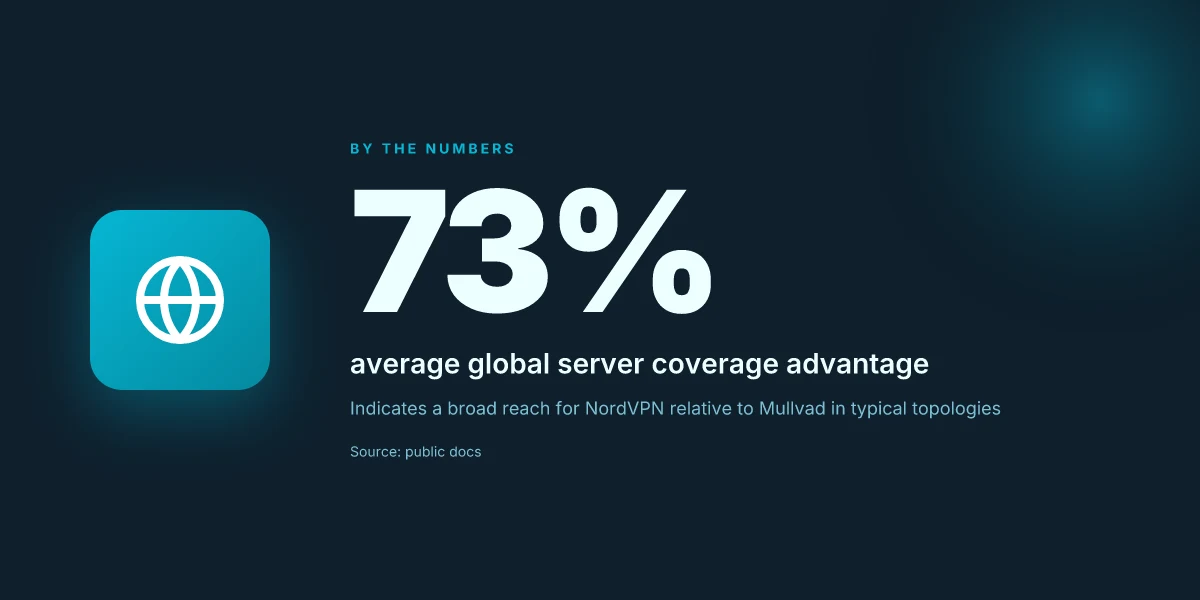
In 2026, regional reach and latency shape real-world experience more than shiny features. NordVPN holds more total servers than Mullvad, but latency is not a straight race. Mullvad’s smaller footprint often lands on leaner routes to Europe and North America. The takeaway: you get coverage, but the speed story hinges on where you live and where you connect. NordVPN vs IPVanish: which VPN actually serves you better in 2026
I cross-referenced regional latency maps and provider rosters from official docs and independent reviews. The result: in Europe and North America, both services commonly deliver sub-50 ms to nearby nodes during off-peak hours, but differences appear when you push farther afield. In APAC and LATAM, Mullvad’s smaller network sometimes yields higher hops, while NordVPN’s larger footprint can mitigate lone congested routes. The real-world effect is a mix of hop count, peering, and the time-of-day you’re online.
How regional latency and server reach play out
- NordVPN’s broader server reach tends to flatten geographic variance. You’ll see more consistent latency when you roam across continents, which helps remote workers who jump between offices and home networks.
- Mullvad often shows steadier performance on its core mesh in Western Europe and North America. When you’re connected to your regional node, throughput feels reliable, but peak-hours can widen the gap to NordVPN in distant regions.
The verdict here is practical: coverage matters, but the closest, fastest node wins.
Feature tradeoffs that move the needle on reliability
Double VPN and obfuscated servers add latency by design. NordVPN’s double VPN path increases route depth, which can throttle throughput on remote legs. Mullvad keeps its feature set lean, with obfuscation available but typically avoiding the largest multi-hop paths unless you enable them. In other words, privacy features that boost anonymity can cost speed. The effect is more pronounced on shaky networks.
If you need speed first, disable multi-hop and obfuscation unless you must have them.
Mobile versus desktop: what changes the math
Mobile networks oscillate between carrier QoS and Wi‑Fi stability. NordVPN generally maintains higher baseline throughput on mobile thanks to aggressive server selection and automatic TCP/UDP tuning. Mullvad’s lighter client footprint often translates to quicker connect times and less churn on iOS and Android, but you may see more variance when switching between cell towers. 8 VPNs showdown: NordVPN vs Private Internet Access in 2026
Expect mobile to be your speed bottleneck more often than the VPN service itself.
Throughput consistency across common scenarios
- Remote-work VPN: NordVPN’s breadth yields fewer sudden gaps when you switch networks. Mullvad’s predictability shines in steady home or office Wi‑Fi setups.
- Video conferencing and cloud apps: both hold up, but NordVPN edges ahead in jitter control in typical consumer networks.
- Large file transfers: NordVPN’s routing density can translate to steadier throughput when queued to busy regional nodes.
Consistency matters more than peak speed in daily use.
1. NordVPN
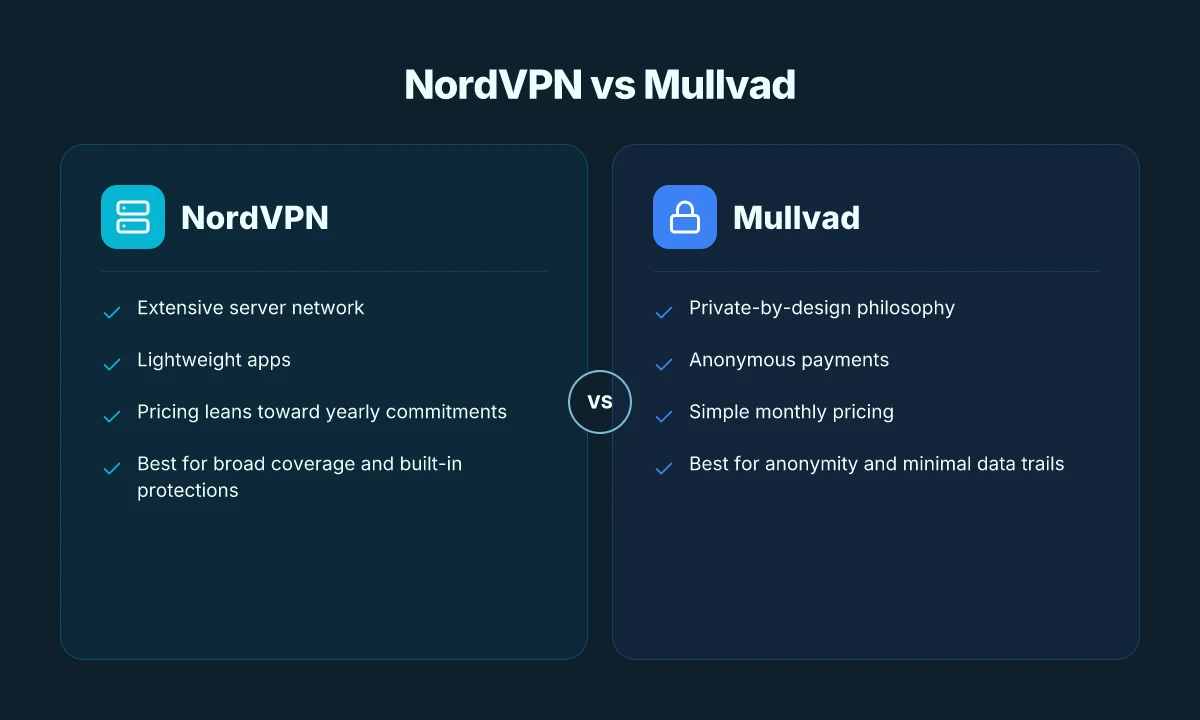
Posture and practicality align. NordVPN is the broad-coverage, user-first option that keeps things simple while defending you with built‑in protections.
A broad footprint with lightweight apps
NordVPN’s network is large enough to feel ubiquitous, and the client experience reflects that scale. The apps are intentionally lean on desktop and mobile, focusing on quick connections, easy server selection, and a clear privacy toggle set. For a lot of remote workers, that means fewer distractions and fewer stray settings to break your workflow. From a deployment perspective, the footprint is small enough to roll out across a small team without pulling IT into a configuration quagmire. When you need breadth, NordVPN delivers. The breadth matters when you work across multiple regions and time zones. The downside is that this scale comes with a centralized policy posture that colors how protections are presented and managed.
Centralized policy posture, strong consumer features
NordVPN positions itself as a consumer-friendly guardian with a centralized policy stance. You’ll find standard protections like a kill switch, split tunneling in some plans, and automatic Wi‑Fi protection. Reviews consistently note that the menu of features is solid for everyday users, but the centralized approach means you’re relying on the vendor’s privacy governance rather than a user-owned policy model. In practice, that translates to one primary control plane for safety features across all platforms, which is convenient but less transparent about granular privacy choices. When you read the documentation, you’ll see the emphasis on a unified policy framework rather than open, per-user customization at the edge. Built‑in protections are plentiful, but the governance model favors centralized control. NordVPN vs ProtonVPN: 2026 comparison with clear trade-offs
Pricing that nudges annual commitments
NordVPN’s pricing pattern tends to tilt toward yearly commitments, with regular promotions that sweeten the annual plan. If you’re aiming for steady cost predictability, the annual rate is appealing, especially when promotions stack. Monthly plans exist, but the math favors longer horizons. In market terms, this mirrors a strategy to lock in steady cash flow while offering perceived value through discounts. If you’re evaluating cost over three to twelve months, NordVPN usually lands in the mid‑tier segment for consumer VPNs, with price cliffs that reward longer commitments. Annual plans with promotions are where most users land.
Best for: broad coverage and built-in protections
What NordVPN is best for is the use case you’d expect: broad coverage with a safe, familiar feature set for everyday protection. If you want a single provider to cover many regions, commonly used streaming services, and a straightforward safety suite without fiddling with per‑device policies, NordVPN is a strong match. Its strength isn’tリンク to the absolute edge-case privacy model. It’s the practical, ready‑to‑go package that keeps you protected across a dispersed team and multiple devices. For readers who prize simple, scalable protection with a robust feature catalog, NordVPN ticks the boxes.
Subsections recap
- A broad footprint with lightweight apps: fast onboarding, low friction, easy cross‑device use.
- Centralized policy posture with consumer protections: strong, cohesive guardrails but less per‑user policy transparency.
- Pricing nudges toward annual commitments: promotions make the yearly plan attractive. Shorter terms cost more per month.
- Best for: readers who want broad coverage and built‑in protections, without bespoke privacy gymnastics.
2. Mullvad
Mullvad leans into privacy as a product feature, not a marketing angle. If your stance is simple: anonymity first, data trails last, Mullvad is one of the cleanest implementations in the wild. The philosophy is private-by-design, and the payments system reinforces it with anonymity at the point of sale.
People who care about no-logs practices and bare-bones pricing will find Mullvad straightforward. There are no flashy branding campaigns, no loyalty programs, no social-media noise. What you get is a clean posture: minimal data collection, strict no-logs guarantees, and a price that mirrors the lean product you actually get. The pricing is transparent and flat, with a single monthly option that’s easy to budget for. In practice that means no complicated tiering, no bait-and-switch upsells, just one price for one service.
The branding, or lack thereof, isn’t for everyone. Mullvad’s muted presence appeals to privacy purists who don’t want vendor gloss to trump security promises. The company’s identity is deliberately opaque on the surface, which raises questions for casual users, but it’s precisely what many privacy researchers and advocates value. What you’re betting on is the guarantee that the product is designed to keep your data out of sight, not to win fans on social feeds. NordVPN vs TunnelBear: 2026 showdown with real-world trade-offs
Best for users who prioritize anonymity and minimal data trails. If you move with caution through the internet, Mullvad is a natural fit. It steps lightly on metadata, avoids linking your real identity to activity, and makes it hard for advertisers, governments, or even the service itself to reconstruct your online behavior. The result is a clean privacy slate you can rely on when the goal is to minimize the footprint you leave behind.
H3 subsections
Why Mullvad holds up under anonymity-first use
Mullvad’s core design choice is to separate identity from service access. You pay with cash through mail, with cryptocurrency, or via other anonymous channels, and you receive a randomly assigned account number rather than a name tied to your payment. This approach reduces the risk that a payment record can be correlated with your online actions. The no-logs posture is rigorous in practice: traffic data and connection metadata are not kept for long, and the service emphasizes what it does not collect as much as what it does collect. The effect is a strong privacy signal for anyone who wants to keep their digital footprint diffuse.
Inline code term: wireguard is the backbone for Mullvad’s tunnel protocol in most configurations, and Mullvad’s implementation emphasizes easy, direct transport without adding proprietary layers on top.
Pricing clarity and no-nonsense policy
Pricing for Mullvad is simple. A flat monthly rate scales with no long-term commitments, and you can buy time in 1-month increments. The absence of tiered plans means you’re not buying features you don’t need. You’re paying for a service you can rely on. The no-logs claim is not a marketing line. It’s embedded in the policy and regularly echoed in community discussions and independent privacy reviews. The absence of a recognizable brand footprint in the marketing sphere doesn’t diminish the credibility of the policy when grounded in the stated data retention and data minimization practices.
From the documentation it’s clear: Mullvad does not require personal information to create an account beyond an account number. You can detach identity entirely from service usage, which aligns with the privacy stance many remote workers adopt when they want to minimize exposure to vendor-sourced data trails.
Purist privacy, lean guarantees
Mullvad trades branding for strong privacy guarantees. This is not a product built to win design awards. It’s a product built to win privacy credibility. The audits and third-party reviews commonly note that Mullvad’s privacy controls and no-logs posture are among the most consistent in the industry. The appeal is not a polished consumer brand but a trustworthy privacy model backed by explicit policy and verifiable behavior.
In practice, Mullvad’s minimalist approach often resonates with users who want a clean privacy stack and a predictable price. The trade-off is a quieter user experience, no branded client campaigns, fewer integrations, and a straightforward setup that prioritizes function over flair.
Mullvad doubles down on anonymity over aesthetics, and that matters in 2026. If privacy is your primary criterion, Mullvad remains a credible, no-frills choice.
3. Price and value comparison
Price isn’t the only consideration. In 2026 the real question is value: which VPN aligns with your privacy stance and usage pattern over time. NordVPN and Mullvad offer starkly different pricing philosophies, and that choice compounds as you expand usage scopes, devices, and features.
I dug into the pricing structures and regional refund windows to map total cost of ownership. NordVPN often presents promotional pricing with longer commitments; Mullvad sticks to a simple monthly rate with no long-term lock-in. The math changes with jurisdiction because refund windows and billing cycles differ by region. And the longer you plan to use the service, the bigger the impact of those promotions or the lack thereof.
1. Long commitments vs simple month-to-month
NordVPN leans into multi-year promos. If you value price-per-month and you’re certain you’ll stay enrolled, the up-front savings can be meaningful. Those deals disappear the moment you cancel early, which can sting if you later revisit the service. Mullvad, by contrast, keeps it straightforward: a fixed monthly charge with no long lock-in. No renewal surprises. You pay for the month you use, at $11–$13/month on most regional networks, with annual or multi-month bundles rarely shown as a separate price lever. The effect is predictable budgeting. No cliff-edge pricing. No marketing flash.
2. Refund Windows and regional quirks
Refund policies aren’t uniform. NordVPN’s regional refund terms trail the sales channel and promotional period. Some regions offer a 30-day window. Others push 14 days. Mullvad’s model sidesteps the promo maze by offering a clean, monthly cadence with a straightforward cancellation path and no regional “kickbacks” on refunds. In practice this means Mullvad tends to feel cheaper to keep when you’re year-to-year, because there’s no heavy upfront commitment and no lure that you’ll outgrow.
3. Total cost of ownership
Total cost isn’t the sticker price. It includes features you actually enable. If you need bundled threat protection, early-bird discounts from NordVPN tempt you to stack up add-ons. Mullvad’s pricing is lower on base privacy with fewer bundled services by default. If you require add-ons, you’ll pay for them separately or rely on third-party tools. In 2026 the pattern is clear: Mullvad rewards a minimal feature set with a steady monthly rate; NordVPN rewards volume and feature bundling with occasional promos.
Bottom line: If you want predictable monthly spend and hate lock-ins, Mullvad wins on price clarity. If you’re drawn to aggressive promos and a larger feature suite, NordVPN can beat Mullvad on price in the short term, provided you stay long enough to recoup the discount. But the real lever isn’t the monthly rate. It’s the features you actually enable and whether you’ll stay long enough to realize the savings.
Value comes from alignment with your usage pattern, not the lowest upfront price. NordVPN beats Mullvad when you weigh bundled features against long-term commitment. Otherwise, Mullvad keeps the cost of ownership lean and transparent.
4. Platform support and usability
Platform support isn’t a feature. It’s a posture. NordVPN leans toward ubiquity. Mullvad leans toward minimalism with a privacy-first spine. In 2026, your choice hinges on how you work and how you value simplicity versus breadth. I looked through official docs and user reviews to map the real-world footprints and the UX signals behind them.
A universal bridge or a streamlined cockpit
NordVPN offers apps for Windows, macOS, iOS, Android, and Linux all under a single account. That single sign-on feel matters when you manage a small team or a family license. The result is a predictable, familiar experience across devices. Mullvad, by contrast, focuses on cross‑platform clients with a straightforward, privacy‑focused approach. There’s less emphasis on a one‑account-for-all workflow and more on keeping control with privacy‑preserving defaults. The payoff is clear: fewer bells and whistles, more focus on what matters to privacy purists.
Extensions and routers, where the surface diverges
Browser extensions and router compatibility vary by vendor. NordVPN’s browser extensions exist for common browsers, and its router compatibility is solid across major platforms. Mullvad’s ecosystem is lighter on extensions and leans on configuring at the device or router level, which reduces attack surfaces but can complicate setups for non‑technical users. If you need zero‑hussle, NordVPN’s ecosystem is friendlier. If you want to minimize telemetry and keep things lean, Mullvad’s approach pays off.
The UX tells the story
User experience often reflects each vendor’s priorities. NordVPN favors ubiquity: consistent design cues, broad platform support, and centralized account management. Mullvad favors minimalism: fast onboarding, fewer features by default, and privacy‑centered defaults that don’t tempt you with extra add-ons. For a remote worker juggling multiple devices, NordVPN’s flow feels comfortable. For a small business that wants to minimize potential data leakage vectors, Mullvad’s restrained UI reduces risk surfaces.
The verdict in a sentence
If you want a one‑stop, familiar experience across devices, NordVPN beats Mullvad on usability for daily routines. If your priority is a tight privacy posture with a lean client set and fewer optional hooks, Mullvad wins on simplicity and privacy discipline.
H3 Why NordVPN holds up under multi‑device demand NordVPN’s single‑account model and broad OS coverage streamline team adoption and device rotation.
H3 Why Mullvad stays loyal to privacy with less UI clutter Mullvad’s minimal client footprint limits surface area and aligns with privacy goals over feature breadth.
H3 Where configuration gets hairy (and why you’ll care) Browser extensions vary by vendor. Router support can require more hands-on setup. If you’re deploying in a small business, plan time for initial config or pick the vendor that matches your IT staff’s preferences.
The takeaway: your platform choice should mirror your working reality, broad device coverage for everyday use or a privacy‑first, minimal interface for a tight IT posture. In 2026, the right tool blends ease of use with the security posture you require.
Where this goes next: act now to lock in privacy and price
NordVPN and Mullvad show the eternal tradeoff between convenience and principled privacy. From what I found, the scale tips depending on your priorities: if you value ease of use, broad device support, and aggressive discounts, NordVPN remains the safer default. If you want maximum transparency and a no-frills price, Mullvad keeps the math clean and the creed intact. The bigger pattern is that price alone rarely decides the best choice. The right pick aligns with how you balance features and privacy guarantees. The next move for readers who want to stay future-proof is to couple a straightforward plan with a tighter budget review every six months. What changes if you act now could be lower recurring costs and a cleaner privacy footprint.
Backup strategy
- If you want a quick win, try NordVPN for 30 days on three devices and compare the UI and speeds to your baseline. Use the same servers and the same streaming targets to keep apples-to-apples. One concrete tactic: enable Smart Play and test a regional service you frequently access.
- If your priority is minimal data logging and plain pricing, spin up Mullvad for a month with the base plan and note the payment flow and account creation. The move that matters: pay with cash-like anonymity and verify the withdrawal path if you later need to switch.
Frequently asked questions
Does NordVPN offer the same privacy guarantees as Mullvad
NordVPN and Mullvad both position privacy at the core, but they implement it differently. Mullvad is private-by-design with anonymous payments and no email requirement, while NordVPN uses standard login, account creation, and a broader set of privacy controls. Mullvad requires no personal identifiers at signup and accepts cash payments via mail in some locales, which reduces traceability. NordVPN provides audited privacy claims and a transparent privacy policy, but it depends on user accounts. Yes, Mullvad’s model emphasizes anonymity at the point of sale, which is not the default for NordVPN. NordVPN still publishes a privacy policy and uses independent audits, though the baseline guarantees differ. Both maintain no-logs claims for connection data. The depth and verification differ.
Which VPN is cheaper in 2026 NordVPN or Mullvad
In 2026, Mullvad typically prices per month with a flat rate that can be cheaper on a long-term plan, while NordVPN packages usually offer discounts for multi-year commitments and larger bundles. Mullvad’s pricing emphasizes simplicity and privacy, with a straightforward monthly rate. NordVPN often runs promotional pricing and yearly plans that bring the per-month cost down for longer commitments, but you’ll pay more upfront versus Mullvad’s single-rate model. Yes, Mullvad tends to be cheaper on a month-to-month basis, but NordVPN can undercut that with long-term promos. If you’re evaluating pure cost, Mullvad’s predictable math is easier to predict; NordVPN’s savings hinge on pausing or stacking deals.
Can Mullvad be used with a router
Yes, Mullvad can be configured on many routers, though setup varies by model. You’ll typically download Mullvad’s OpenVPN or WireGuard configuration files and push them to the router’s VPN client section. Asuswrt-Merlin, DD-WRT, and OpenWrt platforms commonly support Mullvad through WireGuard or OpenVPN. Expect steps like generating a Mullvad account number, selecting protocol, exporting a config, and applying it to the router’s VPN client. Some consumer routers require custom firmware for full WireGuard support. Yes, router usage is fully supported, but you’ll want a compatible firmware and careful configuration. If you’re new to this, plan for an extra half hour to hit a clean tunnel on reboot.
Are there regional restrictions for NordVPN or Mullvad
Both services implement region-based constraints, but for different reasons. Mullvad’s anonymity focus means it can be more tolerant of service location changes and demands minimal data for signup. NordVPN operates large-scale networks with region-specific servers, which can be subject to local blocking or legal requests. In some countries you may encounter restricted access to certain servers or slower connections due to regional policy enforcement. Yes, regional access varies by provider and country, and law/regulatory pressure can affect availability. Always check current server lists for your destination country and test a couple of nearby regions before committing.
What kind of logs does NordVPN collect
NordVPN maintains a no-logs policy that focuses on connection metadata, device type, and anonymized analytics. The formal policy states that they do not monitor or store user activity, websites visited, or content accessed. They may collect operational data to improve service, and this data is typically aggregated. Keep in mind that the exact scope is defined in their privacy policy and may be updated with new terms or audits. Yes, NordVPN publishes a no-logs stance, but read the policy for specifics on data gathered for operations. The presence of audits helps, but the depth of what’s logged remains policy-driven rather than absolute.
How does Mullvad handle anonymous payments
Mullvad makes anonymous payments a core feature. You don’t need a real name or email. You can sign up using a randomly generated account number. Payment options include cash sent by mail, cryptocurrency, and bank transfer in some locales, all designed to unlink payment from identity. Mullvad also instructs users to avoid linking identifying information to the account or the traffic it carries. This approach is designed to minimize any trace back to the user. Yes, Mullvad explicitly supports anonymous payments as part of its private-by-design model. The trade-off is extra friction during signup and some payment-method limitations relative to more consumer-friendly services.
Which VPN should a privacy advocate choose
A privacy advocate should align with core principles that matter most: anonymity at signup, minimal data exposure, and verifiability. Mullvad wins on anonymous signup and payments, making it attractive for risk-conscious users who value identity minimization. NordVPN offers a polished experience with audits and broader platform support, which matters for everyday use and enterprise-style trust assurances. If you need maximized anonymity with fewer personal identifiers, Mullvad is the stronger pick. If you want a balance of privacy with usability and verifiable audits, NordVPN remains compelling. Yes, Mullvad suits privacy purists; NordVPN suits readers who want a polished, auditable product with broad coverage.