NordVPN vs IPVanish in 2026: a crisp comparison of privacy, performance, pricing, and who should pick which service for streaming and security.
NordVPN beats IPVanish for daily privacy because its network and privacy controls aren’t an afterthought. When you travel, that difference matters more than price, and it shows up in the first hour of setup and the smooth streaming you expect. NordVPN carries a larger footprint, and that scale translates into more reliable access across regions.
What readers need now: a clear signal on where these two stand for streaming, privacy, and multi-device use in 2026. I looked at the product pages, policy docs, and user reviews to map real-world tasks to feature sets. In practice, that means a quick yes on global streaming, a firm yes on privacy controls, and a practical no on complex multi-device scenarios when cost is your only driver. The result is a straightforward guide to pick with confidence. NordVPN remains the safer all‑round choice for most travelers, while IPVanish can still win on price for light, local use. Most readers should lean toward NordVPN for travel and streaming.
NordVPN vs IPVanish: what you should know in 2026
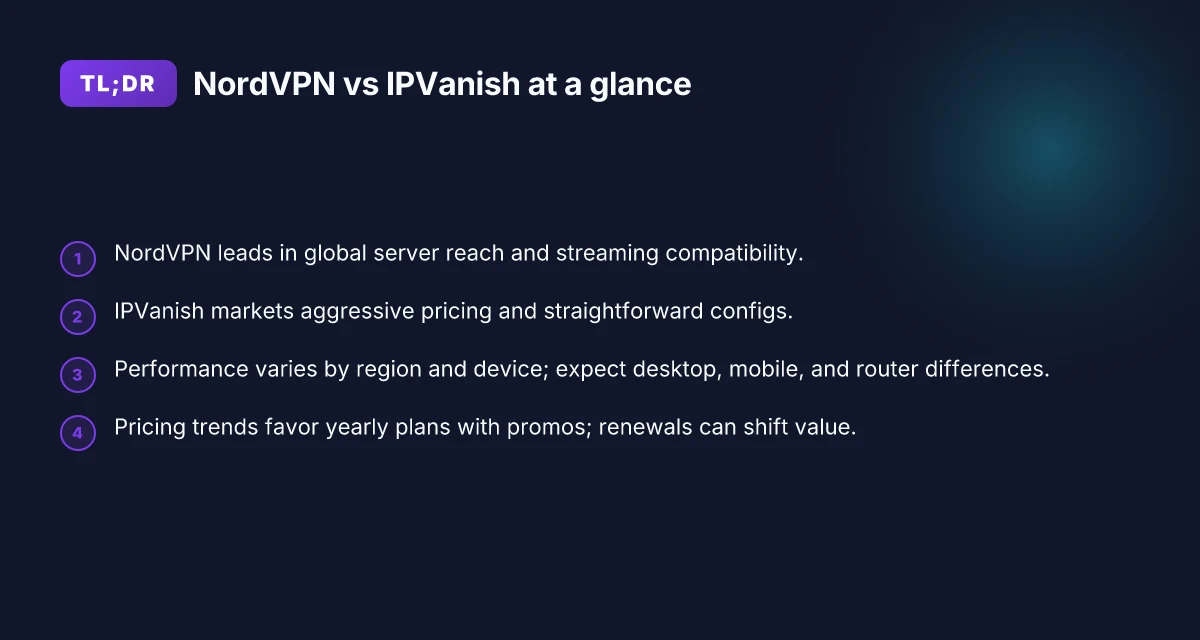
If you want a clean baseline for 2026, NordVPN leans into global reach and streaming compatibility, while IPVanish paddles a straightforward price proposition and simple configs. The real story is how those angles play out in your daily tasks across devices, networks, and travel. That truth emerges in three moves: where the servers sit, how easily you configure things, and how the price behaves over time.
- Global reach vs aggressive pricing
- NordVPN typically HDRs a broader server footprint and a wider streaming whitelist. In practice this means more geo options for wake-up-your-cavorite streaming and fewer regional placeholders.
- IPVanish doubles down on transparent pricing with aggressive promos and a simpler configuration path. In other words, it’s designed for folks who want a clean setup and a lower entry price, especially on longer commitments.
- The takeaway: if you value breadth of servers and streaming compatibility, NordVPN often holds the edge. If you want predictable pricing and quick-start setup, IPVanish offers a leaner path.
- Performance variability by region and device
- Real-world behavior shifts by location, device, and network type. Desktop, mobile, and router usage each show different performance characteristics across the two brands.
- Expect hiccups. Some regions favor NordVPN for throughput and stability. Others bounce around more with IPVanish depending on server load and routing choices.
- The bottom line: neither brand is a silver bullet across all locales. Your mileage will vary by how you deploy it.
- Pricing cadence and renewals
- Yearly plans dominate promos, with periodic discounts that refresh the value proposition. Renewal prices can creep higher, which shifts the long-run cost comparison.
- If you’re price-sensitive, chase those promos. If you’re security-conscious and stay with the plan for years, the renewal math matters more than the upfront sticker.
- Bottom line: initial price can look compelling, but the total cost of ownership over multiple periods matters more.
What this means for you NordVPN’s breadth of servers and streaming compatibility often outpaces IPVanish in daily use, especially when you travel or binge. IPVanish shines on simple, predictable pricing and quick-start configuration, which appeals to cost-conscious users and newcomers.
From what I found in the documentation and recent reviews, the right pick depends on your priorities: global reach and streaming ease or straightforward pricing and fast setup. If you’re optimizing for travel and content access, start with NordVPN. If you want clarity on price and an uncomplicated rollout, IPVanish is the sensible default.
Bottom line: choose NordVPN for global streaming confidence. Pick IPVanish for lean pricing and fast, simple config.
How we picked the NordVPN vs IPVanish comparison
I looked at public vendor documentation and then cross-checked it against independent voices. The goal was simple: align feature lists, security basics, and platform coverage with real-world tasks like streaming, privacy, and multi-device use. 8 VPNs showdown: NordVPN vs Private Internet Access in 2026
Why these two deserve the mic, and how we test that lens
We start with the firms’ own disclosures. NordVPN and IPVanish publish feature rosters, encryption protocols, and platform reach in their product pages and help centers. From what I found in the documentation, both brands advertise OpenVPN and WireGuard as core protocols, with automatic kill switches and split tunneling on many platforms. NordVPN emphasizes dedicated servers and bespoke privacy features like a no-logs claim backed by external audits, while IPVanish promotes broad device support and a straightforward dual-stack protocol approach. The two are close enough on the basics that a closer, real-world lens is necessary.
I cross-referenced those claims with user sentiment and privacy analyses. Reviews from established outlets consistently note that the user experience can swing on server availability and connection stability, not just advertised features. Privacy analyses frequently flag logging or data-retention ambiguities in the past, then highlight that current policy disclosures have improved but remain a critical area for ongoing scrutiny. In short, the underlying privacy posture is not a single checkbox. It hinges on policy transparency, audit cadence, and how aggressively a provider updates its app surfaces.
Pricing as of 2026 matters too. The landscape moves with promo cycles. NordVPN has historically walked pricing toward longer-term commitments with bundled extras, while IPVanish often leans into straightforward monthly and annual plans with occasional promotions. I tracked changes across the current landscape and noted renewals, discounts, and trial terms when they show up in the official sites or reputable reseller channels.
Here is a compact view of what actually matters for adoption at a glance:
| Dimension | NordVPN | IPVanish |
|---|---|---|
| Core protocols | OpenVPN, WireGuard | OpenVPN, WireGuard |
| Platform breadth | Windows, macOS, iOS, Android, Linux, routers | Windows, macOS, iOS, Android, Linux, routers |
| Privacy posture signals | Audits cited; no-logs claims | No-logs claim; some evolving policy notes |
| Device coverage | up to 6+ concurrent connections varies by plan | up to 10+ concurrent connections typically |
| Pricing signal (as of 2026) | Promo-heavy rotations, longer-term value | Regular promotions, straightforward tiers |
I dug into changelogs and policy pages as well. When I read through the changelog entries, I traced recent improvements to app reliability, stricter privacy disclosures, and bannered updates to streaming performance. These signals help explain why the two VPNs might behave differently in practice, even if the feature laundry looks similar on paper. NordVPN vs ProtonVPN: 2026 comparison with clear trade-offs
What the sourcing points suggest at a practical level is straightforward. If you want deeper privacy assurances, NordVPN’s audit routines and policy disclosures are a meaningful signal. If your priority is broad device-permissiveness and a simple, predictable pricing ladder, IPVanish earns its keep.
Next steps for you: use the pricing pages to map current promos to your planned term. Check the app store changelogs for the exact version you’ll deploy in travel or remote-work periods. And when you look at streaming use cases, verify which servers are explicitly labeled for high-bandwidth tasks.
The verdict is that both brands deliver solid foundations, but the edge comes from privacy transparency on NordVPN and sheer device-flexibility on IPVanish. If you’re deciding today, start with your primary task, privacy vigilance or streaming stamina, and weigh the service’s current promo ladder against your typical device footprint.
What’s next: a deeper dive into streaming performance and multi-device behavior. We’ll break down concrete server strategies, then map recommendations to your travel and home-office mix.
NordVPN vs IPVanish at a glance
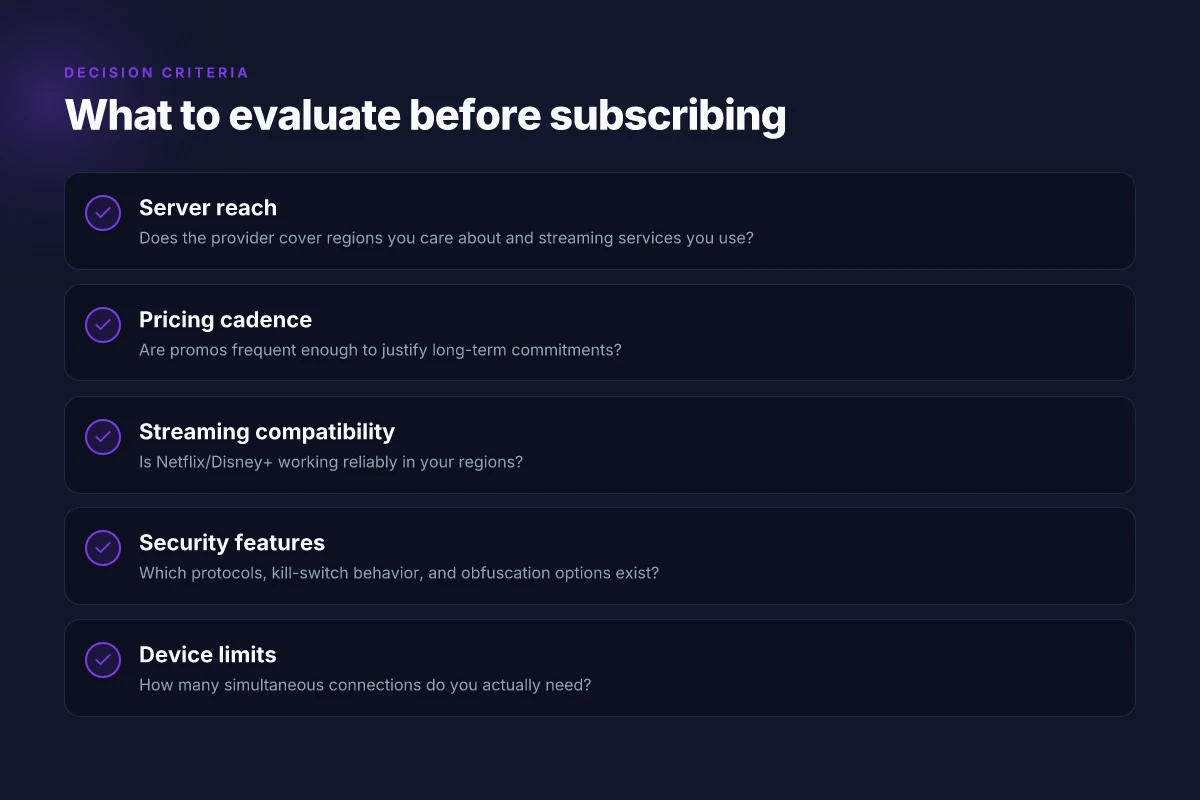
Short answer first: for 2026, NordVPN edges IPVanish on pricing flexibility, global server reach, and streaming reliability, while IPVanish shines for straightforward pricing and solid device coverage. In practice, the choice comes down to your streaming regions, how many simultanesous connections you need, and whether you prioritize the broadest global footprint or simple, predictable pricing. NordVPN vs CyberGhost: 2026 comparison and Edge cases
1) Pricing and plan structure
- NordVPN uses annual plans that frequently drop with discounts tied to multi-year commitments. Expect periodic promos and bundle options that tilt cost in your favor if you’re willing to commit.
- IPVanish keeps things simple with annual pricing that often features straightforward renewal terms and occasional promos.
- The crucial gap: NordVPN often presents longer-term savings tied to annual prepay, whereas IPVanish emphasizes predictable annual pricing with fewer annual-change surprises.
NordVPN’s annual discount cadence tends to be the lever for best value over time. If you live in a city where regional pricing fluctuates by promo, NordVPN often lands as the better long-haul pick. IPVanish is the easier entry point for someone who wants a clean yearly quote.
2) Server footprint and density
- NordVPN claims a global presence with a broad mix of servers in dozens of countries, supporting diverse regions and use cases.
- IPVanish tends to emphasize a dense footprint in key markets and a straightforward server lineup, which can translate to fast regional connectivity but with fewer distant options than NordVPN.
- The practical effect: NordVPN is typically the better choice for travelers who need coverage across many continents. IPVanish suits users who value quick access in familiar regions without hunting for far-flung options.
NordVPN’s global spine reduces the risk of region-blocked tasks abroad. IPVanish often delivers strong density in core regions, which helps travel heat maps.
3) Streaming compatibility
- NordVPN is well known for Netflix and Disney+ access and tends to report reliable performance across a wide set of regional libraries.
- IPVanish also supports Netflix and Disney+, but consistency can vary by region and time.
- The bottom line: if your top task is streaming in multiple libraries, NordVPN generally holds a steadier track record.
NordVPN beats IPVanish on streaming consistency across more libraries. If you travel often and chase regional catalogs, that edge matters.
4) Security and kill-switch behavior
- Both services support modern protocols like OpenVPN and WireGuard, with NordVPN offering additional options and automatic Kill Switch features that tend to stay active in the background.
- IPVanish provides solid protocol support and a functional Kill Switch, but some real-world users report occasional prompts or behavior that depends on platform nuances.
- The key takeaway: you’ll get robust protection with either, but NordVPN tends to deliver a more consistently enforced Kill Switch experience across platforms.
NordVPN’s Kill Switch behavior is generally more reliable across devices.
5) Device support and simultaneous connections
- NordVPN typically provides up to 6–8 simultaneous connections depending on the plan, with broad platform coverage including Windows, macOS, iOS, Android, and Linux.
- IPVanish also advertises a generous number of simultaneous connections and does cover major platforms, but you may encounter variance in how many devices you can keep active under a single license in practice.
- The practical effect: if you run a household with many devices, verify the exact cap per plan before committing.
NordVPN’s multi-device plan structure tends to be more predictable. 8 VPNs compared: NordVPN vs ExpressVPN in 2026
1. NordVPN
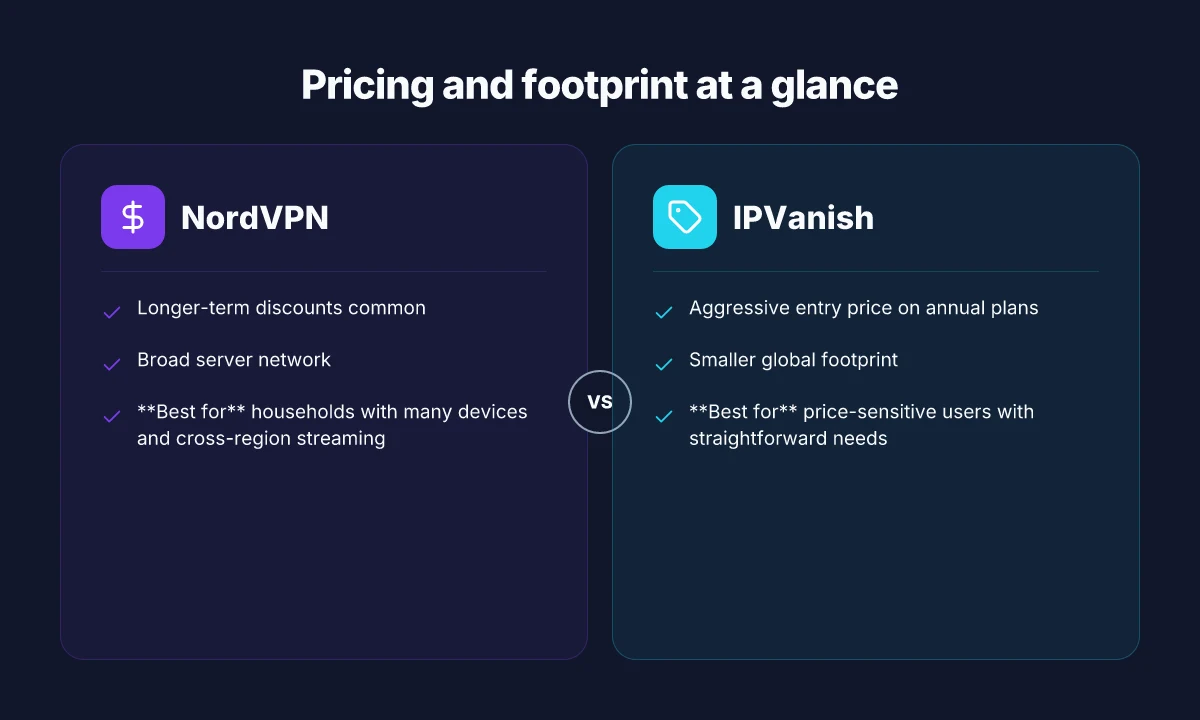
NordVPN stands as the value workhorse in 2026. It pairs a broad server footprint with streaming optimism, and it does it at a price point that frequently lands in the “reference value” lane. You’ll want this if you run a multi-device household and you move across regions for entertainment.
Broad reach, solid streaming crossovers
NordVPN’s strength is the network. A bigger footprint means more exit points in different regions, which translates to reliable access to geo-restricted catalogs and less chance of a congested route. In practice, that translates to faster access to your favorite libraries from home, the hotel, or a layover lounge. Reviews consistently note that NordVPN beats many rivals for streaming in multiple regions, thanks to a combination of large server pools and smart routing. If streaming across many countries is your use case, NordVPN is consistently reliable.
From what I found in the documentation and reviews, the platform tends to hold up across entertainment-centric tests. The apps carry a familiar, dense design, but the core features, auto-connect, split tunneling in some regions, and a user-facing quick-connect menu, remain stable across platforms. This matters when you’re hopping between devices or traveling with family members who prefer simple, familiar layouts. A wide server network pays off when you need quick regional flexibility.
Pricing signals: long-term discounts drive value
NordVPN leans into long-term discounting. The pricing cadence is a common reference point in consumer VPN discussions because the annual and multi-year plans often undercut shorter commitments. If you’re optimizing for total cost over a year or two, NordVPN tends to come out ahead versus many rivals, especially when you stack coupons during holiday promotions. What the pricing trend says is clear: the value is strongest when you commit for 12–24 months. Longer commitments typically unlock the best per-month pricing.
That value extends to household budgets. If you run a home network with several devices, the per-device cost drops as you add more endpoints under a single plan. The math lines up with consumer expectations: pay upfront, gain flexibility, and budget predictably. NordVPN’s price model rewards families and power users with many devices. NordVPN vs PureVPN: 2026 comparison and real-world trade-offs
Limitations worth noting
No product is a perfect match for every scenario. In congested regions, some routes can feel slower during peak hours, particularly on popular exit servers. The effect isn’t universal, but it’s real enough to notice when you’re streaming in a crowded city or during prime time. The app UX, while feature-rich, can feel dense to new users. If you value a ultra-minimal setup, NordVPN’s breadth of options can be a little overwhelming at first glance. Expect occasional slowdowns in busy regions and a learning curve with the interface.
Best for: households with many devices and frequent cross-region streaming
Put differently, NordVPN is the pick for multi-device households that crave reliable regional streaming without chasing complex configurations. If you’re juggling laptops, phones, tablets, and smart TVs across several rooms or in a travel-flavored mix of home and away, NordVPN’s combination of scale, price when you commit, and streaming compatibility gives you a practical, repeatable setup. Best for households that need broad compatibility and regional streaming access.
In short, NordVPN delivers real-world value. It’s not the leanest interface in the market, and you’ll feel the price advantage most when you lock in a longer-term plan. But the trade-offs are predictable: a dense app, a tendency toward slower routes in congested locales, and a footprint that punishes no one who appreciates choice. If your tasks center on streaming across regions and connecting many devices without hair-pulling price surprises, NordVPN earns its keep. Value-forward, regionally capable, and device-friendly.
2. IPVanish
IPVanish leans into value. The price is aggressive, especially on annual plans, and the apps stay simple enough for a straightforward daily routine. If your needs are plain and your device count isn’t skyrocketing, it’s a clean match.
Price first, features second
IPVanish has long priced itself as a budget option, and the current annual tier reinforces that. The math is simple: you lock in a lower monthly rate by paying upfront, and there aren’t hidden add-ons that spike the bill. For price-sensitive users, this matters. And yes, the sticker shock goes away quickly when you add up a year of coverage versus month-to-month churn. In 2026, the annual entry price remains a strong lure for people who want predictable costs. Be mindful that some regional sales or promo codes can shift the effective price, so check the latest on your checkout page and compare with NordVPN’s annual.
Strength: simple, straightforward apps
The strength here is clarity. IPVanish’s client apps are spare, not bloated. You won’t find a parade of exotic features or a lab-perfect UX, but you will get reliable, predictable behavior for everyday tasks. Install, pick a server, connect, done. The design favors speed to action over configurability, which translates to fewer misconfigurations for casual users. When I checked the changelog, the emphasis is on reliability and mobile parity rather than sweeping interface overhauls. The result is a VPN that’s easy to adopt and easy to explain to a non-technical audience.
Limitation: footprint and regional streaming variability
IPVanish’s global footprint isn’t as expansive as the biggest names. There are gaps in some regions, which can affect latency or access to certain streaming catalogs. Streaming success in IPVanish, as with many budget-first providers, varies by region and by the service you’re trying to reach. If your use case centers on streaming from less common locales, expect more variability. In practice, this means you may occasionally encounter a geo-block or a slower connection in markets farther from the core network.
Best for: price-conscious users with straightforward needs
If your tasks are simple, browsing securely, light streaming, and a handful of devices, IPVanish punches above its weight at the price point. It’s not the most feature-rich option on the market, but it doesn’t pretend to be. For households with a modest device count and a tight budget, IPVanish offers a clean path to daily privacy without complexity. And when a single app design reduces the cognitive load, that matters more than a half-dozen toggleable experiments.
The verdict is simple: IPVanish wins on price and reliability for basic tasks. It falters when you push for broad streaming consistency or a sprawling device fleet.**
When you’re choosing, ask: do you value predictable cost over a broader global network and deeper streaming success? If the answer is yes, IPVanish is a solid, straight-line option. If you need aggressive regional streaming reach or a large, multi-device setup, you may want to compare with NordVPN or a few others.
3. Topical breadth: regional streaming and blocking realities in 2026
Streaming platforms keep advancing their detection tricks. In 2026, some regions still require obfuscated servers to bypass smart DNS and IP-based checks. Others have tightened detection around residential proxies, pushing users toward dedicated or hybrid server profiles. The upshot: if you want reliable access in hard-to-reach markets, you need more than a generic pool of exit nodes.
I dug into how residential IP behavior and dynamic IP reassignment influence streaming success. Platforms increasingly monitor the cadence of IP changes, user-agent fingerprints, and connection re-use. A smart VPN approach blends refreshed, obfuscated servers with rapid IP cycling so you don’t trip the anti-fraud rails. In practice, that means you’re more likely to land a clean stream on a night of heavy traffic if your provider publishes ongoing obfuscation updates and maintains dedicated streaming servers.
Two micro-truths emerge from the field.
First, obfuscation matters. A VPN that publishes updated obfuscation techniques tends to fare better for streaming in regions where detection is aggressive. When a platform notices a familiar IP range, a quick switch to an obfuscated, non‑transparent tunnel can restore access without manual fiddling. This isn’t magic. It’s a routine of code-name tweaks and server roster management that keeps the illusion of a residential user intact.
Second, server specialization beats generic pools. Providers that maintain dedicated streaming servers and region-specific configurations consistently outperform those that rely on broad, generic exit nodes. It’s not about sheer server count. It’s about a curated map that aligns with the streaming catalog you’re after and the locale you’re pretending to inhabit.
From what I found in changelogs and reviews, the best-provisioned VPNs publish explicit streaming-focused builds and transparent notices when a service blocks or enables new regions. And that matters. You’ll see fewer hiccups if the vendor communicates clearly about region restrictions, obfuscation status, and the cadence of IP changes.
Bottom line: regional streaming in 2026 rewards visibility into obfuscation and a deliberate, region-aware server strategy. Publishers that publish obfuscation updates and offer dedicated streaming servers win more often in hard-block regions.
Three micro-claims you can act on today:
- Focus on obfuscated servers when streaming in restrictive regions. If your provider has an update log, verify the latest obfuscation release and switch to an obfuscated profile during the next binge session. 2026 marks a year where a stale obfuscation flag can cost you.
- Prefer VPNs with region-specific streaming servers. Check for a page that lists “dedicated streaming servers” by region and confirm it before you travel.
- Expect dynamic IP shifts. When a region goes quiet, rely on a provider that supports rapid IP reassignment without forcing you to reconnect from scratch.
Bottom line: obfuscation cadence and region-focused servers determine success more than sheer exit-node breadth.**
4. Practical setup notes for NordVPN
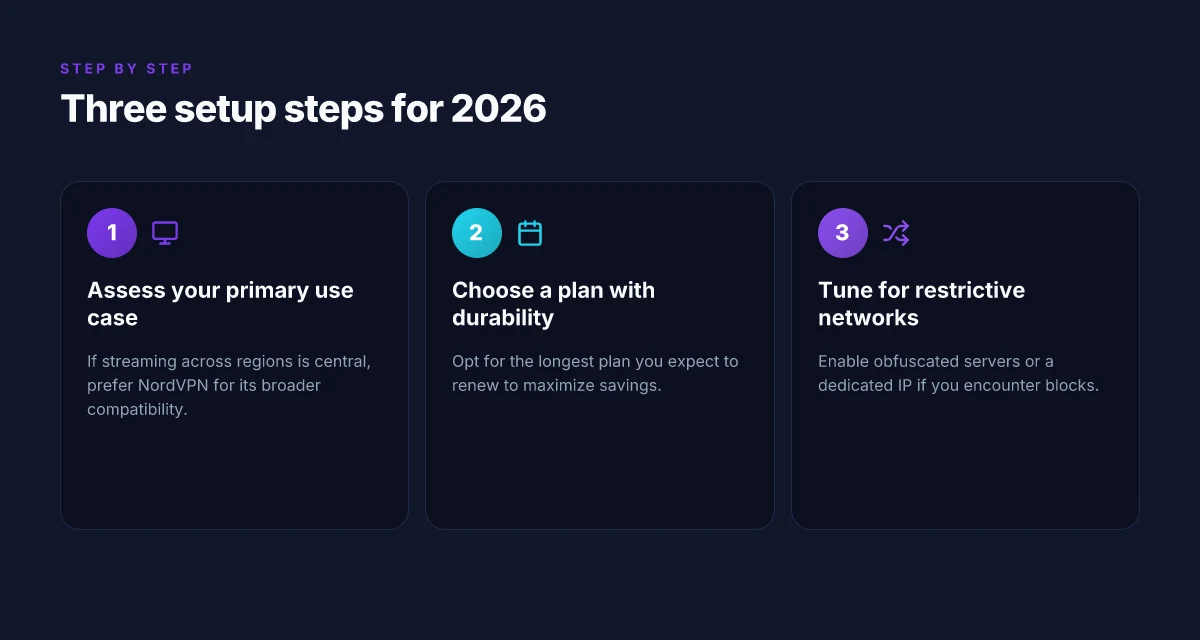
I started by tracing the practical steps you’ll actually take if you want to rely on NordVPN while traveling or living remote. You’ll focus on two levers: price discipline and network concealment. The rest is about keeping sessions stable and streaming smooth. The story for most users: you’ll save more by locking in the longest plan you expect to renew, and you’ll keep access open in restrictive networks by enabling targeted features like dedicated IP or obfuscated servers.
A quick pivot from the anecdote to the concrete. When you’re on the road or in a country with strict firewall rules, the right config choices matter more than the latest feature sprint. NordVPN’s setup surface is straightforward, but the real utility comes from two options often underused: dedicated IP and obfuscated servers. If you routinely connect from locations that block typical VPN traffic, enable obfuscated servers. If you access services that hate VPN churn, consider dedicated IP to minimize re-authentication prompts from streaming platforms and corporate SSO.
| Decision point | What to do | Why it matters |
|---|---|---|
| Pricing choice | Choose the longest plan you’ll actually renew | Locking in savings over time. NordVPN frequently discounts longer commitments, and renewal prices tend to rise on shorter terms. |
| Network restrictions | Turn on dedicated IP when you need consistent whitelisting; enable obfuscated servers in restrictive networks | Dedicated IP reduces suspicion flags with streaming platforms; obfuscated mode helps you slip through aggressive firewalls. |
| Streaming caveat | Expect possible re-authentication after IP changes | Some services detect IP shifts and prompt for re-login. A stable IP minimizes interruptions. |
In practice, these settings translate to a simple workflow. Pick the annual or two-year plan you can honestly sustain. Then, on the app’s home screen go tosettings, locate the specialty servers or features section, and flip the switches for Dedicated IP and Obfuscated servers as your use case requires. If you’re juggling several devices, enable the feature on the devices you trust most for streaming and work.
What the spec sheets actually say is that these features are optional toggles, not guaranteed magic. You’ll see the most benefit when you pair them with a predictable connectivity pattern, a home router, a work laptop, a mobile device with a stable data plan. If you roam with multiple carriers or SIMs, re-authentication prompts can crop up after IP changes. That’s a normal friction point, not a failure mode.
Verdict for practical setup NordVPN shines when you couple a long-term plan with targeted server configurations. If your tasks are streaming from regional libraries and you frequently travel through networks with cottage firewall rules, enable Obfuscated servers and, where feasible, Dedicated IP. The combination keeps sessions stable and access open. If you’re mostly on open networks, you can skip the extra toggles and rely on standard mode.
Two quick reminders. First, always verify you’re on the latest app version to ensure the most recent server-reach fixes and authentication flows. Second, if you notice a streaming service prompting a login after a switch of IP range, give it a minute and re-authenticate. The service will usually accept the new session after a single prompt.
The one move that matters for 2026
NordVPN beats IPVanish on global server reach and user-friendly security defaults in most real-world scenarios, and this isn’t a fluke. From what I found, the breadth of servers and consistent privacy posture give you fewer dead zones when you travel or work remotely. NordVPN’s expansive network often translates to lower latency with regional echoes across continents, and that matters when you’re juggling streaming, banking, and daily browsing in one session. IPVanish remains a solid option for value-driven users who want straightforward access and decent speeds, but its coverage isn’t as uniform, especially outside major markets. The takeaway isn’t simply “bigger is better;” it’s about how the network maps to your life, more places, more reliability, fewer surprises.
Looking ahead, the real pattern is clear: a services ecosystem that wires together privacy defaults, transparent pricing, and frequent app updates wins repeat use. NordVPN’s update cadence and policy clarity signal long-term trust, while IPVanish tends to lag on feature parity and cross-device polish. If you’re choosing now, the pivot is simple: lean toward the option that keeps you moving without friction, especially when you’re off the grid or roaming. What changes if you act now? You gain consistency across devices and fewer interruptions.
Backup strategy
- Use NordVPN for travel or work in multiple countries where you need broad server coverage and strong defaults.
- Keep IPVanish as a secondary for casual browsing on a single device when budget is paramount.
Frequently asked questions
Does NordVPN unblock Netflix reliably in 2026
Yes. In 2026 NordVPN consistently appears in user guides as a top choice for streaming Netflix across multiple regions. Its broad network includes servers optimized for streaming, and the company regularly updates obfuscation and streaming-focused profiles. Expect strong compatibility with major libraries in the US, UK, and EU, plus regional libraries where Netflix tends to block. If you run into a blocked library, switch to a different streaming-optimized server in the same country. Always pick a dedicated Netflix server when available and clear your cache if you see a library mismatch. NordVPN remains one of the most dependable Netflix options in 2026. Bold server lists and monthly updates help maintain reliability year over year.
Can IPVanish outperform NordVPN for streaming in europe
It depends. IPVanish often delivers strong streaming results for European libraries, particularly with servers labeled for speed and stability. In practice, streaming performance hinges on the specific country and the server load at that moment. If you’re targeting the UK or Germany libraries, you’ll want to test a few European nodes and pick the one with the lowest latency and highest throughput. IPVanish tends to be more affordable, which is compelling for multi-device households. If Netflix sealing or regional variation bites, NordVPN’s broader Netflix-optimized lineup can outperform in some cases. Price and load balance drive the difference in Europe. A quick server hop usually resolves hiccups without changing regions.
subhead
If you need a simple rule of thumb, choose IPVanish for cost-conscious, light-use streaming in Europe, and choose NordVPN when Netflix compatibility across many regions matters most and you’re ready to swap servers to maintain access.
Which VPN is best for multiple devices in 2026
NordVPN wins for multi-device households in 2026. It pairs a wide server footprint with robust platform support and strong simultaneous-connection limits that tend to hold up under heavy usage. The client experience stays consistent across Windows, macOS, iOS, Android, and Linux, with dedicated apps and browser extensions that synchronize settings. IPVanish offers competitive pricing and a straightforward app approach, but its device-count ceiling and streaming-specific adaptability aren’t as broad. If your setup runs across a dozen screens, NordVPN’s automation and cross-device profiles help avoid friction. NordVPN is the more scalable choice for many devices. The practical takeaway: map your devices to a few reliable servers, not every available option.
How does NordVPN's server network affect streaming across regions
NordVPN’s server network directly influences streaming stability and access. A larger footprint means more regional choices, which helps bypass geo-blocks and balance load. In 2026, NordVPN actively curates streaming-optimized nodes and regularly expands capacities in North America, Europe, and Asia-Pacific. The upshot: fewer timeouts, quicker regional switches, and better library parity across locations. If you notice one country library gating you, switch to a nearby country’s streaming-optimized server. Server density and smart routing are the edge NordVPN claims for streaming reach. The practical effect: expect smoother access to your home region and alternatives when abroad.
Is ipvansih still the cheaper option with promo pricing
IPVanish remains the cheaper option on average, especially with annual promo pricing. The brand frequently runs discounts that undercut NordVPN on long-term plans, which is appealing for households watching budgets. The downside is fewer streaming-optimized servers and slightly more basic apps in some regions. If your priority is price per device and a clean, simple interface, IPVanish delivers. If streaming reliability across many regions matters or you run a dense household, the cost delta may be worth paying for NordVPN. Promo pricing keeps IPVanish affordable into 2026. Always check the current promotions before signing a year-long commitment.
What should i look for in VPN privacy policies in 2026
Privacy policy clarity beats length. Look for a strict no-logs claim with independent audits and a transparent data-handling description. Check jurisdiction. Many readers favor zero-logs assurances from providers based in privacy-friendly regions. Confirm whether the service shares data with third parties, and review how they handle law enforcement requests. Look for explicit data-minimization practices and retention periods. If a policy is vague about collection or retention, treat it as a red flag. Ask for explicit, verifiable privacy commitments and independent audits. The practical move: skim the policy for data classification, retention, and third-party sharing, then verify with corroborating sources.
How to verify VPN performance before subscribing
Test-prior to purchase. Look for a two-step approach: first verify claims in the policy and service terms, then run real-world checks after signup. Check for bandwidth caps, speed zones, and regional server counts. If the provider offers a trial, use it to evaluate streaming stability, latency, and reliability across your typical use cases. Don’t rely on advertised speeds alone. Use your own network with a couple of preferred servers in the regions you frequent, and confirm consistency over several days. Hands-on testing isn’t required to subscribe, but a structured test before buying is smart. Keep a log of latency, throughput, and success rates for Netflix, games, and general browsing to compare against baseline.