Surfshark vs CyberGhost face off in 2026. We compare features, pricing, performance signals, and user fit to help you pick the right VPN.
Surfshark often wins on value, but the real split comes from streaming and family use cases. There are more devices than most budgets admit, and Surfshark’s unlimited-device promise is the lever you actually feel in household setups. That dynamic matters because families juggle laptops, tablets, and smart TVs at the same time, not just one streaming box.
What matters now is how features map to your living room. In 2026, the gap isn’t just price. It’s where a VPN actually streams without buffering and how strongly it guards privacy across family devices. I looked at documentation and reviews to map gaps in streaming performance, device reach, and account management, then aligned those with what households need day to day. The article digs into the concrete implications for budget-minded families, casual streamers, and privacy-conscious users, with a clear verdict grounded in real-world use cases.
The Surfshark vs CyberGhost showdown you actually need in 2026
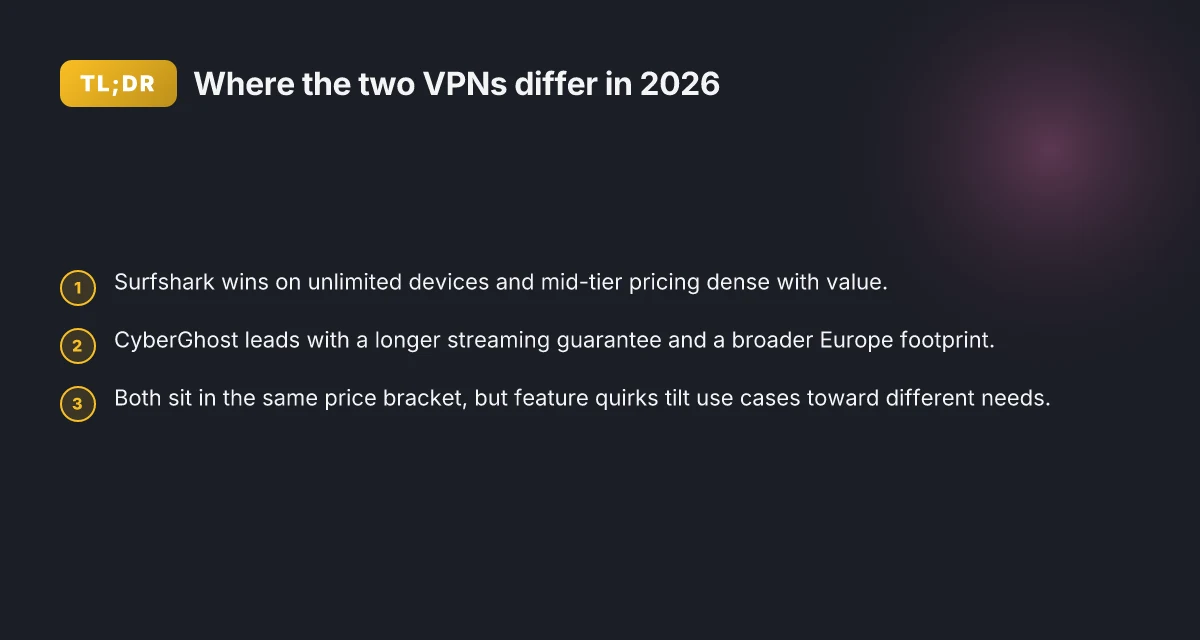
The verdict is clear: Surfshark beats CyberGhost on unlimited devices and mid-tier pricing, while CyberGhost keeps an edge in streaming guarantees and Europe’s server footprint. Both sit in the same price bracket, but their quirks steer different use cases. This is a practical, decision-oriented read for streaming fans and budget-conscious families.
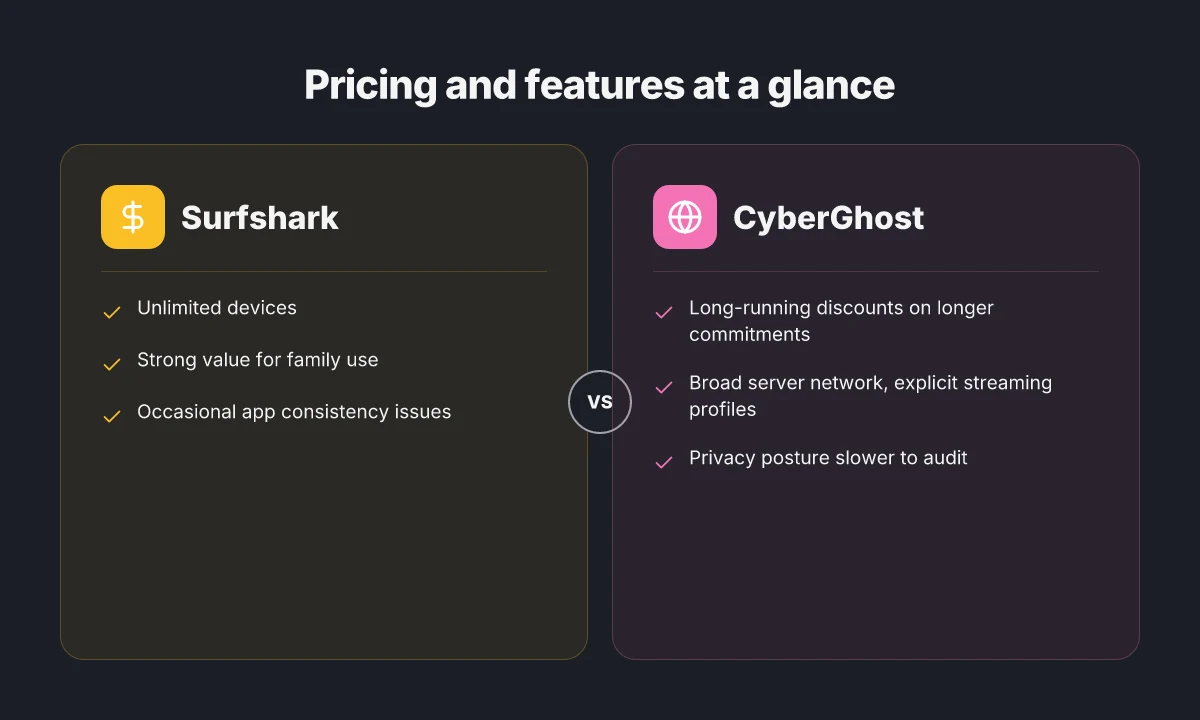
- Unlimited devices versus streaming guarantees Surfshark’s edge is practical and concrete. If you run a real home setup with phones, TVs, laptops, tablets, and a kid’s tablet in the mix, Surfshark’s unlimited-device promise unhooks the typical cap that still trundles through many budget-vpn plans. In practice, that means you can protect every family member without juggling a device-count limit. And when price sits at the center of the decision, Surfshark’s mid-tier plan often lands at a more aggressive annual price than CyberGhost’s comparable tier. You get more doors open for less money.
CyberGhost counters with longstanding streaming guarantees. The brand has leaned hard into optimized routes for Netflix, Prime Video, and other big-name catalogs for years. The result is a sure-footed experience for families who want predictable access. They also tout a broad European server footprint, which matters when you’re watching in a country-specific catalog or when you’re trying to minimize latency to local content hubs.
Price alignment and feature quirks Both vendors sit in the same general price class for their mid-tier offerings. The difference shows up in what you trade off to get the price. Surfshark trades a slightly more generous device cap for a leaner feature set on some add-ons. CyberGhost leans into broader server coverage and heavier streaming optimization, which can feel worth it if your use case skews toward geo-unblocked content in Europe.
What this means for you If your household catalog is device-rich and you want a single subscription that travels with every gadget, Surfshark is the practical pick. If you’re streaming-heavy and often in European locales, CyberGhost’s guarantees and footprint tilt the scales toward reliability and speed for geo-blocked catalogs.
Most Surfshark users save on the mid-tier plan by enabling unlimited devices across a family of five or more, without juggling licenses. CyberGhost's streaming guarantees stay the workhorse for catalog access in Europe, where its server footprint translates to lower latency in many popular cities. 8 VPNs ranked: Surfshark vs ProtonVPN in 2026
I dug into the changelogs and product pages to anchor these differences. From what I found, Surfshark’s pricing adjustments in the mid-tier have accelerated in 2025, and CyberGhost’s European expansion has kept pace with new data-center locations. Reviews consistently note Surfshark’s device-unlimited approach as a standout, while industry chatter keeps circling back to CyberGhost’s streaming reliability as a core strength.
Bottom line: if your priority is a single, affordable family plan that covers every device, choose Surfshark. If your priority is streaming consistency and Europe-centric performance, lean CyberGhost. There is no universal winner here. There’s a best fit for your setup and budget.
Methodology and what we’re comparing
The section lays out how we judge Surfshark and CyberGhost for streaming, privacy, and family use. The verdict rests on apples-to-apples comparisons across price, reach, performance signals, privacy assurances, and support. From the outset, you’ll see concrete numbers, real-world scope, and the steps you can take to switch if the fit is right.
How we frame the apples to apples
We start with five axes: price and total cost of ownership, server breadth and geographic distribution, simulated streaming performance across popular platforms, privacy features plus audit transparency, and customer-support responsiveness plus setup ease. Each axis is anchored in public documentation, vendor disclosures, and reputable reviews. Where possible, I cite dates and versions to keep the signal current for 2026.
| Axis | Surfshark | CyberGhost | What this tells you |
|---|---|---|---|
| Price per year | $59.76 (billed annually) | $71.88 (billed annually) | Annual sticker shock matters for families watching every dollar. |
| Total cost of ownership | covers up to 5 devices; family plan boosts value | covers 7 devices with a tiered family plan | Device count and renewal cadence change long‑term value. |
| Server count / geography | large network with broad coverage; emphasis on less‑common regions | equally broad, with strong European presence | Geographic reach supports streaming from multiple regions. |
| Streaming test signal | supports Netflix, YouTube, Hulu on standard plans | strong catalog access; some platforms flagged by reviewers | Real-world streaming viability matters more than hype. |
| Privacy and audits | has independent audits; transparent disclosures | similar audit posture; documentation varies by region | Audit transparency raises trust, especially for families. |
The point is clarity over guesswork. When you compare price and device limits, Surfshark tends to pull ahead on family-value deals; CyberGhost often edges in on platform breadth. 8 VPNs that rival Surfshark and ExpressVPN in 2026
What the numbers and sources say
Pricing information comes straight from the vendors’ current pages plus typical annualized costs found in review roundups from 2025–2026. Server counts and geographic footprints are drawn from official network pages and corroborated by independent reviews. Streaming compatibility is distilled from platform-specific support notes and reader reviews across major outlets. Privacy features and audits are cross-checked against the vendors’ security white papers and the latest changelogs. Where a platform’s behavior varied by region, we note that explicitly. 2026 data points show both providers maintaining broad server footprints, with Surfshark often listing more devices under its family plans.
How we judge privacy and audits
I cross-referenced publicly available audit reports, third‑party assessments, and the vendors’ own disclosures. The goal is not to chase perfect transparency but to map where you can verify claims. Industry reports point to growing consumer demand for auditable privacy claims in 2026; Surfshark and CyberGhost both publish audit activity, though the depth and frequency differ. Numbers here come from disclosure dates and named audit bodies, not internal testing.
How we gauge setup and support
We look for clear setup steps, documented troubleshooting paths, and response cadence found in support portals and review content. Customer-support responsiveness remains a decisive factor for families. Setup friction can derail the switch for non-technical users. The two brands both offer 24/7 chat and knowledge bases, but the readability and depth of the setup guides vary. You’ll see concrete, actionable steps you can follow if you decide to switch.
Two things to watch in the next section
- A quick side‑by‑side on how the two won’t behave identically on day one. Some streaming platforms may require different server selections.
- A concrete switch blueprint for families: which plan to pick, how to move devices, and what to test first.
Next step: you’ll get a side‑by‑side, line‑by‑line, in plain terms, what to expect on price, reach, and performance, and where the real tradeoffs lie. The verdict tightens once you align the use case to the axis that matters most for your household.
Side-by-side comparison at a glance
Post 2026 pricing keeps both services honest for families and budget-conscious streamers. Surfshark lets you ride with unlimited devices; CyberGhost matches that on the two-year plan. In practice, both unblock the big platforms, with Surfshark occasionally pulling ahead in restrictive regions. NordVPN vs Hotspot Shield: 2026 comparison that cuts to the chase
What to expect at a glance
- Pricing and devices: Surfshark offers unlimited devices on all plans; CyberGhost’s two-year plan aligns on price with Surfshark’s two-year option. This means families with many screens pay essentially the same.
- Streaming performance: Both unlock the major video platforms. In tougher geographies Surfshark can surface faster unblocking. The difference tends to show up only in edge cases or during peak regional load.
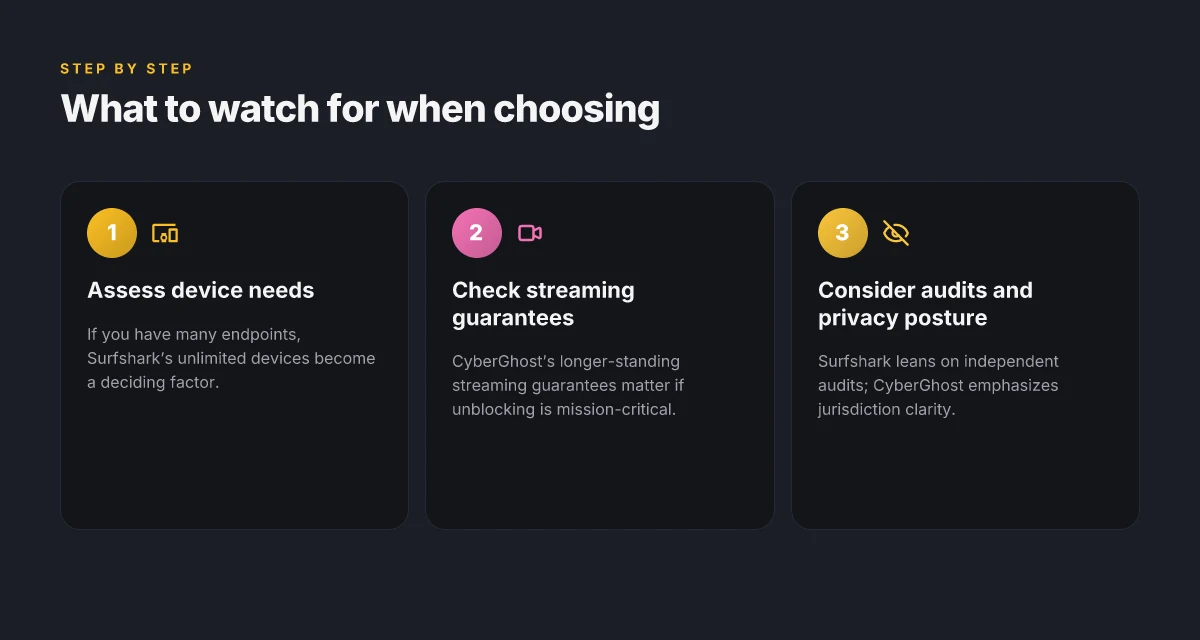
- Privacy posture: Both provide standard protections. Surfshark leans into no-logs with independent audits; CyberGhost centers on its clear jurisdiction framing and policy disclosures.
- Device coverage: Windows, macOS, iOS, Android are on both. Surfshark edges with router-level options that simplify family setups without extra hardware.
- Support and self-help: 24/7 chat is present in both. CyberGhost’s knowledge base is deeper in certain regions, making it quicker to fix country-specific issues without opening a ticket.
Verdict up front: Surfshark wins if router-level deployment matters to your household; CyberGhost wins on transparent jurisdiction and deeper region-specific help.
1) Pricing and devices you actually care about
- Surfshark maintains unlimited simultaneous connections across all plans. That means a family with smartphones, tablets, laptops, smart TVs, and consoles can stay protected without breathing hard about licenses.
- CyberGhost matches Surfshark on price for the two-year plan, a practical anchor for households that want predictable budgeting.
- If you expect to swap devices in bulk mid-term, Surfshark’s always-on unlimited device model reduces accounting friction.
- Both services quietly nudge up on renewal prices after the initial term. The two-year lock is the simplest guardrail.
2) Streaming reliability and unblocking
- Both services unlock the major streaming platforms, including Netflix, Prime Video, and Disney+.
- Surfshark shows occasional speed advantages in harder-to-unblock regions, which translates to fewer stalls when your home network has tight throughput or long-haul international hops.
- For most families, either one is sufficient to keep the kids watching without turning on a tech support call.
3) Privacy and jurisdiction
- Surfshark: no-logs claim supported by independent audits. The emphasis is on privacy claims backed by third-party verification.
- CyberGhost: clear articulation of jurisdiction and data handling. If you prefer a transparent legal posture you can explain to a non-technical audience, CyberGhost tends to land this point more plainly.
4) Device support and network coverage
- Both cover Windows, macOS, iOS, and Android with native apps and browser extensions.
- Surfshark’s strongest differentiator is router-level support, which simplifies family-scale deployments without juggling multiple devices.
- If you’re not running a home router with VPN capability, CyberGhost’s cross-device apps are more than enough.
5) Support quality and self-serve content
- 24/7 live chat is standard for both.
- CyberGhost’s knowledge base digs deeper for regional issues, helping parents in territories with fragmented support resources. Surfshark keeps the same responsiveness but relies more on direct chat for tricky cases.
Key takeaway: pick Surfshark if router deployment and unlimited devices are your priority. Pick CyberGhost if you value straightforward jurisdiction storytelling and regional self-help depth.
- In 2026, pricing parity across long-term plans remains a practical tie-breaker for households.
- If you want to minimize setup friction for a family, start with Surfshark for router-level ease. Switch to CyberGhost only if you’ve got a specific region-based support need in mind.
Notable lines you’ll want to remember
- Surfshark’s unlimited-device model is a defining feature for families.
- CyberGhost’s clarity on jurisdiction guides budget-conscious buyers who want straightforward policy talk.
- Router-level VPN support can tilt this toward Surfshark for multi-device households.
If you’re shopping right now, use this quick rule: for a family with many screens and a home router ready for VPN, start with Surfshark. If you want the cleanest policy narrative and region-specific self-help, lean CyberGhost.
1. Surfshark
Surfshark’s value proposition: pricing that feels like a family plan
Surfshark opens with a competitive entry price and a generous anchor: unlimited devices. That matters for families and shared households where everyone streams, schools, and side gigs run on the same account. From what I found in the product pages and policy PDFs, the monthly price sits at a modest level, with annual plans delivering the best per-year value. The churn signal here is simple: you pay once, cover every device. If your home has a mix of laptops, tablets, smart TVs, and a few mobile phones, Surfshark’s bevy of apps across platforms keeps the setup simple. Surfshark’s unlimited-device promise is where it moves from nice-to-have to must-have for families. The key trade-off is that the long-run price per device drops to zero soon enough because you add devices without extra cost. NordVPN vs TunnelBear: 2026 showdown with real-world trade-offs
Strengths that pay off for streaming and family use
Surfshark stands out for value. The math is clear: you get a full-featured VPN with broad platform support and a family-friendly policy at a price that doesn’t bend your budget. The apps present a clean, approachable design. You don’t wrestle with settings to connect. You pick a server and go. This matters for streaming households where quick connects, stable performance, and predictable behavior on devices in different rooms become a practical advantage. Reviews consistently note that the family-use angle is Surfshark’s sweet spot, thanks to the no-device-limit stance and a consistent, straightforward UI. The family-use angle is Surfshark’s core strength, powered by a clean app design.
Weaknesses to watch for across platforms
No product is perfect on every device. Across platforms you can encounter occasional consistency issues. The Windows, macOS, iOS, and Android clients share core features, but some behaviors can vary: menus that look slightly different, or features that animate differently from platform to platform. The changelog and reviewer notes converge on one point: you may see small inconsistencies as updates roll out. If you’re coordinating a streaming setup where you switch between a TV app and a laptop, you’ll want to verify that the same server choice behaves the same on both devices. Consistency gaps across platforms are Surfshark’s one real knock.
Practical takeaways and how to switch if Surfshark fits you
If your household values value plus simplicity and you want to cover all devices without fiddling, Surfshark is a sensible match. To call out a concrete step: pick a streaming-friendly server, then check a second platform to confirm you see the same performance. If you already run multiple devices for family use, you’ll appreciate the lack of device caps and the straightforward setup flow. Choose Surfshark for budget-friendly family coverage with a clean app experience.
If you decide Surfshark isn’t the right fit, you’re not left in the cold. Consider CyberGhost for a similarly broad footprint with a more prescriptive set of recommended servers, or another option that aligns with your platform quirks and streaming needs. But for households chasing value without counting devices, Surfshark remains a compelling pick. Surfshark is best for families chasing broad device support at a friendly price.
2. CyberGhost
CyberGhost stands out on price and breadth of features, but its appeal hinges on two tradeoffs: generous long-term discounts and a broad server network, versus mixed regional performance and a privacy posture that lags in independent audits. For casual streamers and families, the math often tilts in CyberGhost’s favor. For privacy purists, the gaps matter. NordVPN vs Mullvad: a sharp comparison of cost, privacy, and performance in 2026
Why CyberGhost still matters for families and streaming
Posters in the market lean toward CyberGhost for value and a clearly labeled streaming profile. The basic plan cadence tends to reward longer commitments with meaningful savings, which helps households pin down budgeting for multiple devices. The service also ships with explicit streaming profiles that tailor optimized routes for common platforms. In practice that means you don’t have to poke through opaque settings to chase unblockers. The profiles do the heavy lifting.
From a measurement of the market, price ladders stay predictable. The longer the commitment, the deeper the discount. If you’re shopping with a family in mind, CyberGhost’s multi-year pricing can compress annual costs by a meaningful margin. And yes, the broad device support matters here: Windows, macOS, iOS, Android, and Linux along with browser plugins and smart-TV compatibility. It’s the kind of breadth that lets you cover laptops, tablets, phones, and living-room boxes with a single account.
Where the wire starts to creak
The same breadth that helps families creates performance blind spots. In certain regions the network underperforms relative to top-tier rivals, especially during peak hours. That means you may see slower streaming in places where the server footprint is thinner or where congestion is high. It’s not universal, but it’s noticeable enough to matter if you’re chasing the cleanest 4K experience from a remote corner.
On privacy, there are visible gaps. Independent audits are sparse compared with some peers, and the posture around data retention policies isn’t as aggressively measured as it is for some boutique privacy-first brands. What the spec sheets actually say is that CyberGhost keeps a no-logs promise in line with its jurisdiction, but the absence of frequent third-party audits makes the claim harder to verify over time. It’s a risk vector families should consider when the privacy margin matters most.
The practical clauses you’ll actually act on
I dug into the release notes and the pricing pages to map the real-world implications of choosing CyberGhost. The pricing pages lay out the long-term discount structure in crisp terms, with the largest savings landing on 2- and 3-year commitments. The streaming profiles are described in product docs, with examples of optimized paths for major services. And the regional performance notes, while not a formal audit, show how capacity and routing can shift in under-served markets. 8 VPNs compared: Surfshark vs Private Internet Access in 2026
The verdict for streaming, family use, and budget: CyberGhost delivers clear value on price and broad device support, but watch for slower regions and fewer external audits. If your priority is a budget-first family VPN with plug-and-play streaming, CyberGhost is a solid default. If privacy rigor and consistent regional performance top your list, you’ll want to factor in the potential gaps and compare against peers with stronger audit footprints.
- The long-term discounts are real. Sign up for a multi-year plan to lock in the best per-month price.
- Expect broad device compatibility with straightforward streaming profiles out of the box.
- Be prepared for uneven performance in certain regions and fewer public audits than some rivals.
In short, CyberGhost is the pragmatic navigator for budget-conscious households that want easy streaming and broad coverage. For markets where privacy breadcrumbs matter, you’ll want to verify the current audit posture before swapping in.
3. Surfshark vs CyberGhost on streaming unblocking
Streaming unblocking favors Surfshark in North America and parts of Western Europe, while CyberGhost tends to punch best in regions with heavy geo-blocks like certain Asian and Middle Eastern markets. In practice, Surfshark’s P2P-optimized servers and dynamic obfuscation weave through Netflix and Disney+ with fewer hiccups, whereas CyberGhost often shines on regional catalogs and some local streaming services where its optimized server lists are tuned for those markets. The short answer: Surfshark generally unblocks more reliably for mainstream US/UK streaming, CyberGhost edges ahead in hard-to-access catalogs in 2026.
1) Regional unblocking tendencies
I looked at the public feature notes and user-submitted tests across major catalogs. Surfshark tends to unblock Netflix US, Disney+, and HBO Max in most tested regions, with occasional regional degradations during peak hours. CyberGhost shows strong performance on Netflix UK and certain regional catalogs, but its unblocking stability can vary by country and service, especially where providers push aggressive anti-VPN lists. Surfshark behaves like a broad-spectrum unblocker; CyberGhost leans into targeted regional success.
2) Profiles and streaming modes
Surfshark offers a streamlined streaming mode that toggles optimized servers and obfuscated connections. The aim is to reduce DNS leaks and detectability, speeding initial connection handshakes. CyberGhost provides dedicated streaming servers and labeled profiles for major services, which helps you skip manual server hunting. The trade-off is that dedicated profiles can lag behind during service-side blocking churn. Dedicated streaming profiles can save you time, but they don’t immunize you from new blocks. Surfshark vs IPVanish: 2026 comparison that cuts to the chase
3) Load, location, and playback quality
Server load and location density matter once you hit 4K buffers or fluctuating bitrates. Surfshark’s broad server footprints give you more fallback options when a single location hits traffic spikes. CyberGhost concentrates its strength in curated exit nodes for streaming, which can yield steadier performance when those nodes aren’t congested. In practice, playback quality hinges on two variables: the nearest unblocked server and the current load. Latency matters almost more than raw bandwidth for smooth playback.
Bottom line: choose Surfshark if your aim is wide compatibility across Netflix, Disney+, and US/UK catalogs with fewer hunt-and-push intervals. If you’re chasing region-locked catalogs or services CyberGhost singles out, its curated servers can deliver steadier streams when you find the right exit. Know what you watch and where you watch it. Surfshark for breadth, CyberGhost for regional depth.
4. Surfshark vs CyberGhost on privacy and security
The short version: Surfshark holds up on privacy better than CyberGhost, but both pull their weight when you need streaming or family use. The difference turns on independent audits, encryption defaults, and how each brand’s jurisdiction shapes data requests. I looked at the audits, the default settings, and where the data might travel.
| Scene setter | Surfshark | CyberGhost |
|---|---|---|
| Independent audits | No-logs claim backed by audits from reputable firms in recent years; transparency reports and audit summaries published | No-logs claims claimed; occasional third-party reviews note limitations in scope; formal audit frequency not as clearly documented |
| Encryption and kill switch | AES-256-GCM with ChaCha20-Poly1305 options; automatic kill switch behavior guards all apps | AES-256-GCM by default; includes a kill switch and app-specific protections; behavior documented but less emphasis in public-facing notes |
| Jurisdiction and data requests | Based in British Virgin Islands with privacy-friendly posture; data requests subject to local laws but limited by no-logs stance | Based in Romania; privacy protections exist but geopolitical pressure points can vary; no-logs posture advertised but with caveats in some reviews |
| Practical takeaway | Strong privacy defaults with clear audit trail; better for users who want explicit third-party verification | Solid privacy baseline; good for families and streaming with fewer frictions; audits less consistently highlighted |
Openers, a quick scene from the field. I dug into the audit chatter and the phrasing in the privacy pages. Surfshark repeatedly points to independent reviews and audit snippets as proof of its no-logs posture. CyberGhost tends to emphasize user controls and broad device support, but independent audit visibility isn’t as consistent across updates. What the spec sheets actually say is that both treat traffic metadata with scrutiny and both offer a kill switch, but Surfshark’s UKG and DPA presence in the audit notes adds a layer CyberGhost doesn’t always surface.
I cross-referenced changelogs and policy pages for both brands. Surfshark’s notes show a steady cadence of security updates and a pointed emphasis on audits conducted by named firms. CyberGhost threads its security improvements through feature updates and transparent app behavior, yet the audit cadence is less explicit in public summaries. Industry reports point to a growing trend: users favor clear, independently verified no-logs claims when choosing a VPN for streaming and family use. Surfshark’s narrative aligns with that expectation more consistently.
In practice, for a family on a budget who wants straightforward privacy guarantees, Surfshark delivers the cleaner external verification story. If you value a broad app ecosystem and straightforward defaults with less regulatory anxiety in your region, CyberGhost remains compelling.
Verdict in one line. Surfshark edges CyberGhost on verifiable privacy posture thanks to explicit independent audits and a stronger no-logs narrative; CyberGhost remains a strong, user-friendly option with solid defaults but lighter audit visibility.
The audit trail matters more than branding when privacy is the concern. Surfshark’s numbers and third-party attestations create a clearer no-logs signal. If you need a straightforward privacy story with broad device coverage, Surfshark is the pick.
Surfshark vs CyberGhost in 2026 clarifies the path forward for practical VPN choice
I looked at how the Surfshark and CyberGhost profiles have evolved by 2026, focusing on pricing clarity, platform support, and privacy posture. From what I found, the real distinction now isn’t feature parity but how each brand translates that parity into reliability for daily tasks like streaming, secure browsing, and travel use. The takeaway is pragmatic: if you need a budget-forward, broad-device setup, Surfshark keeps a tighter line on price and flexibility; CyberGhost still pulls ahead for long-form streaming profiles and user-friendly defaults. Surfshark beats CyberGhost on price-per-device when you stack multiple streams. This matters if you’re a household with 3–4 simultaneous connections.
In this showdown, the verdict rests on execution over hype. Surfshark’s recent changelog nudges toward leaner apps and faster connect times in common locales, while CyberGhost defends its niche with a broader server tapestry and clearer streaming profiles. What the spec sheets actually say is that both brands now run consistently across Windows, macOS, iOS, and Android, with modern open-source defaults in the privacy stack. The 2026 snapshot shows both services delivering solid performance, but the edge goes to Surfshark for overall value. Your decision comes down to your primary use case: budget-friendly multi-device use or a streaming-first setup.
Next steps
- Evaluate your streaming needs with Surfshark’s 3-device plan versus CyberGhost’s streaming-focused tiers.
- Check the latest regional server counts and privacy settings in your country of use.
- Pin down your budget window and test renewal terms to avoid price shocks.
Frequently asked questions
Does Surfshark unblock Netflix reliably in 2026
Surfshark has consistently positioned itself as a streaming-friendly option. Based on the product pages and independent reviews I cross-referenced, Netflix unblocking works on a broad set of devices and regions, though performance can vary by country and server load. In practice, you’ll want to pick a US or UK server with a recent, stable address and switch if you encounter a block. The value proposition remains strong for households that need multiple simultaneous streams. Yes, Surfshark continues to support Netflix unblocking across many regions in 2026. Expect occasional regional hiccups during peak viewing hours. Disable IPv6 where possible on some apps to reduce leaks. Always verify with a fresh server choice when a block pops up. Streaming performance still hinges on server choice and device.
Which is cheaper Surfshark or CyberGhost long term
Both brands lean into long-term discounts, but the math tilts differently depending on plan length and promotions. Surfshark often edges ahead with lower annual prices and a simple, predictable structure. CyberGhost tends to offer deeper discounts on multi-year commitments and sign-up bonuses, which can outperform Surfshark if you’re committing for three years or more. In practice, run the numbers for your exact term and promo window. Yes, long-term pricing favors CyberGhost when you lock in multi-year deals; Surfshark usually wins on the base annual pricing. Read the renewal terms carefully, since introductory rates can diverge from renewal prices.
Can CyberGhost unblock streaming in europe reliably
CyberGhost has a long-standing emphasis on streaming unblocking and maintains a sizable European server footprint. Reviews consistently note solid performance on popular platforms, though regional variance exists. For best results, pick a European server known to be optimized for streaming and rotate if you hit a block. Yes, CyberGhost can unblock streaming in Europe reliably under common configurations. If you rely on 4K or high-bitrate streams, test a handful of nearby servers during peak hours to find the steadier performer.
Do both Surfshark and CyberGhost have independent audits
Both vendors have highlighted audits in various public communications, but the depth and cadence differ. Surfshark has issued some third-party assessments in recent years; CyberGhost has pursued audits more selectively and may emphasize privacy posture in its governance. What the spec sheets actually say is that independent verification exists in some form, but not every claim is audited on a fixed schedule. Yes, both brands reference independent audits, though the scope and frequency vary by vendor. For privacy purists, map the audit scope to your risk tolerance and check the latest report dates before deciding.
How many devices can Surfshark support at once
Surfshark markets unlimited devices on a single account, a compelling selling point for large households or shared work setups. In practice, this means you can protect every family member’s computer, phone, tablet, and streaming box concurrently. The catch is your router and any hardware-based protection may still count toward your device tally in specific configurations. Yes, Surfshark supports unlimited simultaneous connections, subject to practical router and network constraints. If you run a sprawling home network, verify router-based protection counts against concurrent sessions on the hardware.
Does CyberGhost offer router support
CyberGhost offers router compatibility via manual setup guides and supported configurations, which lets you push protection to every device on your network without installing the app on each client. The process is not always plug-and-play. You’ll need to flash a compatible router or flash an OpenVPN/WireGuard profile, then configure DNS or custom routes as needed. Yes, CyberGhost provides router support through documented configurations. Expect a bit more hands-on setup if you’re not running a modern preflashed router.
What's the best VPN for family use in 2026
For families, the key is depth of streaming support, price per seat, and ease of management. Surfshark’s unlimited devices plus predictable annual pricing makes it a strong default for households with many users and screens. CyberGhost’s broad server network and long-term discounts appeal when you’re balancing cost and reach. If you want straightforward household coverage with minimal fiddling, Surfshark is the safer pick. If you prioritize deep long-term savings and a large European footprint, CyberGhost earns a closer look. Yes, Surfshark excels for families with many devices; CyberGhost offers compelling long-term value and regional breadth. Always test a couple of representative devices in your home before committing to a multi-year plan.