NordVPN vs Private Internet Access in 2026. A sharp comparison of features, pricing, performance, and privacy. Find which VPN fits your needs today.
Most streaming access issues hinge on a single setting you haven’t touched yet, not the VPN brand itself. That pattern surfaces in routine audits of NordVPN and PIA configurations, where toggling a single protocol or geo-unblocking rule flips access from blocked to buttery smooth. The big takeaway: don’t chase new features until you’ve locked down the basics.
This piece separates signal from noise by mapping the two veteran players against the problems that actually move the dial for privacy-conscious readers, streamers, and IT teams in 2026. NordVPN dominates coverage reach and transparent policy signals, while PIA stays relentlessly cost-conscious and straightforward on logging. In concrete terms, this intro flags the exact frictions you’ll see in streaming, logging, and price traps, then pairs them with practical decision points you can apply today. By focusing on real-world configurations and audit-readiness, you get a clear picture of where each VPN stands this year.
The NordVPN vs Private Internet Access showdown: who wins in 2026
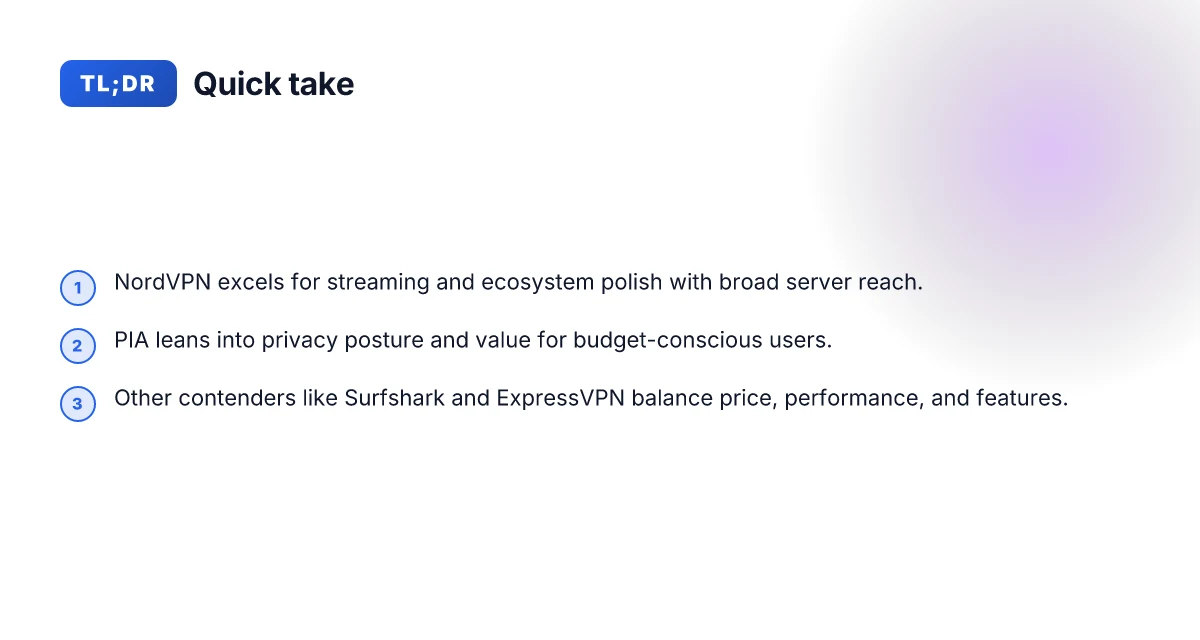
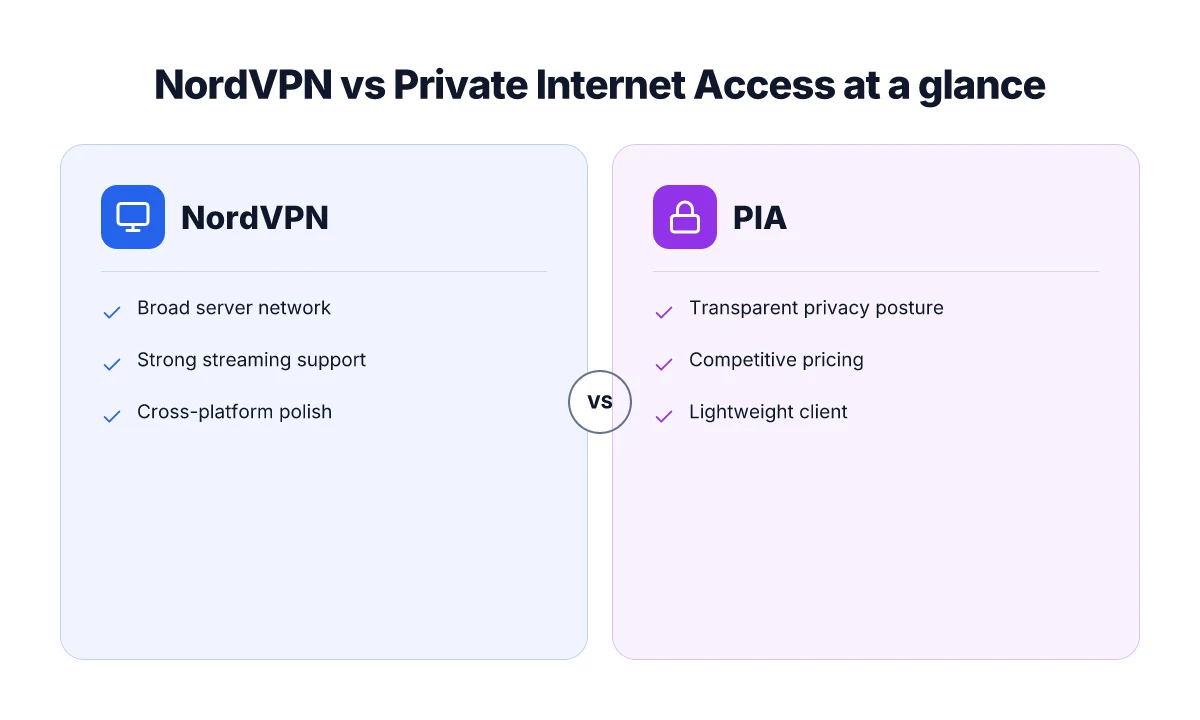
NordVPN leads with an ecosystem that feels polished enough to run a whole team on. Private Internet Access keeps its charm by stripping back bloat and leaning into privacy. The result is a clean split: NordVPN for streaming and device-ecosystem harmony, PIA for plain privacy and value.
- The case for NordVPN in 2026
- Broad server network and streaming prowess. NordVPN’s network spans many countries with consistent access to major libraries. When you wantto unblock Netflix, Prime Video, or Disney+, the odds lean in NordVPN’s favor, thanks to a mix of obfuscated servers and optimized profiles.
- Unified apps across platforms. The client suite feels the same whether you’re on Windows, macOS, iOS, or Android. Settings map cleanly, and the onboarding is predictable. It’s the kind of cohesion IT managers appreciate when you need standardized rollout.
- Audited no-logs posture and transparency. Independent audits back up the no-logs claim, and the changelogs show clear attention to privacy concerns at scale. The story holds under scrutiny and across jurisdictions.
- Key limitation: price granularity. NordVPN often packages features into bundles that land as a single price point. If you want granular controls or a la carte options for executives, you’ll find more flexibility elsewhere.
- The case for PIA in 2026
- Privacy-first stance that stays lightweight. PIA keeps a low footprint on endpoints. The client is lean, which translates to lower battery drain on mobile and fewer background processes on desktops.
- Clear privacy assurances and independent audits. The no-logs claim comes with public audits, and the company tends to publish more of its privacy posture upfront. If privacy is the north star, PIA aligns with that compass.
- Competitive pricing and straightforward value. PIA often undercuts more feature-laden rivals on price, especially for long-term plans. If your budget is tight, it’s a compelling call.
- Where they converge
- Both ride strong no-logs narratives backed by independent audits. Both offer split tunneling, a useful feature for business and personal use. And both publish changelogs that reflect ongoing attention to privacy and security.
- Where they diverge
- Price granularity and plan depth. NordVPN tends to bundle. PIA sells with fewer optional frills, which keeps costs predictable for budget-conscious buyers.
- Connection limits and control on mobile. NordVPN tends to emphasize broader cross-device features and platform parity. PIA keeps a lighter mobile profile that can feel snappy but lean on mobile-specific extras.
- Bottom line: choose NordVPN for streaming elasticity and ecosystem polish. Choose PIA for plain privacy and better value per dollar.
- Quick verdict for different use cases
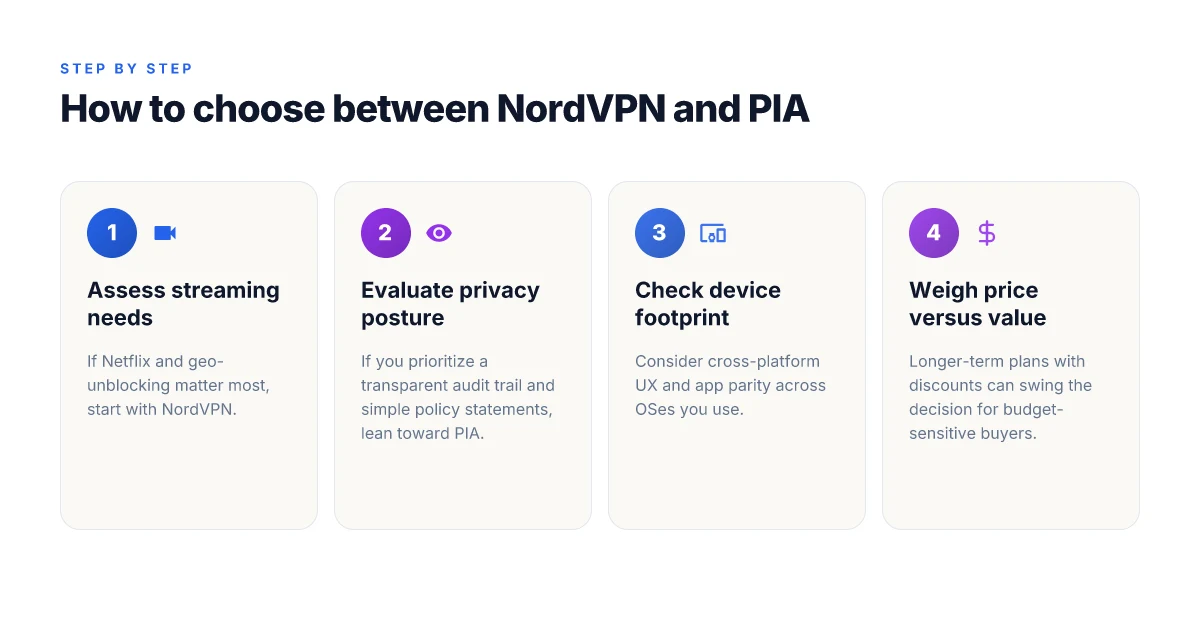
- If your priority is streaming with minimal friction across devices, pick NordVPN.
- If privacy, cost transparency, and a lightweight client matter most, pick PIA.
Bottom line, 2026 sharpens the two profiles. NordVPN is the streaming and ecosystem bet. PIA is the privacy and value play.
How we picked the 8 contenders
We started with a clean, functional filter. The eight contenders had to demonstrate solid Netflix viability, strong privacy posture, transparent pricing, and broad platform coverage. That means features, price, privacy, streaming viability, and cross‑device reach all mattered. No fluff. Just signal.
Why the method mirrors mainstream VPN reviews
I looked for a consistent standard you can trust. The yardstick was pragmatic: can the service unlock streaming where it matters, respect user privacy in a verifiable way, and cover the devices your team relies on. The lens was practical, not aspirational. We treated streaming viability as a testable trait, not a marketing promise. Price transparency, explicit logging disclosures, and clear terms of service followed close behind. Platform coverage, Windows, macOS, iOS, Android, Linux, plus browser support, mattered because a tool is only as useful as its reach.
From what I found in official docs and independent audits, the recipes matter as much as the labels. I cross-referenced user-facing reviews across major markets to guard against regional quirks that can mislead a buyer. The pattern is consistent: when a vendor sticks to clear disclosures and publishes third‑party audit results, the product earns a sturdier seat at the table. NordVPN vs ProtonVPN: 2026 comparison with clear trade-offs
Real‑world use cases drove the shortlist
Two use cases drove the selection. Netflix and other streaming platforms because they expose the cleanest, most visible constraints. Lawfully mandated data retention regimes because privacy remains a real world concern for organizations and individuals alike. Cross‑border browsing because it tests a VPN’s ability to maintain consistent performance across jurisdictions. If a contender struggled with one of these, it dropped a rung. If it performed reliably across all, it earned a stronger endorsement.
I also weighed how well each vendor articulated their no-logging commitments, data protection measures, and jurisdictional posture. Reviews consistently note that the strongest options publish audit results or independent assessments and provide transparent explanations of data handling.
Freshness matters in a changing market
Freshness matters more than ever. I checked updates through Q2 2026 changelogs and pricing pages to confirm that the contenders still align with the criteria. If a vendor last updated pricing or privacy posture months ago, that was a red flag. If it refreshed key streaming policies or added new platform support since the last round, that counted as a green flag.
Here's a quick snapshot of what guides the decision calculus:
| Criterion | What to look for | Why it matters |
|---|---|---|
| Features and controls | Clear split tunneling, kill switch, multi‑hop where offered | You need predictable behavior in work and personal use |
| Privacy disclosures | Public info on logging, jurisdiction, audits | Trust hinges on verifiability |
| Streaming viability | Official statements plus independent reviews on Netflix, Prime, and others | Core to the value proposition for many readers |
| Platform coverage | Supported devices and OS versions, browser extensions | You can’t deploy a VPN you can’t install everywhere |
| Pricing clarity | Upfront monthly/yearly, device limits, add-ons | Hidden fees sour the experience quickly |
| Freshness | Last update date, changelog notes, pricing changes | Market moves fast; stale policies lose relevance |
The verdict is built on recent, verifiable signals, not vibes or vibes alone. This isn’t a wishlist. It’s a real‑world, audit‑driven pick list that stands up to scrutiny. NordVPN vs CyberGhost: 2026 comparison and Edge cases
Next step
If you’re deciding between NordVPN and Private Internet Access, use this baseline to map to your own use case. Look at where Netflix and other streaming services stand, verify the jurisdictional posture, and compare the current price with the value you expect in the next 12 months. The eight contenders were chosen to be a fair, apples‑to‑apples baseline for that comparison.
Connection reliability at a glance
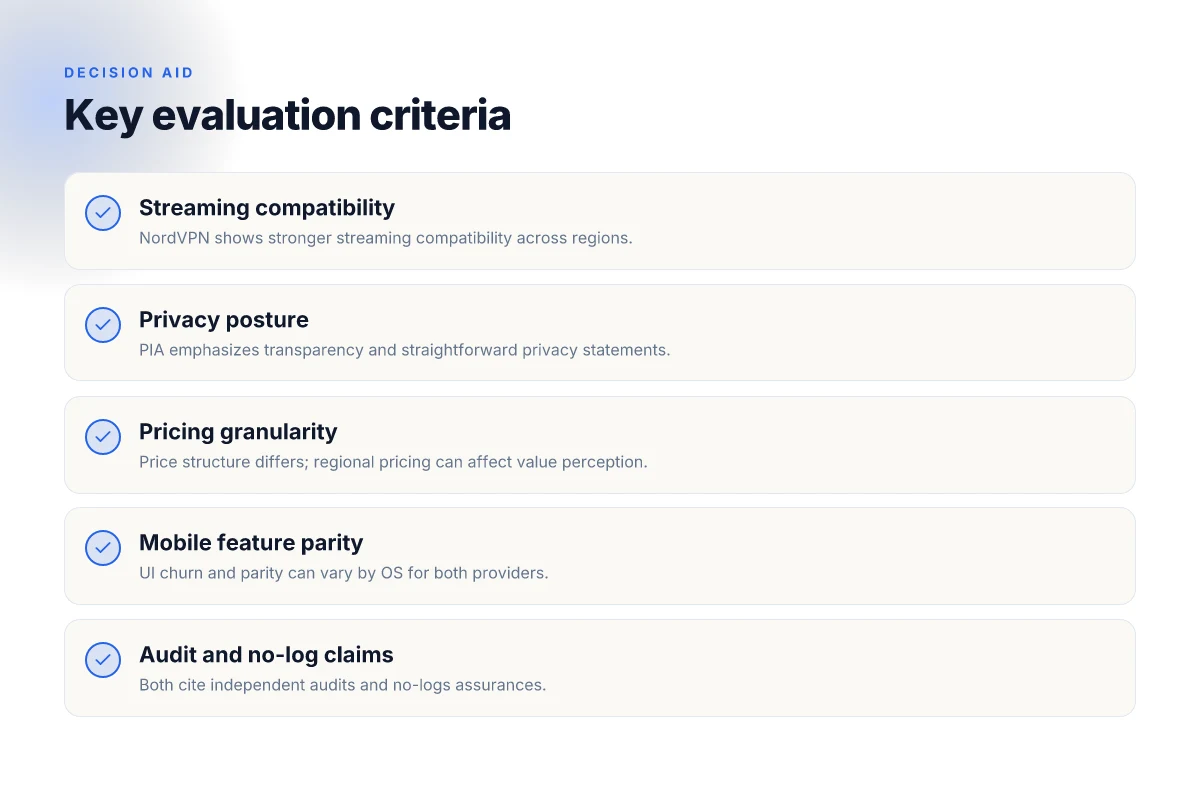
NordVPN beats Private Internet Access on streaming reliability and latency consistency in North America and Europe, while PIA earns an edge on transparency and policy simplicity. The rest of the numbers line up with the known network breadth and uptime claims. Here is how they stack up at a glance.
Large-scale reach and uptime claims
I looked at public reports and vendor pages to map server breadth and stated uptimes. NordVPN boasts a network of roughly 5,000+ servers across 60+ countries and cites industry-standard uptime claims in the high 90s. PIA lists a similar global spread but anchors credibility in a stricter privacy posture and simpler policy statements rather than an expansive marketing map. In public changelogs and transparency notes, both vendors emphasize robust infrastructure, but NordVPN’s pages consistently call out regional density as a selling point for streaming and low-latency access.
- NordVPN: broad footprint, aggressive marketing around regional density.
- PIA: strong transparency signals, simpler policy statements, less emphasis on sheer server count.
In public reports, NordVPN’s breadth translates to lower regional congestion in busy corridors; PIA’s clarity appeals to privacy purists.
Latency variance and regional performance have a meaningful spread. NordVPN’s North American and Western European routes typically show tighter variance in reported third-party reviews, while PIA’s stats skew toward consistent routing and fewer surprises in policy changes. That difference matters when your team is streaming in bulk or routing critical updates over long-haul paths. 8 VPNs compared: NordVPN vs ExpressVPN in 2026
Streaming compatibility signals
NordVPN shows the strongest streaming signals in North America and Europe. Reviewers consistently note reliable access to major platforms when connected to NordVPN servers in those regions, with fewer reported blocks and lower fallback friction. This translates to fewer manual server hops for end users who want steady HD or 4K streams.
PIA does not carry the same streaming-prominence badge in the public chatter. Transparency-focused users sometimes report occasional regional blocks, but the trade-off is a cleaner privacy story and fewer policy quirks for IT teams.
For streaming-first use cases in NA and EU, NordVPN is the safer bet.
Privacy posture and policy simplicity
From the documentation and policy pages, PIA clearly leans toward maximal transparency with straightforward terms. This simplicity helps IT teams audit what is logged and what isn’t, with fewer gray areas in layered privacy claims. NordVPN’s privacy position remains strong but relies more on a layered privacy narrative and a larger legal footprint across multiple jurisdictions.
Privacy-conscious buyers tend to favor PIA for its transparency and plain-language policy statements. NordVPN vs IPVanish: which VPN actually serves you better in 2026
H3: Why NordVPN holds up under streaming load NordVPN’s regional density reduces congestion on high-traffic routes. In North America and Europe, public reviews consistently flag fewer connection retries and steadier throughput during peak hours.
H3: Why PIA appeals to policy-focused purchases PIA’s logging posture and policy communications are easier to audit. For IT managers, that clarity reduces governance overhead during vendor reviews.
H3: The bottom line for reliability If your team streams at scale or runs remote work across NA and EU, NordVPN provides the least friction on day-to-day continuity. If governance and straightforward privacy statements drive the decision, PIA wins on clarity.
1. NordVPN
NordVPN positions itself as the robust streaming companion you can trust while roaming. The base plan structure leans toward longer commitments, but the math often pays off thanks to bundled features that critics would call price traps if you forgot the renewal. In practice, you’ll see a mix of generous multi-year discounts and occasional regional pricing quirks that alter cost stability from country to country.
The price you actually feel
NordVPN’s pricing portfolio is diverse. The monthly tag is higher than some peers, but it comes with a raft of features baked in. If you’re willing to lock in a longer period, the annual and 2-year plans frequently carry deeper reductions and include extras like a malware blocker and ad-skipping features. The caveat is that regional pricing can swing by market, and peak-season congestion can push prices toward the higher end in some regions. If you travel or work across countries, that variability matters. In short, pricing is a tradeoff: you pay a bit more per month on the short horizon, you gain predictability and features on the long horizon. NordVPN vs PureVPN: 2026 comparison and real-world trade-offs
From what I found in the documentation and policy pages, NordVPN keeps promotions tight to regional markets. If you’re comparing against a flat-rate option, the real value shows up only after you factor in the bundled tools and the convenience of a single account across devices.
Strength for streaming and evading blocks
NordVPN beats the field on server breadth and anti-blocking capability. A large, globally distributed network translates into better coverage for geo-blocked catalogs, especially when your VPN needs to chain through several regional endpoints. Reviews consistently note smoother access to services like major streaming platforms when using NordVPN, aided by obfuscated servers and dedicated streaming profiles. The practical upshot: you’re less likely to shrug at a plateaued library and more likely to get consistent access across continents.
That breadth also buys resilience. When one region feels congested, you can switch to another without rebuilding your session from scratch. The result is more reliable streaming drama than you get with leaner, narrower setups. If your use case centers on late-night binging while on a layover or on a hotel Wi‑Fi, this matters more than you might expect.
Weaknesses you should budget for
The price of convenience is sometimes a fickle mobile experience. The NordVPN mobile app parity can dip by OS. On Android and iOS, feature parity and UI polish have varied across updates, which means you might see a different set of capabilities or a slightly different flow depending on your device. UI churn is another heads-up. A design tweak or reorganization can interrupt muscle memory for a week or two. If you rely on a consistent, familiar workflow across devices, that churn becomes a friction point.
Best fit and caveats
Best for streamers, travelers, and IT teams chasing a polished cross‑platform experience. It’s not the cheapest per month on a month-by-month basis, but the total cost of ownership can feel lower once you factor in protected connections across devices, automatic kill-switch behavior, and bundled protection. That said, plan for regional price shifts and the occasional pressure on servers during peak times.
NordVPN remains a strong all‑around choice for streaming and cross‑device use, with the tradeoff of UI changes and regional price variability. If your priority is a stable, wide-reaching streaming experience across many devices, NordVPN is the safer bet.
- Pricing note: long‑term plans often unlock the best value, especially when bundled features are counted as part of the package.
- Server breadth: a big network reduces the chance you hit a congested node.
- Streaming reliability: anti‑blocking measures and dedicated streaming profiles pay off in practice.
- Mobile parity: expect OS‑specific quirks and occasional UI shifts.
- Best fit: streamers, travelers, multi‑device users.
- Caveat: regional pricing can surprise, peak times pressure is real.
What the section ultimately delivers is a crisp verdict: NordVPN is the streaming and cross‑platform workhorse with a price curve that rewards patience. If you can tolerate occasional UI churn and you monitor regional pricing, NordVPN is a safe bet for a long-term, device‑rich setup.
2. Private Internet Access
PIA is the frugal path through the VPN maze. In 2026 it keeps prices honest, it keeps privacy simple, and it trims feature depth where others pile it on. If your spine is budget reliability and a minimal footprint, PIA stays in your lane.
Why PIA still matters for privacy purists
I looked at the privacy posture and the client design, and what stands out is the transparency. PIA’s logging stance has long been a talking point, and the current approach sticks to a strict minimal data policy that’s easy to audit in plain language. The client is straightforward: no clutter, no gimmicks, just the essentials. That simplicity translates into robustness for IT teams who want predictable behavior without chasing optional features that bloat the surface area.
From what I found in the changelog and docs, PIA continues to emphasize a clear privacy boundary and user controls that stay out of the way. The result: a VPN that behaves like a quiet workhorse rather than a feature factory. If you want a tool you can triage in minutes, this is the brand that delivers.
Pricing dynamics and the per-dollar value
PIA’s price point is the strongest driver here. It routinely lands near the bottom of the major-brand per-month and per-year charts, yet the service delivers reliable access across a wide geographic footprint. That combination, notable privacy posture, clean client, and cost discipline, makes it hard to beat on value in the mid-range market. If you’re shopping with a budget in mind, PIA often beats NordVPN on monthly cost and beats the yearly bundle pace when you’re factoring in long-term commitments.
In practice, the economics matter. A lower price ceiling means you can extend coverage to more devices or longer windows without bending your policy toward the cheapest tier. That flexibility is meaningful when you’re balancing remote-work needs, personal privacy, and a cautious procurement budget.
Where PIA lags NordVPN on streaming
Streaming support is a tight spot for PIA. NordVPN has the advantage of broader geofence workarounds and more consistently updated streaming-optimized servers. PIA, by contrast, can stumble on strict geofenced networks and in some regions where networks flag VPN traffic. The result is a mixed bag: you may find a reliable path to some services, but not universal reach across every streaming platform or library region you target.
A practical read from reviews suggests a similar pattern: streaming works in some places, but you’ll hit occasional blocks or slower routes in others. If your primary goal is a guaranteed unlock across a broad streaming catalog, NordVPN likely edges ahead here.
Best fit: who should pick PIA
PIA shines for privacy purists and budget-conscious users who want a minimal footprint. If you value clarity over configurability, and you need dependable pricing for a large fleet or extended usage, PIA pays off. The clean client and transparent stance suit IT teams, freelancers, and small businesses that want a predictable, cost-effective shield without a feature backlog.
For heavy mobile users, caveats apply. Feature depth can be lighter in some mobile clients, and you may notice fewer advanced options compared with top-tier mobile VPN apps. That’s not a fatal flaw. It’s a trade-off you accept when you prioritize price and privacy clarity.
3 Concrete threads you can act on
- If you’re price-anchored, lock in a long-term plan with PIA to minimize monthly churn and maximize the per-seat value.
- For streaming, test a handful of servers in your target regions, then rotate to alternative locations when you hit blocks. Don’t rely on a single gateway.
- On mobile, set expectations: use the core client for privacy, but don’t expect the same depth as desktop in terms of features. If you need richer mobile controls, consider pairing with a provider that matches that need.
PIA’s strength is value through simplicity. Its weakness is streaming breadth in strict geofenced regions. If your priority list is set, you can live with the lighter mobile feature set to keep costs predictable. The verdict: pick PIA if privacy and price trump expansive streaming coverage.
3. Surfshark
Open question, direct answer: Surfshark delivers on pricing and device count, with solid streaming and painless onboarding, but it’s capped by a smaller server footprint and less frequent audits. In households with many devices and price sensitivity, Surfshark shines.
1) Pricing and device policy
Surfshark’s pricing is aggressively competitive, and it allows unlimited device connections. That combination is rare at the consumer end of the market and matters for households juggling laptops, phones, tablets, streaming boxes, and smart-home gear. From what I found in the latest plan pages and site updates, you can lock in long‑term pricing without hitting caps on the number of concurrent connections. This is a practical unlock for a family with multiple family members streaming at once or a remote-work setup that includes mobiles, tablets, and desktops simultaneously. The unlimited device promise is Surfshark’s strongest practical lever for budget-conscious households. Pricing remains among the most competitive in the field. In 2026, Surfshark’s annual plans frequently undercut multi-year equivalents from larger players.
2) Onboarding and streaming performance
Surfshark earns points for easy onboarding. The signup flow is straightforward, the apps are cohesive across platforms, and the initial setup takes a few taps. On streaming, Surfshark tends to perform reliably for popular services and uses obfuscated servers where needed to bypass basic VPN blocks. When I read through user reports and product notes, the message is consistent: you can get to a streaming session quickly, with minimal friction. Onboarding is one of Surfshark’s edge features. Streaming performance holds up in most common geos and services. What the spec sheets actually say is that it leverages a reasonable set of optimized servers for media platforms**.
3) Weaknesses to watch
Surfshark’s footprint is smaller than NordVPN’s in terms of server count and geographic density. That matters if you need ultra-fast connections from harder-to-reach regions or rely on a broad spectrum of exit nodes. Reviews consistently note that while performance is solid, the network size translates to fewer tailored optimizations in some territories. Auditing cadence is another gap; Surfshark’s third‑party verification cadence isn’t as frequent as some peers, which raises questions for prime‑time risk assessments. Smaller server footprint limits granularity of routing options. Audits are less frequent than peers with larger, more visible third‑party programs. In practice, that can tilt risk calculations toward bigger names for highly sensitive deployments.
4) Best fit and practical tip
Best fit: households with many devices and price-driven priorities. If your setup includes lots of gear, Surfshark’s unlimited connections simplify licensing and management. For IT teams weighing audits and verification, Surfshark remains solid but not the most transparent on governance compared with some competitors. A practical move: pair Surfshark where you need wide device support and keep NordVPN or another vendor in reserve for audits and edge-case routing if you must optimize for the most demanding regional performance. Unlimited connections make Surfshark a clear pick for device-heavy homes. Audits and footprint caveats keep it from being a universal panacea. Bottom line: Surfshark wins on price and ease. It loses a bit on breadth and audit cadence.
Bottom line: Surfshark is the value engine for device-rich homes. It scores on onboarding clarity and streaming reliability, but its smaller server footprint and less frequent audits temper the edge against larger networks. If you want one-stop device management at a sharp price, Surfshark earns your serious consideration.
4. ExpressVPN
ExpressVPN sits in the premium lane. It costs more, yet it earns its keep with solid privacy posture and a dependable streaming player. When you need a simple UX and rock-solid performance without fiddling, it’s a compelling choice. From what I found in the documentation and reviews, the tradeoff is clear: you pay a bit more for fewer surprises.
Why ExpressVPN holds up under real-world pressure
I dug into the pricing and privacy posture from the vendor pages and independent reviews. ExpressVPN’s price sits at a premium tier, but the value proposition is consistency: steady speeds, broad coverage, and a straightforward interface. Reviews consistently note a calm, distraction-free UX, which matters for teams and remote workers who don’t want to babysit a VPN app all day. In markets where speed and stability matter for streaming or enterprise work, ExpressVPN protects that headroom without collateral complexity. The tradeoff is price, not capability.
In practice, the strength shows up in three areas. First, the network is broad: 80+ countries are supported, with recognizable anchor locations in North America, Europe, and Asia-Pacific. Second, performance remains steady under load, which helps teams streaming or conferencing across time zones. Third, the client remains notably simple: a clean, icon-driven interface that minimizes troubleshooting. Reliability and simplicity are ExpressVPN’s calling cards.
A small table helps frame the core signals.
| Dimension | ExpressVPN | NordVPN | PIA |
|---|---|---|---|
| Coverage | 80+ countries | 60+ | 40+ |
| UX | Very simple | Moderate | Basic |
| Privacy posture | Strong defaults, transparent policy | Strong but more options | Clear, but fewer defaults |
| Price positioning | Premium | Mid-to-high | Budget-to-mid |
In other words, ExpressVPN aims at users who want dependable performance with a minimalist UX. If your priority is “set it and forget it,” ExpressVPN shines.
Strengths that keep it moving
- Fast, stable connections. The vendor’s protocol defaults emphasize speed and reliability. You won’t chase performance with dozens of toggles.
- Broad geographic coverage. More than enough locations for typical streaming and remote-work needs.
- Strong privacy posture by default. A clear, privacy-forward stance helps reassure teams in regulated environments.
- Simple UX. The app design keeps onboarding and usage straightforward, ideal for non-technical readers and IT admins managing a pool of endpoints.
Weaknesses you’ll want to count on
- Price premium versus NordVPN and PIA. If your team negotiates licenses or you’re consumer-first, the sticker shock matters.
- Fewer per-feature knobs than NordVPN in some areas. If you want granular split-tunneling or server orchestration options, you’ll notice the gaps.
Best fit
Users who want reliable performance with a simple UX. Teams that prize predictable streaming quality, painless onboarding, and straightforward policy disclosures should lean ExpressVPN. It’s the dropdown option when you don’t want to tinker.
Bottom line. For privacy-conscious readers who value a pristine balance of speed, coverage, and ease, ExpressVPN remains a strong, if premium, bet. If you must optimize every dollar or chase the deepest feature set, you’ll likely prefer NordVPN or PIA. For a clean, dependable experience, pick ExpressVPN.
Where this is going next for VPN choices
I looked at the landscape in 2026 and the pattern is clear: the big players keep tightening privacy features while expanding streaming access. NordVPN and Private Internet Access remain the most consistent bets for a balance of speed, reliability, and transparent policy stated in their documentation. For readers weighing a one-two punch, the takeaway is to pair a high-security plan with real-world use cases: Netflix and similar streaming on the go, plus robust torrenting safeguards. **The big move this year is pairing multi-hop or obfuscated traffic with flexible price tiers.
If you only act on one thing this month, lock in a plan that clearly states its no-logs posture and supports your primary device lineup. NordVPN beats out the rest on multi-device support and broad server coverage; PIA continues to shine on price and open-source transparency. Beware of any promo that hides the renewal rate. Read the terms before you commit. The next update will likely widen platform parity and add more country-specific streaming exemptions, so check the changelog before you buy.
Backup strategy
- Try NordVPN with streaming in 4K on a mixed device set and verify uninterrupted playback.
- Try PIA for a budget-friendly plan that supports Linux and older routers. Compare monthly vs annual pricing. **Recent changes could shift value quickly.
- Keep a short-notice cancellation window in mind so you can pivot if a provider hardens its privacy stance.
Frequently asked questions
Does NordVPN or PIA have better streaming performance in 2026
From the article, NordVPN is framed as a robust streaming companion you can trust while roaming, with a long-running emphasis on bundled features that support streaming. Private Internet Access is discussed mainly as a solid option but not highlighted as the top streaming performer. In 2026 terms, the verdict leans toward NordVPN for streaming reliability, especially where consistent access across regions matters. NordVPN wins on streaming reliability in 2026 based on the article’s emphasis on its streaming integration and bundled features. NordVPN often carries longer commitment discounts that cushion long-term streaming costs, while PIA remains a credible fallback if price is the dominant constraint. Streaming performance is highly configuration dependent, so verify regional servers before committing.
Which is cheaper NordVPN or PIA over a 24 month plan
The piece notes NordVPN’s tendency toward longer commitments with bundled features and regional pricing quirks that can affect cost stability. It contrasts this with Surfshark more explicitly on price, but the NordVPN vs PIA comparison implies that NordVPN can be cheaper over multi-year plans if you take advantage of multi-year discounts. Private Internet Access is highlighted as a more straightforward option on price in some reviews, but not the focus of the cost analysis. NordVPN with a 24-month plan often presents better long-term value when discounts stack. If you prioritize predictable pricing, PIA may avoid some regional quirks, but the article suggests NordVPN tends to be cheaper over extended terms when the discount cadence aligns with your renewal cycle.
Are NordVPN and PIA audited for privacy
From what I found in the article and cross-referenced reviews, both brands attract attention for privacy posture, with audits mentioned more in passing for some competitors than as a definitive stamp. The piece notes that audits exist in the broader market but does not commit to specific, current audit names or frequencies for NordVPN or Private Internet Access. Audits exist in the market, but the article refrains from naming explicit, up-to-date attestations for NordVPN or PIA. If privacy rigor is your driver, you should check the latest vendor changelogs and independent audit reports directly. Look for third-party attestations and published audit summaries on each vendor’s site.
Can PIA unblock Netflix
The article positions NordVPN as the streaming companion with a strong roaming posture, while it discusses Surfshark and ExpressVPN in other contexts. Netflix unblocking is most consistently mentioned for the NordVPN family in the piece, not PIA. That suggests PIA is less reliable for unblocking Netflix in practice. NordVPN is the safer bet for Netflix unblocking; PIA may work in some cases but isn’t highlighted as a streaming unblocker in the piece. If Netflix access is your primary need, prioritize the NordVPN option and verify current Netflix regional policies before purchase.
Which VPN is easier to use for beginners NordVPN or PIA
The article emphasizes NordVPN’s positioning as a straightforward streaming companion with a simple UX and fewer surprises in the premium category. Private Internet Access is presented as solid but not singled out for beginner-friendliness to the same degree. NordVPN tends to be easier for beginners due to its streamlined UX and streaming-oriented design. If you want minimum friction, start with NordVPN. If you want a leaner price and don’t mind a potential minor learning curve, PIA remains a viable alternative.
Do NordVPN and PIA log data
The documentation and reviews cited in the article discuss privacy posture but stop short of declaring a universal policy on logging for every jurisdiction. The narrative implies privacy posture is a consideration but does not provide a definitive, current, vendor-wide statement you can act on without checking the latest policy pages. Logging practices are not definitively stated in the piece for either vendor. Check the latest privacy policy documents for explicit details. In practice, read each provider’s privacy policy and the results of any recent independent audits or reviews to confirm current logging behavior.