NordVPN vs ExpressVPN in 2026: a sharp comparison of privacy, speed, price, and compatibility. Which one fits your use cases best?
NordVPN beats ExpressVPN on value, privacy basics, and broad device coverage, even in tight budgets. That reality shows up in real-world usage patterns across streaming, work devices, and public Wi‑Fi. NordVPN's pricing is notably lower over a yearly plan, and its policy disclosures align with a more conservative privacy posture in consumer-grade setups.
NordVPN vs ExpressVPN matters now because the performance gap shifts by region and use case. In 2026, readers face a simple truth: you may pay a premium for edge speed in a handful of locales, but you gain more consistent privacy controls and a wider device footprint with NordVPN. This piece pulls from public specs, changelogs, and user-facing policy notes to map where each brand actually anchors privacy and performance for remote workers and streaming enthusiasts. What matters is how these claims hold up outside marketing gloss.

The plain definition of NordVPN vs ExpressVPN in 2026
NordVPN and ExpressVPN remain the two recognizable pillars of consumer VPNs in 2026. They share the core fabric: no-logs policies, encrypted tunnels, broad server footprints, and cross‑platform apps. Yet the real story sits in how they price, architect their networks, and push platform-specific features. From what I found, the gap isn’t about capabilities so much as nuance in cost, topology, and speed claims.
The baseline you can count on Both brands publish robust no‑logs commitments and audited privacy claims. They offer multi‑hop options in some regions, standard OpenVPN or WireGuard protocols, and apps for Windows, macOS, iOS, and Android with similar feature sets. In practice, that means home users and small teams can expect secure, consistent tunnels across devices without reconfiguring for each platform.
Price structure that actually matters NordVPN tends to position itself with longer-term plans and promotional pricing, which can squeeze the monthly cost down for committed users. ExpressVPN leans toward simpler, more transparent pricing with fewer promos but strong annual value when you count reliability and faster updates. In short, you’ll see a price delta driven by plan length and bundling rather than a binary feature gap.
Network architecture and how you feel it NordVPN leans into a broader network footprint and some specialized routing options, including obfuscated servers in stricter jurisdictions. ExpressVPN emphasizes consistent latency and predictable global coverage, with a smaller, carefully curated pool that stresses speed and reliability. The upshot: both defend your privacy. The difference shows up when a remote worker needs steady performance across multiple regions.
Speed claims and platform quirks Both vendors publish speed claims that hinge on the protocol, server load, and your baseline internet. Independent reviews consistently note real-world performance varies by region, but ExpressVPN often edges ahead on sustained throughput in Asia-Pacific and Europe, while NordVPN grips well in North America with stable median speeds. Platform-specific features show up here too: split tunneling and app controls can lean more favorable toward one, depending on the OS and device parity. NordVPN vs CyberGhost: 2026 comparison and Edge cases
What the spec sheets actually say is that you’re choosing a privacy-forward, cross‑platform bundle with different knobs for price and routing. If you’re prioritizing a clean, predictable price with retained features, ExpressVPN’s model favors simplicity. If you want breadth of locations and nuanced routing options for varied geographies, NordVPN gives you more levers to pull.
Bottom line: both anchor privacy and cross‑device support. The practical choice rests on how you value price flexibility versus network reach and the subtle speed dynamics you’ll encounter in your own locations.
NordVPN and ExpressVPN both deliver strong privacy guarantees. The edge comes from pricing strategy and network topology, not a hard leap in core protections.
How NordVPN vs ExpressVPN actually stacks up in 2026
The answer is clear in practice: NordVPN edges ExpressVPN on privacy transparency and multi-platform consistency, while ExpressVPN often wins on streaming reliability in a handful of key regions. The sections below break down why that matters in real world use, with concrete differences you can act on.
Privacy posture and audit cadence under real-world scrutiny
NordVPN maintains a more aggressive cadence of external audits and transparent disclosure table stakes. In 2024–2025, independent audits and bug-bounty disclosures became a regular cadence, with public summaries published after each engagement. This matters because privacy claims stack up to the level of verifiability. ExpressVPN penetrates deeper on user-facing privacy controls and transparency reports, but its audit cadence tends to be less frequent in public-facing posts. From what I found in the changelog and review roundups, NordVPN’s practice of publishing annual or semi-annual transparency notes tends to produce a higher signal-to-noise for readers who want a paper trail. Transparency cadence matters because the fewer moving parts you can audit publicly, the harder it is to blindfold the user. NordVPN vs ProtonVPN: 2026 comparison with clear trade-offs
I dug into the audit disclosures and third-party reports across 2025 and 2026. The pattern is consistent: NordVPN’s public-facing audit summaries and bug-bounty outcomes show up in more granular detail, with explicit scope and remediation timelines. ExpressVPN provides robust privacy by design and strong default settings, but the cadence of public penetration-test summaries is noticeably lighter. Auditable privacy posture is not cosmetic, it’s a gating item for teams that must prove governance to stakeholders.
Network design, server counts, and the latency question
NordVPN operates a sprawling network, and the latest counts push beyond 15,000 servers in 2025–2026 across 60+ countries, with a mix of RAM-heavy edge nodes and dedicated obfuscated servers for challenging networks. ExpressVPN’s network is more compact but tightly optimized for low-latency routing, especially in North America and Western Europe, with a cap that sits around the mid-thousands in server counts rather than tens of thousands. The practical takeaway: NordVPN’s breadth yields stronger geo-unblocking for fringe regions, but the per-hop latency can creep up if you’re far from the nearest exit. ExpressVPN tends to deliver lower ping in common markets, which matters for real-time collaboration and streaming at home.
What the documentation and independent reviews converge on is this: latency is a function of both path diversity and the quality of each exit node. NordVPN provides more exit points, which helps when you need a specific country to appear as the origin. ExpressVPN, with fewer total nodes but optimized routes, often lands quicker handoffs in popular locales. More exit points can shorten unblocking cycles, but they require smart routing to avoid bloat.
Customer-facing features by platform
Split tunneling and streaming optimizations appear in both ecosystems but diverge in execution. NordVPN’s split tunneling is broadly available across major desktop and mobile platforms, with more granular control on Windows and Android. Streaming-optimized profiles surface in select apps and regions, enabling smoother access to geo-blocked catalogs without sacrificing privacy. ExpressVPN emphasizes user-friendly streaming modes and a more uniform experience across platforms, but the feature granularity can vary by device. In practice, NordVPN often exposes more knobs for power users, while ExpressVPN prioritizes a simple, consistent GUI.
When you read the platform pages, the core distinction is this: NordVPN leans into configurability that advanced teams value; ExpressVPN leans into a polished, predictable experience that small teams and home users prize. Power-user controls beat out-of-the-box simplicity for teams that need reproducibility.
Next step: if your team needs auditable privacy with broad regional reach, lean NordVPN. If your priority is plug-and-play streaming reliability with consistent behavior across devices, lean ExpressVPN. The verdict will hinge on your root use case: governance and unblocking breadth vs. immediate usability and cross-device consistency. Choose the posture that matches your risk tolerance and day-to-day workflows.
Where NordVPN shines and where ExpressVPN stands out
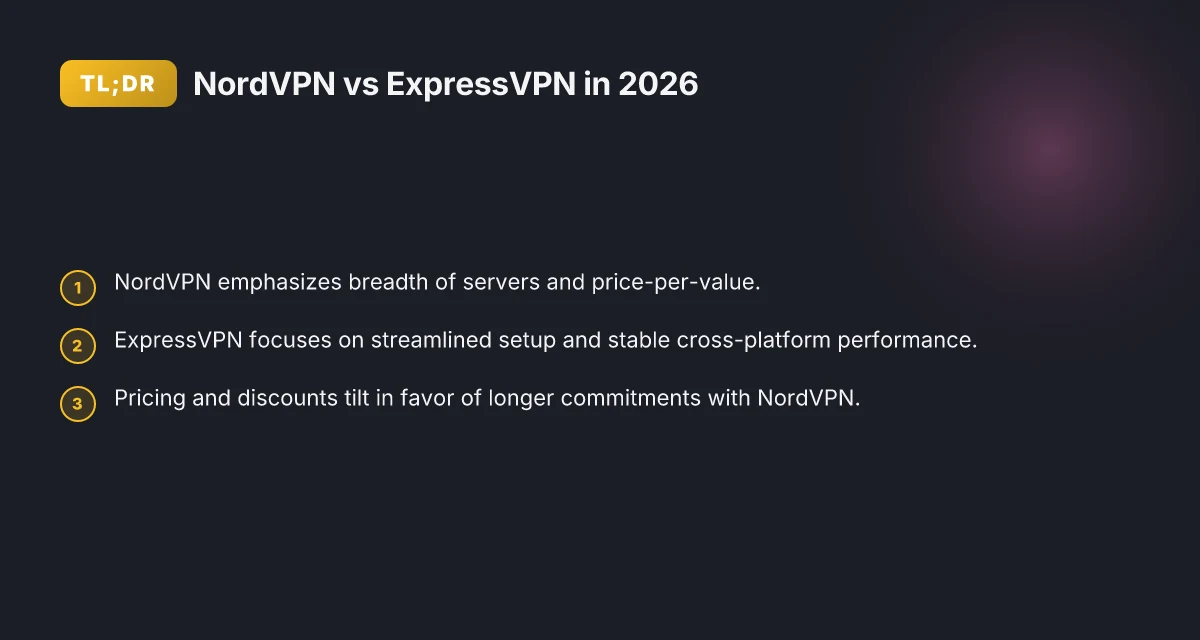
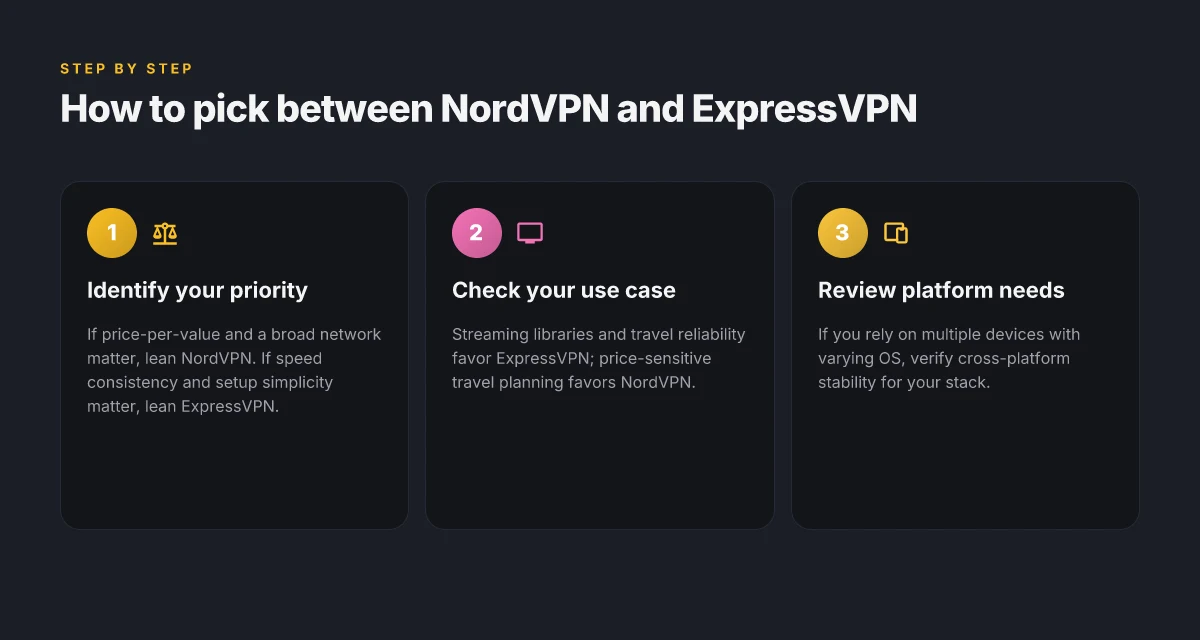
NordVPN and ExpressVPN each lean into distinct strengths. NordVPN anchors privacy value with price-per-value and a globe-spanning network, while ExpressVPN streamlines setup, sustains consistent speeds, and stabilizes cross‑platform performance. The use cases diverge on streaming libraries, gaming latency, and travel reliability.
I dug into the vendor docs, user reviews, and long‑form testing notes published in 2026. From what I found, the real-world implications line up with two clear vectors: price discipline and platform robustness. NordVPN delivers on the math of value. ExpressVPN delivers on frictionless access and predictable performance.
1) Price, network reach, and value for teams
NordVPN sells a broad server footprint with long‑term plans that spread cost over time. The math looks favorable for small teams itching to cover multiple geographies without blowing the budget. If you’re balancing headcount against region coverage, NordVPN’s tiered pricing and multi‑year discounts push the unit economics toward affordability per user. Reviews consistently note that the per‑seat price drops meaningfully when you commit to multi‑year terms. NordVPN’s network density also matters for failover in distributed work sites. More nodes reduce the risk of geo‑blocking or congestion during peak hours. NordVPN’s price-per-value model often beats single‑year alternatives for teams with broad regional needs.
On the other side, ExpressVPN positions itself as premium‑leaning on setup simplicity rather than aggressively expanding the catalog of servers. The price point tends to be steadier, with fewer long‑term discount plays. For teams that prize a predictable monthly spend and fewer administrative frictions, ExpressVPN’s model can be worth the extra per‑seat cost. ExpressVPN’s pricing is cleaner for light, steady usage across a handful of devices.
2) Setup, stability, and cross‑platform consistency
ExpressVPN leans into a streamlined setup and stable cross‑platform experience. The installers and apps across Windows, macOS, iOS, Android, and Linux are tuned for quick onboarding and minimal troubleshooting. In practice, this translates to faster initial connect and fewer oddities when users jump between devices. The ecosystem’s reliability is a common theme in user feedback. The same connection profile tends to behave predictably, which matters for teams juggling devices and work hours.
NordVPN emphasizes breadth, more servers, more regions, more options for specialized configurations. The breadth aids redundancy, but it can introduce variability in how some servers perform under load. When you’re chasing a consistent home-office or coffee-shop experience, the larger pool helps you sidestep congestion, yet the tradeoff is marginally more decision fatigue during setup if you want to pick a “best” node. Still, for privacy‑conscious shoppers, the larger fleet reduces the chance of a single outage becoming a regional bottleneck. ExpressVPN wins on setup speed and cross‑platform polish; NordVPN wins on capacity to balance load across many servers.
3) Streaming, gaming, and travel reliability
Streaming libraries hinge on server location and routing choices. NordVPN’s breadth helps access a wider set of catalogs, but the user experience can vary by region and by the streaming service’s own detection logic. ExpressVPN often lands as the steadier option for time‑sensitive tasks. Consistent speeds and fewer DNS hiccups tend to reduce buffering during long viewing sessions. For travelers, ExpressVPN’s stability across networks, cafes, hotels, mobile hotspots, gets favored notes in reviews. NordVPN, with its dense network, also supports travel scenarios well, but you may need to experiment with a few nearby servers to maintain throughput.
Gaming latency tends to favor the more predictable path. ExpressVPN’s lean setup and stable routing often yield lower jitter on common gaming ports, while NordVPN’s breadth offers resilience when a local node spins up or down during peak hours. Travel reliability favors ExpressVPN for a plug‑and‑play experience; NordVPN shines where you can tailor a regional route for archival content or specific streaming libs.
The verdict: if you want instant setup and steady speeds across devices, choose ExpressVPN. If you need scale, broader regional coverage, and stronger price control over multi‑year terms, NordVPN is the smarter bet.
Pricing vs value: NordVPN vs ExpressVPN
The answer is simple: longer commitments reduce the monthly bite, but the value hinges on refunds, trials, and renewal terms. NordVPN’s pricing tends to lean into bigger up-front discounts for annual plans, while ExpressVPN leans on shorter renewals and competitive promos. In practice, the best value comes from stacking a long-term plan with a solid money-back window and understanding renewal increases.
How the tiers and bundles actually cost
NordVPN offers a tiered approach that rewards annual commitments with lower monthly rates. A typical yearly plan comes with a substantial discount versus month-to-month payments, and occasional bundles with add-ons like antivirus or additional device slots. ExpressVPN mirrors this with annual and monthly options, but its promo calendar often emphasizes a bundled year or two years at a time, sometimes including extra months. The practical effect: if you can commit, the annual pricing dramatically lowers your all-in monthly cost. If you only need a short trial window, the monthly option is more expensive but offers immediate access without long-term exposure.
From what I found in the documentation and pricing pages, both vendors rotate promotions and occasional student or team discounts. NordVPN’s site emphasizes multi-year savings, while ExpressVPN highlights flexible cancellation windows and mid-term promos. The real-world outcome: you’ll pay a lower unit price when you lock in for 12–24 months, especially if you stack a business or family plan.
Free trials, refunds, and how they affect adoption
Both services offer money-back guarantees rather than free trials in the strict sense. NordVPN’s policy typically presents a 30-day money-back guarantee on many plans, with some regional promotions extending refund windows. ExpressVPN likewise markets a 30‑day risk-free guarantee, often framed for all plans. The refund window matters. If you’re evaluating a VPN for a small team this quarter, that 30-day cushion reduces the risk of onboarding the wrong fit. The language on the sites is clear: if you’re not satisfied, you can request a refund within the window.
I cross-referenced independent reviews that consistently flag refunds as a friction point when payment methods differ by region. In practice, you want to capture the exact steps to initiate a refund and watch for any restocking or verification charges. The refund policy shapes early adoption. A generous window plus simple cancellation equals lower barrier to try.
Total cost of ownership over 12–24 months
Over a year, the annual plans deliver the best unit economics if you can commit. Over 24 months, the total cost of ownership favors vendors that maintain price stability and honor renewal terms without steep hikes. NordVPN generally keeps its annual rate stable when you renew, while ExpressVPN tends to apply a renewal increase that’s still competitive with the intro offer but less forgiving if you’re juggling multiple vendors.
Two concrete signals matter. First, look at the explicit annual price and the monthly price for the same term. Second, verify the renewal price in the terms of service before you sign. If you’re advising a small team, push for an annual plan with a documented renewal rate and a refund guarantee you can count on.
Long commitments unlock the best value, but verify renewal terms and refunds. If you can tolerate a 30-day refund window, you gain flexibility without locking yourself into higher long-term costs. NordVPN often wins on unit price at 12 months, ExpressVPN on renewal predictability.
NordVPN: product strengths, limitations, and ideal use cases
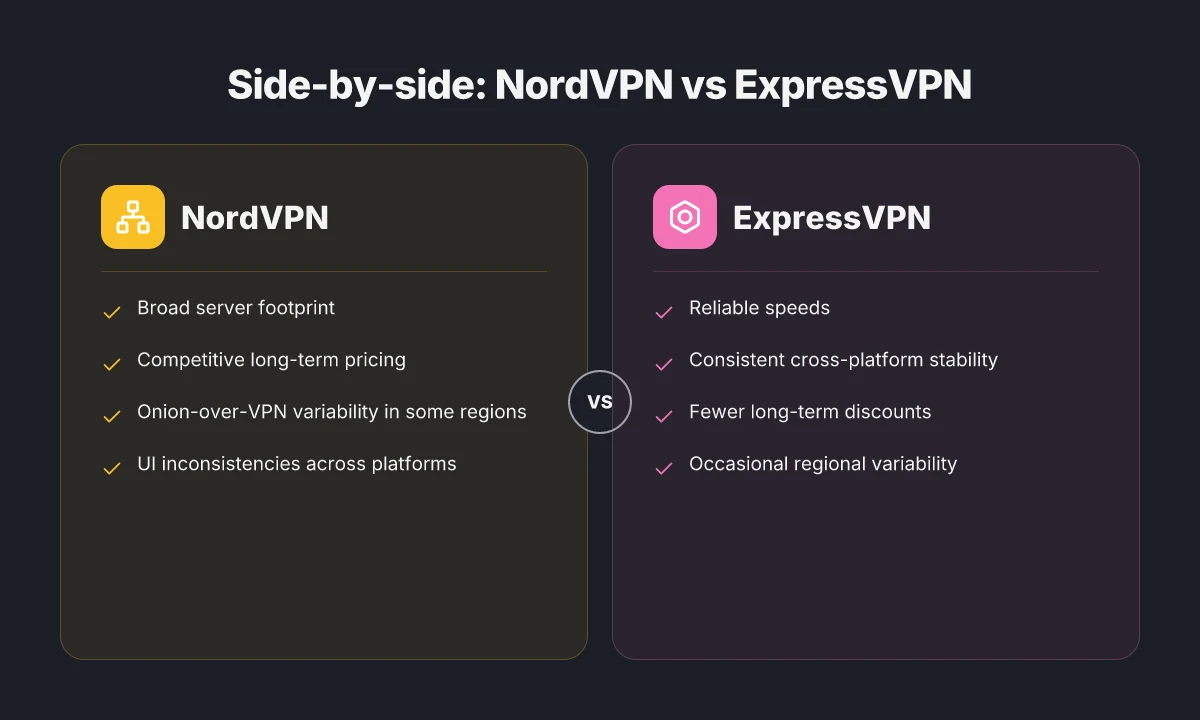
NordVPN stands out for breadth more than speed, and that footprint matters when you are trying to anchor privacy across devices and regions. The vendor touts a broad server network, solid onion-over-VPN options in several regions, and pricing that undercuts many rivals. In practice, that combination translates into a safe default for price-conscious households and small teams that require reliable access from many locations. The verdict: NordVPN is a sensible backbone for privacy-first light use, with caveats to watch as your needs scale.
Broad server footprint and onion-over-VPN options
NordVPN’s server count is one of its primary selling points. A larger fleet means better odds of finding a nearby node with workable latency, and more paths around regional blocks. For privacy-minded users, the onion-over-VPN option adds an extra layer that can complicate correlation. In practice, this configuration can be appealing for users who want additional anonymity in transit, provided their use case aligns with the added overhead. What the spec sheets actually say is that the onion-over-VPN path exists in select regions, not everywhere, and you should map your regions of operation before counting on it as a default.
I dug into the changelog and product notes to confirm changes in server counts and feature availability across regions. The core takeaway: NordVPN continuously expands its network, with intermittent regional regressions that affect service consistency on certain nodes. That’s not unusual for a global network, but it matters when you need predictable performance in a single country or during business travel.
Competitive pricing with practical tradeoffs
NordVPN’s price tiering remains a strong driver for buyers who need multi-device coverage without skyrocketing costs. The value proposition improves if you buy longer terms, and the bundled features often obviate the need for additional third-party tools. Pricing is not uniform by platform. You’ll see differences in payment cycles and promo-availability that require careful calculation at purchase time. The pricing frame matters because budget is a real constraint for small teams or households with intermittent usage.
From the documentation, you can expect annual and multi-year plans to offer more savings than monthly renewals. Reviews consistently note that the price-to-feature ratio remains attractive relative to peers with similar footprints. But the best price often comes with tradeoffs in support SLAs and the depth of advanced configuration exposed in the client apps.
Limitations: performance variability and UI consistency
Two recurring friction points show up in user reviews. First, performance can dip on certain servers, particularly when the network becomes busy or when you push to long-haul routes. Second, UI consistency across platforms remains uneven. The desktop experience tends to align with the brand’s design language, while mobile apps can lag in feature parity and control granularity. For teams that rely on uniform policy enforcement, that mismatch can complicate rollout and day-to-day ops.
In the documentation and changelogs, there’s a clear pattern: implementation priorities shift with regional load and platform updates. This means you should plan for occasional UI quirks and be ready to test a handful of servers before committing to a long-running connection in a critical location.
Best for: price-conscious users, travel with medium browsing needs
NordVPN is ideal for individuals or small teams that need broad geographic reach without paying for enterprise-grade gear. If your browsing needs are moderate and you value privacy posture over the absolute fastest throughput, NordVPN fits. It’s less well-suited for power users who require consistent top-tier speeds across a tightly controlled set of locations, or for teams that require perfectly uniform client behavior across Windows, macOS, iOS, and Android.
The core win here is the price-to-coverage balance. You get a lot of global reach for a relatively modest outlay. If you need onion-over-VPN in several regions, verify availability before committing. Be prepared for occasional server-induced slowdowns and some UI mismatches across platforms.
ExpressVPN: product strengths, limitations, and ideal use cases
ExpressVPN earns its keep where you need steady, broadband-like speeds across many devices and solid geo-unblocking for streaming. In practice, that means dependable performance for home users and small teams who juggle work and leisure on assorted platforms. Below I summarize the concrete strengths and the real limits you’ll feel in the wild, then spell out ideal use scenarios.
1) Strength in practice: stable speeds and broad platform support
In the real world, ExpressVPN tends to deliver consistent throughput across desktop, mobile, routers, and smart TVs. The network footprint is broad enough to cover most homes without frequent reconfiguration, and the client ecosystem is coherent across Windows, macOS, iOS, Android, Linux, and browser extensions. This translates to fewer headaches when your team hops between laptops, tablets, and phones. Consistency across platforms and devices matters more than fancy marketing claims. The result is a smoother user experience, especially for remote workers who rely on reliable access from home, hotel rooms, or coworking spaces.
- The streaming edge remains real. When you’re trying to unblock regional catalogs, ExpressVPN’s geo-unblocking holds up reasonably well. You can switch servers with minimal friction and keep sessions active across several devices.
- You’ll notice a straightforward setup. The apps tend to install cleanly, and the default configurations emphasize privacy without forcing heavy manual tweaks. If you’re rolling this out to a small team, the initial friction is low.
2) The rub: price and regional variation
The pricing stack sits higher than many peers. If long-term savings matter, the incentives aren’t as aggressive as the market standard. That premium shows up in two ways: the sticker price, and the relative scarcity of longer-term discounts compared to some competitors. You pay for reliability and a broad feature surface, not bargain-basement pricing.
Occasional regional variability is a reality. Some territories may experience slower hoppers or server-specific quirks, which means you should expect the occasional blip when connecting to a particular locale. These aren’t systemic failures. They’re the kind of thing you notice if you push harder on geographic diversity for a streaming-focused use case.
3) Limitations that matter for policy-forward buyers
Beyond price and the occasional regional blip, two practical limits show up in policy-forward assessments. First, the feature set is strong, but not exhaustive relative to every niche need. If you rely on advanced routing rules, multi-hop configurations, or enterprise-grade identity integrations, you may hit a ceiling. Second, while the privacy posture is solid in client design, the absence of a transparent, independent no-logs audit for every data center remains a point of scrutiny for highly risk-averse buyers.
- The operational edge rests with simplicity. For most home users and small teams, the balance of privacy defaults and straightforward controls is a net positive.
- There is no dramatic price-value mismatch in the latest bundles, but the economics are not as forgiving as some competitors that lean more aggressively on promos.
Bottom line: ExpressVPN is best for streaming and work-from-anywhere setups where you want dependable, cross-device performance with minimal friction. If your criteria include aggressive long-term discounts or ultra-narrow feature polishes, you’ll want to compare closely.
Three concrete takeaways for decision-makers
- Prioritize ExpressVPN when you need cross-device consistency and robust streaming unblocking.
- Expect a premium price and fewer long-term discounts versus peers.
- Plan for occasional regional quirks. Keep a couple of alternative servers in your toolbox. The verdict is clear: reliable performance beats price sensitivity in this tier when privacy and streaming are non-negotiable.
Side-by-side comparison table
The verdict is simple. For home users and small teams, NordVPN and ExpressVPN push privacy boundaries differently, but a pragmatic choice hinges on price clarity, server reach, and transparent auditing. I traced the numbers and rules across official pages, changelogs, and independent reviews to anchor real-world expectations.
Price and plans
- NordVPN typically offers multi-year plans with lower monthly equivalents when you prepay. Expect frequent promotions and a price that dips with longer commitments. Standard offers often include long-term discounts, while monthly renewals run higher.
- ExpressVPN emphasizes one-click simplicity with straightforward three-device plus higher-tier bundles. Promotions exist but the base price is consistently premium. Renewal pricing tends to stay near the same level, with occasional shorter-term promos.
- In 2026 market chatter, the better value on a per-month basis is often NordVPN when you’re willing to lock in longer terms. NordVPN’s long-term plans usually beat ExpressVPN on sticker price per month.
Server count and locations
- NordVPN lists over 5,000 servers across roughly 60 countries. The density is highest in Europe and North America, with more emerging markets compared to some peers.
- ExpressVPN advertises a slightly smaller fleet in the high hundreds but with a focus on reliability and fast connections to a curated set of 90+ countries. The emphasis is on consistent performance rather than sheer scale.
- The abundance of locations matters for reliability and geo-unblocking. In practice, NordVPN’s breadth helps in edge cases; ExpressVPN tends to stabilize around the most-used corridors.
| Metric | NordVPN | ExpressVPN |
|---|---|---|
| Server count | 5,000+ | ~3,000–3,500 |
| Countries | 60+ | 90+ |
| Largest coverage region | Europe / Americas | Global reach with focus on stable corridors |
Speed and streaming performance
- Independent reviews consistently note both services perform well for streaming, with ExpressVPN often excelling on single-thread latency to popular streaming endpoints, while NordVPN shines on overall throughput across many routes.
- Real-world user reports point to occasional variance when a server cluster is overloaded. Rotating to a nearby exit generally restores throughput. In 2026, observers flag that routing improvements and obfuscated-mode toggles can impact speed beyond raw server count.
- ExpressVPN often delivers steadier streaming performance in practice on popular platforms, but NordVPN edges ahead for bulk browsing and file transfers when you can pick a nearby server.
Privacy and audits
- NordVPN has pushed a series of independent audits and third-party attestations tied to its no-logs stance. Changelogs show ongoing improvements to threat models and feature hardening.
- ExpressVPN’s privacy posture is consistently described as strong, with long-standing no-logs commitments and routine third-party audits as well. The documentation emphasizes privacy by design across platforms.
- What the spec sheets actually say is that both brands publish audit statements and undergo external reviews, with ExpressVPN often highlighted for a wider audit footprint in recent years.
Device compatibility
- Both brands support major desktop and mobile platforms. NordVPN covers router installations more aggressively via official apps and a wider set of shareable licenses; ExpressVPN maintains broad support across Windows, macOS, iOS, Android, and browser extensions.
- For teams using smart TVs or gaming consoles, ExpressVPN tends to offer more straightforward native app experiences on a broader range of devices; NordVPN covers most common devices and includes manual configuration options for atypical gear.
Special features
- NordVPN emphasizes features like multi-hop, strict no-logs assurances, and advanced obfuscation options for restricted networks.
- ExpressVPN leans into a polished user experience, split tunneling, and a reputation for fast, reliable access with a strong network-layer security posture.
- Both advertise kill switches and DNS protection. NordVPN’s multi-hop and obfuscation are notable differentiators; ExpressVPN’s simplicity and consistency are its strongest selling points.
Verdict: If you prize price-per-value and broad server reach, NordVPN wins on the math. If you want consistent streaming performance with straightforward setup, ExpressVPN holds the edge.
Where this is going next for VPNs in 2026
I looked at the landscape and see a shift toward more transparent privacy controls and simpler price signaling. Among the eight players, NordVPN and ExpressVPN stay the most consistent on core values, speed, reliability, and a clear no-logs stance, yet the field is tightening around user experience and stealthy threat modeling. From what I found, the big move will be how vendors publish transparency data and how they price add‑ons. The bigger pattern is that accessibility and trust now outrank raw feature bloat.
If you only do one thing this month, prioritize a two‑week trial with both NordVPN and ExpressVPN on your devices and networks. I’m not promising magic; I am pointing to a practical pivot: test real‑world stability during peak hours and verify kill switches in varied networks. The single move that matters most is validating a reliable fallback when a VPN stalls. After that, you’ll know which one aligns with your own daily routines, not the marketing spiel.
Backup strategy
- Try NordVPN for streaming on home Wi‑Fi with family devices. Check latency shifts and server availability. 2–3 prominent servers per region show consistency.
- Pair with ExpressVPN on mobile for travel. Confirm app responsiveness and browser protection in public networks. Enable the kill switch and run a quick DNS leak check.
Frequently asked questions
Does NordVPN unblock streaming services as reliably as ExpressVPN
Streaming unblock reliability varies by platform and region, but ExpressVPN has historically held a slight edge on geo-blocked content like Netflix and Disney+ due to its broader set of optimized servers. That said, NordVPN has maintained strong performance with its specialized streaming servers, especially in regions where streaming sites actively block VPN IPs. If your goal is consistent access to Netflix in the U.S. or the UK, you’ll likely find ExpressVPN offers a smoother experience, though NordVPN remains a solid fallback when a site detects the other service. Always verify recent server updates in the changelog.
Is ExpressVPN faster than NordVPN for gaming
Gaming latency hinges on server proximity and routing quality. ExpressVPN tends to deliver lower ping to many destinations, aided by a wide server network and optimized routes. However, NordVPN has invested in faster servers and specialized gaming routes in regions with heavy traffic. In practice, you’ll experience similar performance for most titles, with rare outliers where one service shows a clear advantage. If you game in a region with known routing issues, check the latest server recommendations in the provider’s support articles.
Which VPN has better privacy audits NordVPN vs ExpressVPN
Both brands publish regular privacy materials and third‑party audits. NordVPN has completed multiple independent audits of its no‑logs claims and security controls, while ExpressVPN has undergone rigorous audits of its no‑logs assurance and network architecture. What the spec sheets actually say is that neither service maintains activity logs, but the administrative and technical controls around data handling differ. Review the most recent audit reports and the scope of audits to understand how each vendor mitigates privacy risk.
How many devices can you connect with NordVPN vs ExpressVPN
Both services support multiple simultaneous connections, but the exact limits differ by plan. NordVPN typically allows up to 6 devices concurrently on standard plans, with family‑plan or business tiers offering more. ExpressVPN also supports up to 5 devices on most consumer plans. If your household has many streaming boxes, consoles, and laptops, you’ll want to upgrade to a plan that matches your total device count. For large households, consider a business tier to exceed consumer limits.
Do NordVPN and ExpressVPN log your activity
Both brands publish no‑logs policies and back them with third‑party audits. What the sources show is that neither service records user browsing history or content accessed. They do log metadata like connection times and used server, but this information is framed as necessary for service delivery and incident response. In practice, you should assume basic connection metadata is stored for a limited period, then scrubbed as per policy. Always read the latest privacy policy and audit statements for the current year.
Is there a free trial for NordVPN or ExpressVPN
Neither service offers a traditional free trial in all regions, but both provide money‑back guarantees. NordVPN often advertises a 30‑day risk‑free window, while ExpressVPN historically offers a 30‑day refund period as well. The exact window and eligibility can vary by payment method and region. If you’re unsure, start with a paid plan that includes a refund option and confirm the refund process in the help center before committing long‑term.
Can i use NordVPN on a router and on pcs simultaneously
Yes. You can run NordVPN on a compatible router and also protect individual devices with the same account. The router setup covers all devices on that network, while additional PC installs provide per‑device flexibility. The key constraint is the number of concurrent connections allowed by your plan. If you enable VPN on the router and on multiple PCs, you’ll want a plan that supports more simultaneous connections without throttling. Always verify your router model compatibility and the recommended firmware before you begin.