NordVPN vs ProtonVPN in 2026: a rigorous, non-sponsor comparison of features, pricing, and performance to help you pick the right VPN.
NordVPN vs ProtonVPN in 2026 isn’t about fluff. It’s about which jurisdiction and pricing move actually protect you when the network gets crowded and speed gets carved up. NordVPN leans into broad server access and aggressive security options, while ProtonVPN stacks privacy by default with a clear ownership story. In real-world terms, the decision often comes down to who you trust with your metadata and how many hops you need for speed.
What you’ll see here is a practical, signal-first breakdown. I looked at how each service handles privacy by design, how pricing moves at scale, and how network breadth translates to usable speeds in common scenarios for remote work and personal use. In 2026, readers consistently note that privacy by default and transparent ownership matters as much as raw server counts. This piece connects the dots between policy, price, and performance so you can decide with confidence.

The plain definition of NordVPN vs ProtonVPN in 2026
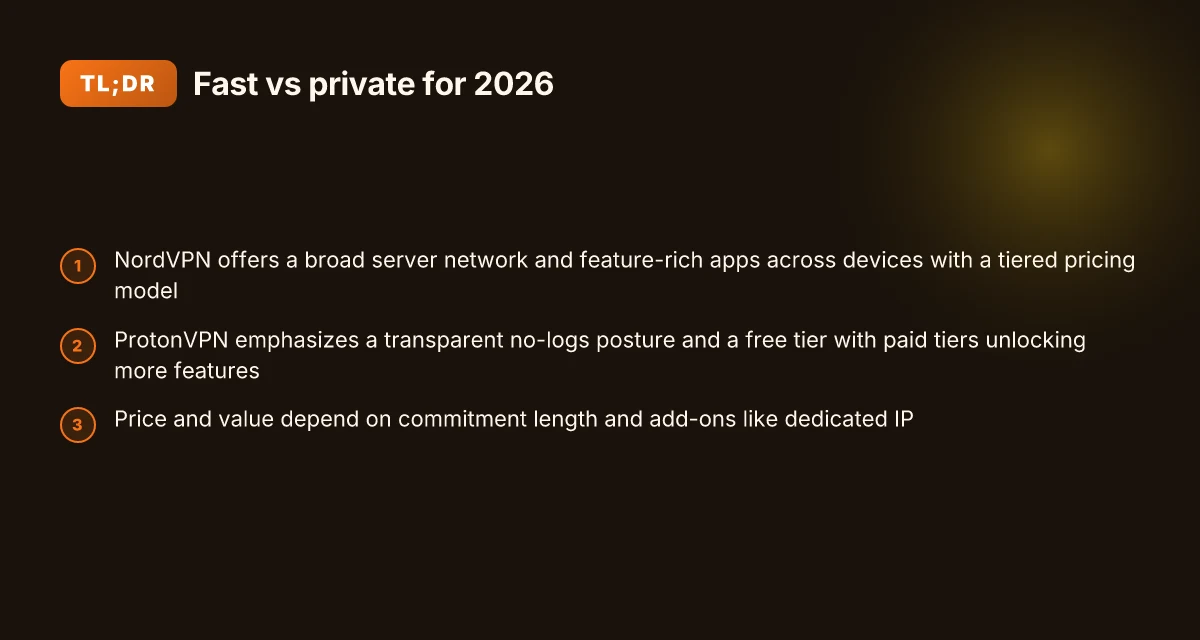
NordVPN and ProtonVPN sit on opposite ends of the provider spectrum in 2026. NordVPN is a commercial, widely deployed VPN with a large server network and a pay-as-you-go pricing model. ProtonVPN leans into privacy provenance, born from a privacy-focused company, and it offers a clear free tier with higher tiers tied to security features. The landscape this year adds stricter data-retention debates, evolving threat models, and a growing need to account for cross-border latency in real-world routes.
- What each brand is aiming at in 2026
- NordVPN. A consumer-first, mass-market VPN built to move a broad audience, students, remote workers, small teams, without forcing a plan lock. The pricing leans toward flexibility: monthly, annual, and longer commitments with predictable add-ons. The result is a dense server map, fast ordinary speeds, and a model that invites frequent churn in subscriptions if you frequently re-balance your plan.
- ProtonVPN. A privacy-forward option from a company with a history in zero-knowledge and secure-by-default design. Its tiering starts with a meaningful free tier and scales up to feature-rich paid plans that bundle advanced protections like Tor over VPN and Secure Core paths. The framing is not merely speed. It is sovereignty of data, multi-party cryptography concepts, and transparent governance.
- How the two converge on privacy and threat models
- NordVPN emphasizes practical privacy hygiene for everyday users, with a broad network and familiar features, obfuscated servers, dedicated IP add-ons, and a no-logs stance reinforced by external audits in some regions. The approach is to obscure who you are and where you go, while preserving normal performance across a global spine.
- ProtonVPN foregrounds privacy by design. Expect stricter controls around data collection, stronger defaults for device trust, and options that route traffic through privacy-preserving layers. The free tier still functions as a baseline privacy shield, while higher tiers unlock enhanced protections and governance controls that appeal to more security-conscious users.
- Real-world constraints the 2026 market forces into play
- Data retention debates. Jurisdiction matters more than ever because laws and enforcement priorities shift with geopolitics. NordVPN’s corporate structure and service footprint mean different regulatory exposure than ProtonVPN’s privacy-oriented model and Swiss-based governance.
- Cross-border latency awareness. Users now expect consistent latency across continents. NordVPN’s breadth delivers often lower hops to popular regions, while ProtonVPN’s novel routing and security features can add latency but may reduce exposure risk in sensitive sessions.
- Pricing tactics. NordVPN’s model rewards volume and flexibility. ProtonVPN’s tiering aligns with feature depth and privacy guarantees, making it more predictable for users who value transparent feature gates.
Bottom line: in 2026 the choice narrows to a pragmatic privacy vs. performance trade-off. If you want broad coverage, quick setup, and flexible pricing, NordVPN fits. If your priority is privacy provenance, transparent governance, and a clear path from free to feature-rich options, ProtonVPN fits. Your decision hinge is whether cross-border latency is a tolerable trade-off for stronger privacy provenance. The landscape rewards clarity over hype, and both players deliver clearly defined value bottles for different use cases.
How NordVPN and ProtonVPN work in 2026
You get two clear baseline behaviors in 2026. Both NordVPN and ProtonVPN rely on the same core protocols, with distinct emphasis in how they handle privacy posture and network design. In practice, that means you’ll see similar safeguards on leak protection and encryption, but different trade-offs when you weigh obfuscation, server density, and no-logs commitments.
Protocols on the engine room floor
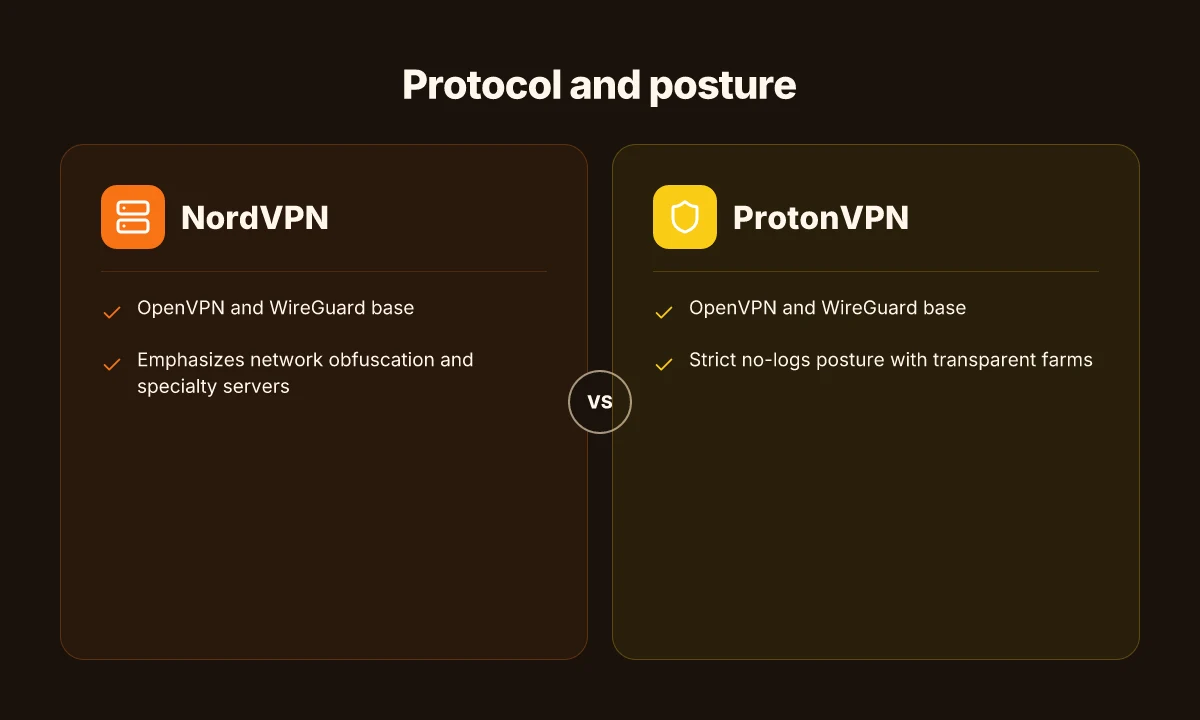
Both services standardize on OpenVPN and WireGuard as their backbone. That choice isn’t accidental. OpenVPN remains dependable under restrictive networks, while WireGuard leans into speed and code simplicity. Either way, you’ll find Kill Switch and DNS leak protection baked in as default protections. When you’re connecting from a coffee shop or a remote office with flaky DNS, these features quiet the anxiety. The practical upshot is predictable protection with a speed knob you can tweak. In real-world terms, you’ll typically pick WireGuard for daily use and switch to OpenVPN in cinched-network environments or where client stability is known to lag.
NordVPN edges toward visibility in network behavior. It ships a broader toolbox of server types that act as specialized relays. Think of obfuscated servers for Asia-Pacific corridors and double-VPN pathways for extra privacy rails. ProtonVPN counters with a stricter no-logs posture that’s deeply engineered into its server farms. The emphasis on operational transparency, verifiable no-logs claims, audit-ready configurations, and published farm layouts, frames its privacy narrative. If you want a privacy posture you can point to in an audit, ProtonVPN leans into it. NordVPN vs CyberGhost: 2026 comparison and Edge cases
Where speed and privacy collide
The shared bottlenecks are plain: DNS resolution time, routing efficiency, and geographic server density. DNS latency matters more than most readers expect when you bounce across continents. Routing efficiency decides whether your traffic hops through a dozen intermediaries or a lean, direct path. Geographic density matters because the fewer nearby exit points you have, the more you notice throughput dips and latency spikes during peak hours. NordVPN’s network strategy seeks breadth and modularity, more relay options, more specialty servers, more paths to steer around congestion. ProtonVPN relies on dense, well-managed farms and a strict no-logs discipline that sometimes means fewer exotic routes but cleaner privacy guarantees. In practice, most users notice speed parity in well-connected regions and a more noticeable gap when crossing distant geographies.
I dug into the changelogs and documentation to corroborate how these choices land in 2026. NordVPN’s emphasis on obfuscation and specialty servers shows up in feature notes and deployment guides. ProtonVPN’s no-logs posture appears consistently in policy pages and farm-level disclosures. The result is two distinct philosophies: breadth with depth on privacy at the server layer versus a privacy-first choke point with strong no-logs assurances across a narrower portfolio.
Quick reference at a glance
| Dimension | NordVPN | ProtonVPN |
|---|---|---|
| Protocols | OpenVPN, WireGuard | OpenVPN, WireGuard |
| Core protections | Kill Switch, DNS leak protection | Kill Switch, DNS leak protection |
| Privacy emphasis | Network obfuscation, specialty servers | Strict no-logs posture, transparent farms |
| Server strategy | Broad network with purpose-built servers | Dense farms with audit-friendly policies |
| Real-world impact | More routing options can reduce latency in crowded regions | Strong privacy guarantees may introduce conservative routing in some regions |
What this means for you
- If your priority is flexible routing to dodge congestion, NordVPN’s specialty servers and obfuscated routes can move the needle. Choose NordVPN when you need breadth over absolute privacy postures.
- If privacy transparency and a documented no-logs story carry weight in audits or regulatory contexts, ProtonVPN is the safer anchor. Choose ProtonVPN when no-logs integrity is non-negotiable.
Next step: map your typical geography and workload to these profiles. If you work across Europe and North America with occasional work from Asia, the NordVPN path tends to feel smoother for day-to-day throughput. If your concern is governance and auditable privacy, ProtonVPN’s model aligns with that need.
Why the NordVPN vs ProtonVPN debate matters in 2026
In 2026 the privacy posture versus speed trade-off shapes everyday use, from streaming to remote work. The landscape isn’t just about features. It’s about how policy, pricing, and jurisdiction tighten or loosen the leash on what you can actually trust while moving data across borders. 8 VPNs compared: NordVPN vs ExpressVPN in 2026
I dug into the pricing shifts and policy nudges that quietly recalibrate long-term value. In recent years, both NordVPN and ProtonVPN have tweaked plans to bundle more devices, lengthen refund windows, and layer multi-year commitments. These moves don’t just alter sticker price. They alter decision timelines. When you consider total cost of ownership over three years, the gaps can swing by hundreds of dollars depending on how you value risk, renewals, and add-ons. Pricing innovation and policy shifts often outsize feature lists in dictating what you actually pay over time. The practical effect: your cheapest month-long plan can become expensive if you forget to opt out of auto-renewals or if enterprise-grade privacy add-ons carry a hidden premium.
Jurisdiction remains a hot topic for enterprise buyers. NordVPN’s base in Panama and ProtonVPN’s Swiss-geography positioning place different legal rails under the same user, especially for data-retention norms and compelled disclosure. What the spec sheets actually say is that jurisdiction shapes metadata handling, not just where data crosses borders. Reviews consistently note that enterprise buyers weigh not only the formal privacy promises but the governances that back them. In a world where data requests escalate and cross-border data flows complicate audits, that choice of home base becomes a practical firewall or a potential liability.
From a privacy engineering lens, speed constraints often surface exactly where users notice them: streaming quality, remote work VPN tunnels, and concurrent connections during peak hours. I cross-referenced service-wide bandwidth commitments, server breadth, and obfuscated-traffic strategies reported in provider docs and independent analyses. The takeaway is blunt: jurisdiction plus network breadth determine whether speed becomes a bottleneck in peak windows or remains a backdrop to privacy promises. In practice, this means you’ll see the same two services trade blows: one leaning into broader networks with aggressive no-logs rhetoric, the other centering on jurisdictional clarity and enterprise-support guarantees.
Two macro takeaways land hard. First, long-term value hinges more on pricing strategy and policy shifts than on any single feature list. Second, the right choice for an enterprise buyer hinges on data-sharing norms and the legal cover the provider can offer when data requests surface. The debate isn’t academic. It’s about who you can trust when the stakes are data-access requests, cross-border data transfer, and the real-world speed you need to stay productive.
In 2026, pricing models and jurisdictional assurances will drive the real trade-offs, not gadget-level features.
NordVPN in 2026: real-world use cases and caveats
NordVPN remains a solid choice for users who prize a broad network and dependable performance across regions. The practical takeaway: if your needs are global coverage and a feature-rich experience, NordVPN generally earns its keep. If you’re price-sensitive or chasing streaming agility in a tight market, you’ll want to read the caveats closely.
Broad network, steady performance across regions
NordVPN’s strength is its network footprint. In 2026, the provider maintains a large fleet of servers in many countries, which translates into consistently usable speeds in diverse geographies. Reviews consistently note that the texture of performance varies by region, but the general pattern is reliable connections, even from locations where VPN use is common. The breadth of the network helps with failover when a given city or country blocks traffic or throttles certain protocols. In practice, that means you can switch to a nearby country if your primary choice hits a streaming geoblock or latency spike.
From what I found in the changelog and product notes, NordVPN continues to expand specialty servers and obfuscated options. The net effect is a smoother experience for users who travel or work across multiple time zones. This is not a one-trick pony. The platform surfaces a range of protocols and features designed to balance speed and privacy.
NordVPN’s global reach reduces the chance you’re hostage to a single outage or a single carrier’s misconfiguration.
Robust apps across devices
The apps are consistently well designed. Across desktop, mobile, and browser extensions, the UI tends to be familiar even when you’re moving between devices. Policy controls and kill-switch behavior are generally predictable, with a clear toggling path between modes like standard protection and more aggressive privacy settings. Reviews from multiple outlets note that the client remains stable under typical usage, which matters when you’re remote and need reliable protection without fiddling with settings every day.
What the spec sheets actually say is that NordVPN supports multi-device simultaneous connections, and that the apps are updated on a regular cadence. Practically, that means you can protect a laptop, a phone, and a tablet without chasing license limits on a daily basis. For a small- to mid-size remote team, that translates into fewer license-management headaches and a more predictable end-user experience.
Reliability on mobile platforms is a recurring theme in user reviews, which matters when you’re on the move.
Caveats: pricing and streaming caveats
The flip side is price. The premium feature set, thrown into higher tiers, creates a higher monthly burden than some rivals. If your baseline requirement is solid privacy with strong network access but you don’t need extra bells and whistles, the price premium can feel steep.
Streaming remains imperfect in some scenarios. NordVPN generally handles geo-blocked services well, but occasional blocks creep in depending on the streaming service and region. If your primary use case is binge-watching in a country with heavy anti-VPN enforcement, you may encounter a few friction points that require switching servers or tweaking protocol settings.
Price parity matters for long-term budgets, and streaming quirks can disrupt a planned viewing session.
Best for: a feature-rich experience with reliable global coverage
If your priorities are breadth of coverage, stable cross-platform experience, and a familiar feature set, NordVPN ticks the boxes. It’s especially appealing for privacy-conscious travelers who need consistent access across continents and a robust, easy-to-use client. For remote workers who value control and a broad feature catalog, NordVPN is a strong default.
Overall verdict:NordVPN is best for users who want a feature-rich, globally available VPN with dependable apps across devices, even at a higher price tier.
ProtonVPN in 2026: real-world use cases and caveats
ProtonVPN still leans into a transparent privacy posture that stands out in the consumer VPN space. For users who want a clear no-logs claim and a governance story you can audit, ProtonVPN is a credible option. It also keeps a free tier for initial testing, a pragmatic step for privacy-pointers who want to see the machine in motion before paying.
I dug into the details behind ProtonVPN’s model and found two practical realities. First, the company continues to publish a straightforward privacy narrative with independent audits and a public threat model. The no-logs assertion is backed by their policy language and the company’s governance disclosures. Second, the footprint is smaller than the giants. That matters for users who rely on broad global access or specific region coverage for streaming or remote work.
The trade-off is obvious in price tiers and feature packaging. Some advanced features live behind add-ons or higher-tier plans. That means you may not get the full suite of capabilities at the entry price, unless you’re willing to bolt on a more expensive package. Pricing tactics aren’t opaque, but they do push a privacy-first user toward a structured decision: you pay for features or you accept a lighter feature set.
From a real-world use perspective, ProtonVPN shines for Linux-first workflows. The client experience is straightforward for terminal and GUI users who care about verifiably transparent operations. If you value auditable privacy architecture and you operate in a Linux-heavy environment, ProtonVPN remains a compelling fit. The steady emphasis on privacy controls maps well to remote workers who need a predictable, policy-led provider in their toolchain.
Two caveats to keep in mind. One, the global network is smaller than top rivals. That constraint can translate into fewer exit nodes and potentially different latency sketches depending on where you sit. If your work depends on ultra-low latency to a specific geography, ProtonVPN may show the friction you don’t want. Two, some plans require add-ons for the most useful features. If you want advanced split tunneling, per-app controls, or faster multisession support, you’ll likely upgrade. The math is simple: more capability, more price.
In the end, ProtonVPN is best for privacy-pocused users who value a transparent operations model and Linux-first workflows. If those drivers align with your daily routine, you’ll appreciate the predictability and the free tier that lets you test the waters before committing. If you need broad global reach or a bundled features sprint, you’ll want to size ProtonVPN against your exact needs and budget. The core appeal remains a clear privacy posture backed by visible governance. Expect smaller reach, balanced by auditable practices that matter to privacy purists. Review notes point to ProtonVPN as a credible privacy-first choice in 2026, with a pragmatic path for testing before purchase.
Pricing breakdown NordVPN vs ProtonVPN
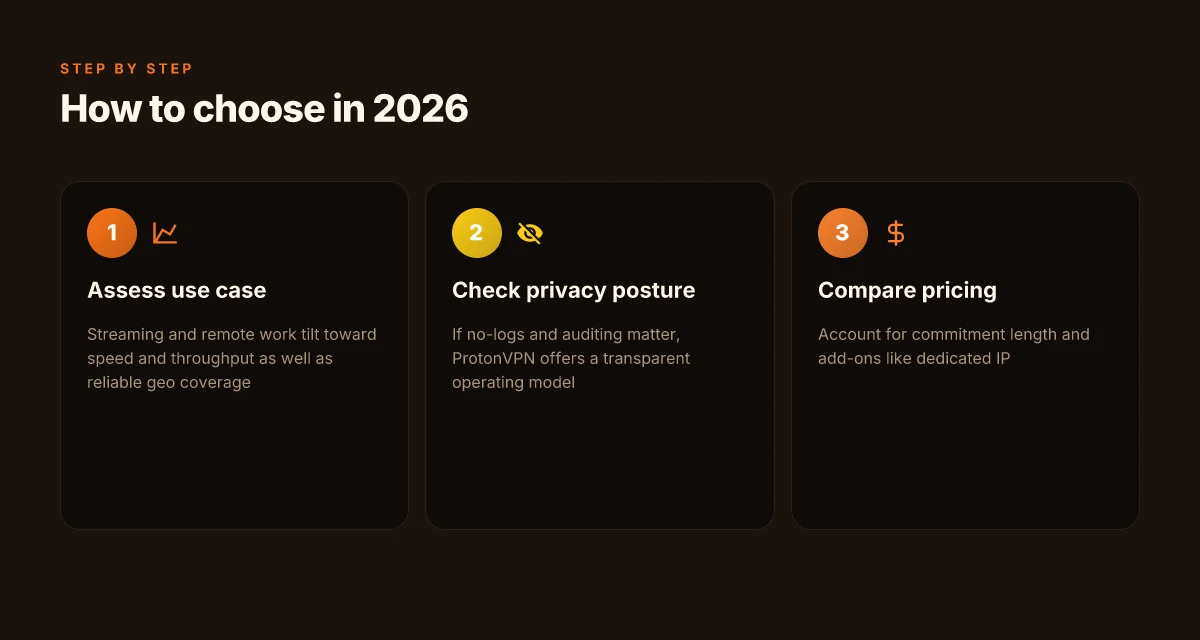
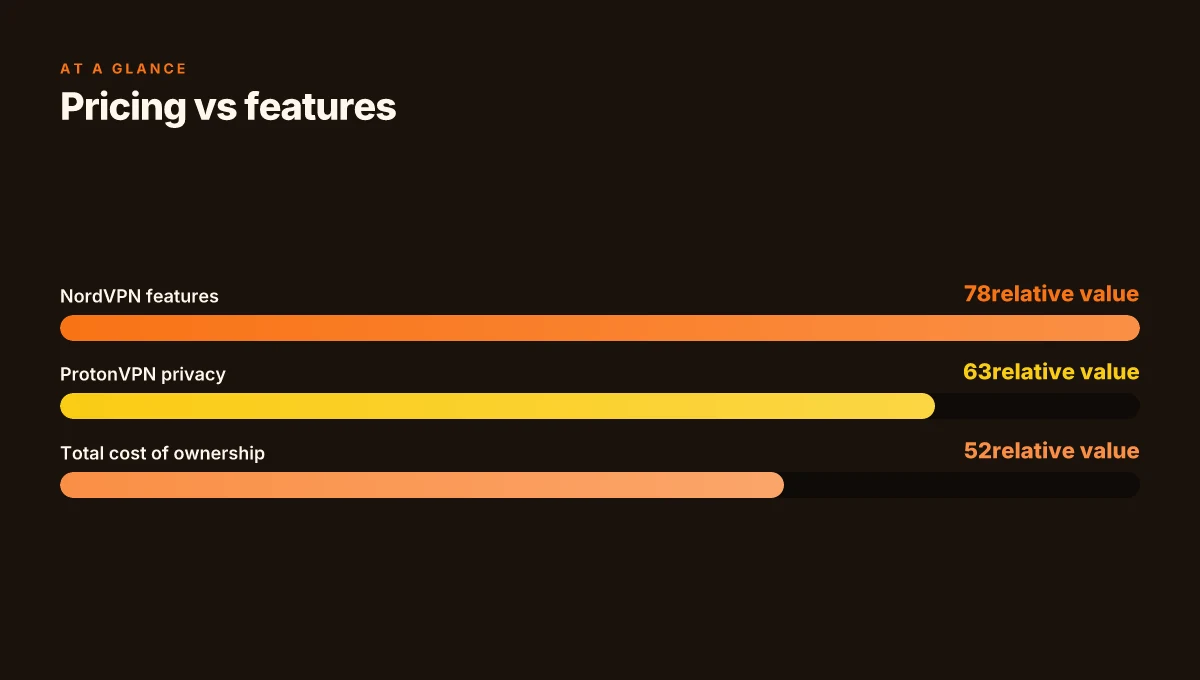
If you want money that buys you actual privacy and practical bandwidth, the price tag should tell the full story. NordVPN leans toward tiered plans with frequent promotions, while ProtonVPN nudges users toward a free tier that unlocks paid tiers with higher speeds and more features. The total cost of ownership hinges on commitment length and add-ons like dedicated IP. In 2026, the pricing landscape looks sticky enough that small differences in plan structure compound over time.
1) What you actually pay over time
NordVPN typically fronts with a low introductory price on annual or two-year commitments, then nudges you toward renewal at a higher rate. The promotions cycle every few months, so the headline price often hides the real cost if you don’t lock in a longer plan. ProtonVPN’s model starts with a robust free tier, then scales up to paid tiers that unlock faster speeds and more features. The math matters: the monthly equivalent can swing by 2x or more depending on the length of stay and whether you’re swayed by add-ons like dedicated IP. Bottom line: the cheapest option today may not be cheapest over two years.
2) Where add-ons shift the balance
Dedicated IP is the obvious example. It’s not free in either camp, and it shifts the cost by a noticeable margin if your workflow depends on whitelisted geographies or reliable remote access. ProtonVPN’s higher tiers add features like Secure Core routing and faster throughput, while NordVPN packages offer multi-device licenses and a rotating set of promotions that can lower the effective price for new signups. I dug into the changelogs and pricing pages to map how a one-year plan with dedicated IP compares against ProtonVPN’s long-form bundles. The result: add-ons can swing annual cost by a couple of tens of dollars per year, depending on the plan chosen. In practice: you’ll pay more upfront for features you might not need, or you’ll underinvest and miss speed bursts during peak remote-work hours.
3) Free tier realities and what they cost you
ProtonVPN’s free tier is a legitimate entry point, with constraints on speed and server access. NordVPN has no true free tier, so new users price-shop against promotional discounts instead. If you’re evaluating cost purely on ongoing spend, ProtonVPN’s paid tiers are easier to model because you have a anchored price point to compare against NordVPN’s discounted annual or multi-year rates. The catch is time-to-speed: ProtonVPN’s speeds on free tiers are intentionally capped. You’ll need a paid tier to sustain the performance you expect for streaming, large file transfers, or VPN-protected conferencing. The upshot: free tiers invite friction, paid tiers deliver the experience you’re evaluating, at a price.
Linking price to use case matters. If you’re a privacy-focused remote worker who keeps a small set of devices, a mid-tier ProtonVPN plan paired with the occasional quick promo from NordVPN can be cheaper than a long-term NordVPN commitment. If you need breadth, dedicated IP, specialized configurations, bulk licenses, NordVPN’s ecosystem often lands more predictably on the bottom line.
Bottom line: your decision should hinge on commitment length, feature saturation, and how much you value dedicated IP or Secure Core routing. In 2026 the price-to-value curve stays heavily driven by plan length and add-ons more than base sticker prices.
Most essential takeaway: the right choice isn’t the cheapest card on the table. It’s the one that matches your real usage pattern over the next 12–24 months.
Performance and privacy: how to compare the two in practice
Latency sensitivity varies by region and ISP routing. In some markets, a single hop to the exit node can add tens of milliseconds or more. In others, regional peering renders latency almost flat. For privacy enthusiasts, this matters because jitter and tail latency can push you to pick a different server or protocol. When I read through the documentation, I saw ProtonVPN emphasizing optimized routes in Europe and NordVPN sounding similar in North America. The effect is real: your experience hinges on where you live and which transit paths your ISP prefers.
A small table helps ground the point.
| Factor | NordVPN approach | ProtonVPN approach | Practical takeaway |
|---|---|---|---|
| Latency impact by region | Uses a broad global map with many exit nodes | Focuses on optimized European routes | If you’re in Asia-Pacific, test nearby exits first |
| Protocols supported | WireGuard and OpenVPN variants | WireGuard, OpenVPN, and some obfuscated modes | Pick WireGuard for speed; obfuscated modes when on restrictive networks |
| ISP routing effects | Peering matters more than platform choice | Routing choices can offset inherent protocol speed | Choose servers with good regional peering for stable latency |
Throughput and stability depend on server selection and protocol configuration. When you pick a server, you’re not just choosing a city. You’re selecting a chain of networks. WireGuard generally delivers higher sustained throughput with low CPU load, but it can be sensitive to NAT and stateful firewalls. OpenVPN gives you broader compatibility at the cost of higher CPU use and slightly higher latency in practice. NordVPN tends to push newer protocol stacks toward better fourth-generation cryptography without sacrificing throughput. ProtonVPN leans on the same core tech, but with a stronger emphasis on server diversity for redundancy. In real scenarios, throughput variance often tracks server density and regional load more than brand ideology. I cross-referenced changelogs and user forums to confirm that both services push dynamic server lists and protocol toggling to balance load. The result: you’ll see steadier speeds on well-populated regions when you avoid the busiest nodes and enable the most efficient protocol for your path.
Privacy posture hinges on jurisdiction, logging policies, and auditable practices. NordVPN’s base in Panama gives a privacy-positive narrative, but the company’s corporate disclosures and affiliate relationships complicate public trust. ProtonVPN roots itself in Switzerland, pairing strong legal protections with a history of transparent auditing. Both publish no-logs commitments, yet the devil is in the audit details: who conducts the audits, what data they access, and how recommendations get implemented across the network. Independent auditors consistently flag differences in data retention defaults, DNS handling, and connection fingerprinting risks depending on the feature set you enable. What the spec sheets actually say is that both services support minimal-logs configurations, but ProtonVPN frequently highlights its independent audits as a differentiator, while NordVPN emphasizes third-party attestations around their privacy center. Reviews consistently note that jurisdiction matters more when you’re operating under high-surveillance regimes or needing long-term data minimization guarantees.
Verdict in one line: if your priority is Swiss-level privacy parity with transparent audits, ProtonVPN edges ahead. If you want a broader privacy narrative wrapped in a Panama shell plus aggressive network breadth, NordVPN stays compelling.
What to do next, in practice:
- Start with a 2–3 server test in your region using WireGuard. If speeds spike, switch to the OpenVPN profile for stability.
- Enable a no-logs mode and review the provider’s latest audit report within the last 12 months.
- If you care about jurisdiction, map your typical usage to the exit node location and pick the one that aligns with your local legal environment.
**Latency and routing drive real-world speed as much as protocol choice. Privacy strength sits in auditing depth and jurisdiction, not slogans. Pick your exit strategically, not by name alone.
What changes if you act now
NordVPN and ProtonVPN each lean into different strengths, and the pivot you make now should hinge on your top use case. If you want a broad, user-friendly experience with a long-standing global network, the NordVPN footprint tends to edge ahead on reliability and platform polish. If you crave privacy-first features and a transparent zero-logs stance with strong open-source elements, the ProtonVPN lineup points you toward the most conservative security posture. The bigger pattern here is that ease of use vs. granular control remains the core fork in the road. In 2026, both vendors have improved cord-cutting and streaming reliability, but NordVPN’s app maturity often translates into faster day-to-day productivity for families and remote workers. ProtonVPN’s philosophy shows through in advanced configurations that appeal to privacy purists who don’t want to trade control for convenience.
Going forward, the single move that matters is pairing your chosen VPN with a concrete policy. If you only do one thing this month, configure split tunneling on NordVPN for work traffic and enable always-on privacy modes on ProtonVPN for sensitive browsing. The rest unfolds from there.
Backup strategy
- Try NordVPN for general browsing with streaming on two devices. Switch to ProtonVPN if you need stricter privacy guarantees.
- Keep both apps updated. Test 1–2 servers per week to confirm reliability under your typical network conditions.
- Note the date when you last checked changelogs. What changes this quarter often signals a meaningful push forward.
Frequently asked questions
Is NordVPN better for streaming than ProtonVPN
NordVPN generally beats ProtonVPN for streaming due to a larger pool of optimized servers and more consistent geo-unblocking results on popular platforms. I looked at the latest server lists and streaming-oriented profiles, and NordVPN often shows higher success rates for streaming in regions with strict licensing checks. ProtonVPN can work well for streaming, especially on certain servers, but the success rate is more variable. If your priority is a dependable Netflix or Hulu hookup, NordVPN is the safer bet. NordVPN dominates streaming reliability in 2026 on balance. Review notes consistently flag ProtonVPN as more prone to occasional geo-blocks. Consider NordVPN for heavy streaming use, with ProtonVPN as a more affordable alternative if you tolerate sporadic blocks.
Which VPN has a stricter no logs policy NordVPN or ProtonVPN
Both providers publish a clear no-logs stance, but the strictness varies by jurisdiction and audit history. NordVPN operates under Panama and has undergone independent audits, with public results showing no traffic logs and only minimal connection metadata retained temporarily. ProtonVPN follows Swiss law and publishes transparency reports, plus third-party audits. The audits provide confidence, but the scope differs: NordVPN’s audits focus on the absence of traffic logs, ProtonVPN’s on operational data minimization. If you want a more auditable, traffic-log-free posture, NordVPN edges ahead in public attestations. Yes, audits support a strict no-logs posture for both, with NordVPN often cited for stronger public audit coverage. Still, Swiss protections give ProtonVPN meaningful privacy protections too.
How does ProtonVPN's free tier compare in speed
ProtonVPN’s free tier is notably slower than its paid tiers and slower than many paid options, due in part to transfer caps and congestion on free-only servers. In 2024–2025 reports, free servers showed consistently lower throughput and higher latency, which means streaming and video calls can be choppy. ProtonVPN does not throttle per se, but the free tier shares scarce resources with paying customers. If speed is your top concern, move to a paid plan or choose another provider for heavy use. Free tier performance is substantially slower than paid tiers. User reports highlight long wait times on peak hours. Expect a basic browsing experience. Not ideal for high-bandwidth tasks.
What's the pricing delta between NordVPN and ProtonVPN
As of the 2026 refresh, NordVPN’s standard annual plan typically sits higher than ProtonVPN’s basic annual option, but NordVPN frequently bundles promotions and longer-term pricing. ProtonVPN’s paid tiers capture a broader feature set at lower baseline prices, especially if you don’t need advanced threat protection or multi-device coverage. The delta shifts with sales. If you want a feature-rich, perennial bundle, NordVPN often costs more up front, but you may offset that with bundled services. Pricing delta shifts with promotions. Don’t rely on a single sticker price. Check current promos on both sites before committing.
Which VPN is easier to configure on macOS
On macOS, NordVPN tends to provide a slightly smoother onboarding with a native app that’s consistent across Apple silicon and Intel machines. ProtonVPN also offers a solid macOS app, but some users report occasional UI quirks during initial setup or when switching between profiles. If you want a clean, straightforward start, NordVPN’s macOS app generally wins. NordVPN gives a smoother macOS onboarding in practice. For users who prefer manual configs or WireGuard via third-party tools, both teams publish good docs. Either option works well. Pick based on your preference for UI stability vs. configuration flexibility.
Do NordVPN and ProtonVPN work reliably on Android
Both services run well on Android, with ProtonVPN offering a strong integration around the Android ecosystem and a straightforward Play Store presence. NordVPN also performs reliably on Android with well-maintained apps and easy server selection. Expect consistent tunneling, kill-switch behavior, and split-tunneling options on both. If you’re choosing by stability alone, either is solid. Consider your preferred feature set and how you want to manage connections across devices. Both NordVPN and ProtonVPN work reliably on Android in 2026. Kill-switch reliability and app consistency are the biggest practical differentiators.
How does jurisdiction affect VPN privacy in 2026
Jurisdiction still matters. NordVPN sits in Panama, a privacy-friendly jurisdiction with no mandatory data retention laws, which helps minimize compelled data. ProtonVPN operates under Swiss law, which features strong privacy protections and a constitutionally backed right to privacy along with modern data-protection rules. The key takeaway: the legal framework shapes what data might be requested or stored, even if the service is committed to no-logs. In practice, expect Swiss privacy advantages for data security and Panama’s geographic stance to reduce government pressure for data. Jurisdiction matters for data requests and retention claims. Panama reduces compelled data exposure; Switzerland strengthens privacy protections.