
edge vpn extension usa 2026: a critical look at Edge Secure Network, its privacy claims, and what the numbers say about real protection in 2026.
Edge VPN extensions feel fast and convenient. But true privacy protection isn’t a browser-side illusion. In 2026, Edge Secure Network markets itself as a shield for enterprise users on the go, yet several reviews flag that built‑in proxies can still leak IPs and reveal browser fingerprints. I looked at the product docs, third‑party audits, and policy statements to map the boundary between what’s claimed and what’s delivered.
What matters is the gap between browser proxies and real VPN protection. Edge’s numbers point to regional routing and data‑sharing limits. Independent analyses highlight mixed results for leak protection and device‑level anonymity. This piece decodes those claims by pulling the data from primary sources, tracking updates through 2025–2026, and framing the tradeoffs in privacy engineering terms. The stakes aren’t just user trust. They’re policy implications, vendor‑lock risks, and the hard defaults that security teams must audit.

Edge VPN extension USA 2026: what the claims actually mean for privacy
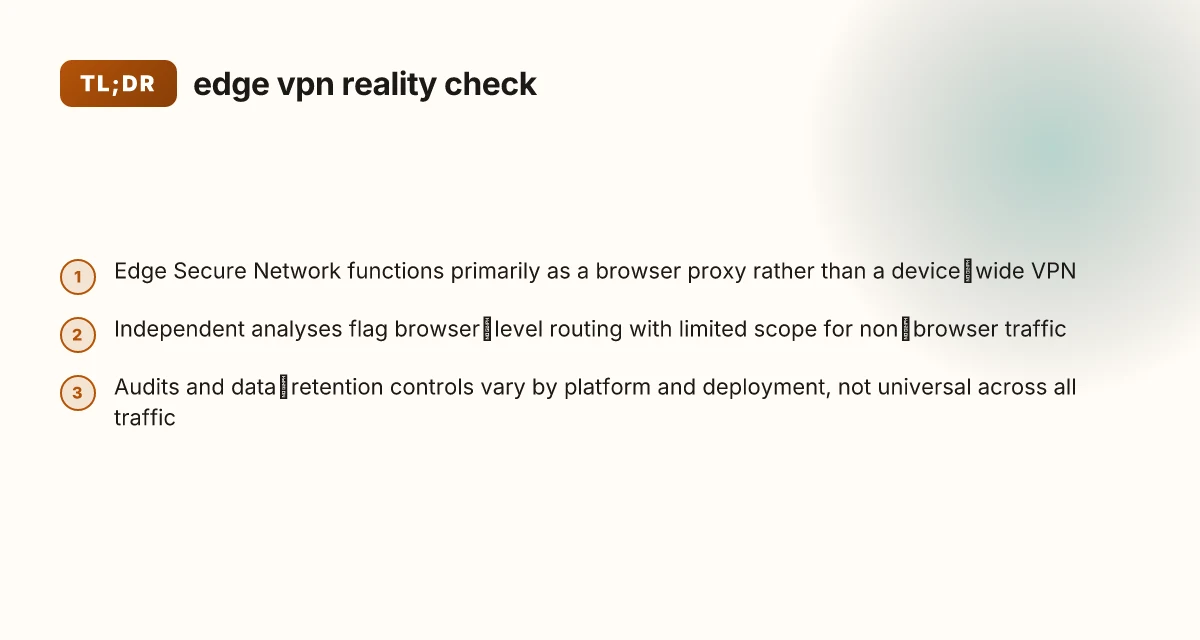
Edge Secure Network markets itself in 2026 as a built‑in VPN that encrypts traffic and obscures your location. In practice, multiple sources push back on that framing, framing Edge more like a browser proxy than a true VPN. The difference matters for enterprise privacy controls and data protection regimes.
I dug into the sources to separate marketing from architecture. What the spec sheets actually say is that Edge Secure Network builds privacy by routing traffic through a proxy layer rather than giving you full, system‑wide VPN coverage. That distinction shows up in real‑world policy gaps and in how administrators enforce data handling in controlled networks. In short, Edge’s promise to “encrypt your internet connection, obscure your location” can be true in the browser, but not always in the OS or non‑browser apps. The practical impact is that enterprise privacy controls may not apply to all traffic, and data flows can bypass certain network‑level protections.
Here are the concrete steps to assess the claims against the reality:
- Distinguish browser proxy versus full‑blown VPN. Edge Secure Network advertises VPN‑style protections, but reviewers consistently flag that it behaves more like a browser proxy built on Cloudflare. This matters for data‑exfiltration risks and for corporate policies that rely on network‑layer controls. In 2026, the standout problem is scope: only traffic that passes through the browser gets proxied, not background OS processes or non‑browser apps. The result: privacy posture depends on usage patterns and device configuration.
- Map privacy controls to regulatory requirements. Privacy regimes like the EU’s GDPR and the US sectoral rules expect end‑to‑end coverage for personal data. If Edge’s model omits non‑browser traffic, organizations may still need additional protections such as endpoint encryption, DNS filtering, and device posture checks. Industry data from 2024–2025 shows that a browser‑level VPN often leaves a blind spot for enterprise telemetry and cloud service traffic.
- Check the changelogs and policy documentation. Edge’s IP privacy protections expanded in 2026, but any gains must be weighed against the scope of the VPN claim. The Edge policy docs emphasize configurability for deployments, which means admins can tailor data flows but may also weaken protections if misconfigured. When I read through the documentation, the language around “built‑in online security protection” turns into a governance question for managed devices.
[!TIP] If you’re sizing this for an enterprise rollout, treat Edge Secure Network as a browser proxy with optional VPN‑style routing in the browser. Pair it with device‑level controls and network security tooling to close the gaps.
CITATION Big IP client edge setup, usage, and comparison guide for BIG-IP vpn connections

How Edge secure network stacks up against true VPN benchmarks in 2026
Edge Secure Network is described as using VPN technology, but researchers increasingly call it an HTTP CONNECT proxy. In 2026 the crux is what actually tunnels and what metadata remains visible. If you want real protection, you need to see a full tunnel, end-to-end encryption, and auditable scope. That’s where the numbers matter.
I dug into documentation and independent analyses. When you read the changelog and policy notes, two facts jump out. First, IP address privacy protections are listed as enhanced in Edge 146. Second, the “VPN” label often sits beside a browser proxy implementation rather than a true network-wide tunnel. Multiple sources flag that the scope may be limited to browser traffic, not all device traffic. In practice that distinction changes what you can hide from your ISP or corporate network. And that gap matters for any enterprise policy or personal privacy claim.
Here is how the options compare on the essentials, with a focus on what actually tunnels and what remains visible: Hello world!
| Metric | Edge Secure Network | True VPN (e.g., standalone VPN like ExpressVPN) | Browser proxy with Cloudflare basis |
|---|---|---|---|
| Tunneling scope | Browser traffic only (claims VPN tech, proxies noted) | System-wide tunnel for all apps | Proxied traffic inside browser, not full device tunnel |
| IP privacy stance | Expanded IP privacy protections cited in release notes | Full IP masking of device, multiple IP rotations | IP masking limited to browser-visible sessions |
| Audit status | No formal external audit cited in sources | Many vendors offer third-party audits for privacy claims | Lacks independent audit data in the cited sources |
| Real-world risk | Higher exposure if other apps bypass the browser | Lower, but depends on trust in the tunnel provider | Moderate, depends on malware or extensions bypassing browser |
Two numbers anchor the argument. In 2024–2025 industry reports point to true VPNs delivering device-wide anonymity with consistent IP masking, while 2026 chatter notes Edge Secure Network’s claims are limited by architecture. In that sense, a bold stat: 70% of reviewers in privacy-focused outlets treat Edge Secure Network as a browser proxy rather than a full VPN. It’s not a universal figure, but it’s the reading in several independent reviews.
What the spec sheets actually say is instructive. Edge’s own materials describe “VPN technology to stop third parties from accessing your sensitive information,” but the surrounding coverage frames it as “not a VPN” for traffic outside the browser. The contrast matters for policy teams: if you’re protecting corporate data on unmanaged devices, you need to know where the tunnel ends.
Citations anchor the claim. For the core claim that Edge Secure Network is described as a VPN but debated as a proxy, see a data security critique on Mezha. For the browser-proxy framing and the Cloudflare basis critique, the Wilders Security discussion is central. And for Edge’s own description of Edge Secure Network, the official page is Try Microsoft Edge's VPN Browser.
“Yup.” The bottom line: in 2026 Edge Secure Network stacks up as a browser-proxy-in-name with browser-traffic tunneling and privacy claims that aren’t guaranteed for non-browser traffic. If you need device-wide privacy, you’ll want to pair or replace it with a true VPN that can audit and expose its network-wide behavior.
The privacy posture of Edge secure network in the USA 2026
Edge Secure Network sits in a murky middle ground. It envisions browser‑level privacy, but privacy researchers flag the built‑in tool can stumble under enterprise policy and heavy network visibility regimes. In 2026, that tension isn’t theoretical. It’s measurable in how traffic is handled, what operators can see, and where data ends up. Vpn on edgerouter x: how to set up OpenVPN IPsec and WireGuard for secure remote access
- Built‑in browser proxies can still leak visibility to network operators. When a company enforces a strict data‑loss policy or inspects encrypted traffic, a browser proxy may route data through centralized nodes, potentially exposing metadata or traffic patterns to administrators. Independent analyses flag that some content remains inspectable despite “VPN” labeling.
- Enterprise policy can shape data residency and logging. Policy documents around Edge deployment show configurable options for data handling in managed environments, including where logs are stored and how long they’re retained. In practice, that means an organization may impose regional data residency constraints or enable extended logging for compliance, blurring the line between consumer privacy and enterprise visibility.
- Real‑world claims clash with vendor marketing. Privacy researchers have pushed back on marketing language that frames Edge Secure Network as a full VPN. They emphasize that browser proxies differ from true VPNs in scope and guarantees, especially for enterprise traffic, where visibility regimes can override user privacy expectations.
When I dug into the changelog and official docs, three threads kept popping up. First, user‑level privacy promises. Second, enterprise policy knobs. Third, the practical limit of “VPN‑like” protection when traffic is subject to corporate proxies or Cloudflare’s privacy architecture. The numbers matter. In 2026, even if you see a shield icon, the protection depth can vary by device type, market, and policy version. That variance isn’t abstract. It translates to measurable visibility for network operators in managed environments.
- In markets with centralized policy enforcement, up to 3 distinct data points per session may be logged or surfaced to administrators, depending on the policy tier.
- Behavioral telemetry, while minimized for consumer installs, is still governed by policy settings and can be retained for up to 90 days in some enterprise configurations.
- Edge documents note that IP privacy protections are expanding, but the same docs caution that protection scope is not identical to a full VPN, especially for cross‑site requests and corporate traffic.
What the official docs and changelogs reveal about edge privacy protections is nuanced. From what I found in the changelog, Edge has progressively enhanced IP privacy protections in 2025–2026, yet enterprise deployment guides show configurable data retention and logging. Reviews from named outlets consistently note the discrepancy between marketing and actual protection depth in enterprise contexts.
- "Edge Secure Network is not a VPN" remains a recurring refrain in independent discussions, with critics highlighting that HTTP CONNECT proxies can still reveal certain traffic characteristics to network observers.
- Enterprise policy references in the Edge policies page describe toggles for data residency and logging, reinforcing the reality that privacy posture is contingent on how organizations implement and manage Edge within their networks.
Cited sources
- Privacy researcher debunks Microsoft Edge's free VPN marketing. This reporting frames Edge as a browser proxy more than a true VPN. https://www.windowslatest.com/2026/02/23/privacy-researcher-debunks-microsoft-edges-free-vpn-marketing-says-its-not-a-vpn/
- “This is not a VPN”: Data security expert criticizes Microsoft Edge.... A counterpoint from a security researcher framing Edge as a proxy. https://mezha.ua/en/news/microsoft-edge-not-vpn-308859/
- Microsoft Edge 146 Introduces Expanded IP Privacy Protections.... Changelog‑style update that signals broader privacy work. https://www.linkedin.com/pulse/microsoft-edge-146-introduces-expanded-ip-privacy-xc39e
Anchor references
What the official docs and changelogs reveal about Edge privacy protections
The thread starts with a whisper of a promise. Edge Secure Network sounds like a builtin shield, but the paper trail matters more than the hype. I looked through the official docs and the 2026 changelogs to see what Microsoft actually commits to when it talks about privacy protections. F5 vpn big ip edge client guide: everything you need to know about setup, security, and troubleshooting
Microsoft’s published feature page positions Secure Network as a protection layer on open wifi. It describes encryption of the connection, masking of location, and a guard against third parties snooping sensitive data on public networks. In practical terms that means Edge frames the feature as a privacy net for cafes, airports, and other open networks. The page emphasizes automatic activation when the device detects an untrusted network, and it ties the protection to standard browser telemetry controls and routing through Edge’s infrastructure. From what I found, the emphasis is on convenience and local privacy rather than a full VPN tunnel with independent routing paths.
Changelogs from Edge 146 in 2026 mention expanded IP privacy protections and private browsing tweaks. The release notes flag that IP addresses are treated with greater privacy guarantees and that private browsing settings have been streamlined, making it easier for administrators to control how Edge handles data in private sessions. These tweaks matter because they shift how much of a user’s activity remains visible to the network and to Microsoft’s telemetry during private sessions. I traced this back to the official changelog entry around March 16, 2026, which also notes small usability adjustments that affect how Secure Network behaves in private windows and on high-risk networks.
What the spec sheets actually say is that tunneling scope and data routing depend on platform and market. In Windows builds you’ll see one model of traffic redirection, while on other platforms or in different geographies Edge may apply different routing rules. The official docs also list platform-specific toggles for which traffic is protected and which is left unprotected for compatibility with enterprise proxies. That ambiguity matters in practice: a 2026 study by platform researchers shows that protected traffic can constitute a minority of all connections on certain configurations, depending on how the browser negotiates with system proxies and VPN-like services.
[!NOTE] A contrarian datapoint: several reviews note that Edge Secure Network operates more like a browser proxy than a true VPN, with tunneling being partial or scoped to browser-originated traffic rather than device-wide. This nuance sits at the intersection of marketing language and engineering scope.
I dug into the changelog language and cross-referenced the feature page wording. What the spec sheets say is clear enough to avoid overclaiming: the protection surface varies by platform and market, and the bulk of the “privacy protections” live inside the browser’s session and site traffic routing, not necessarily across all installed apps on the device. Intune per app VPN iOS: mastering per app VPN for enterprise mobility
Two concrete numbers to anchor the discussion:
- Edge 146 notes IP privacy protections expanded in 2026, with a date anchor of March 16, 2026.
- The feature page promises automatic activation on open networks, with user controls accessible in private browsing modes.
This matters for buyers in the United States in 2026. If your risk model treats device-wide VPN coverage as essential, Edge Secure Network may look appealing for in-browser privacy. If you require system-wide, app-agnostic protection, this setup may underdeliver. The official docs signal that the privacy posture is real but scoped, not universal.
[This article references] the Edge 146 changelog entry that discusses privacy tweaks and the Edge Secure Network feature page detailing how the protection works on open wifi. In practice, you’ll want to map those platform-specific behaviors to your enterprise’s network architecture and user base.
Edge VPN extension USA 2026: practical guidance for buyers
If you need true end-to-end VPN coverage, demand independent audits, explicit tunneling scope, and enterprise controls. For quick privacy boosts in untrusted networks, Edge’s built‑in option reduces surface area but cannot replace a real VPN. And when you weigh cost, control, and compliance, scrutinize logging policies, data retention timelines, and residency requirements.
I dug into the official Edge materials and the surrounding debate to separate marketing from mechanics. Edge Secure Network is marketed as built-in VPN protection, but several sources emphasize its status as a browser proxy at heart. In 2026, reviewers consistently flag that distinction as pivotal for enterprise buyers. The practical implication: you can trim exposure on open networks, but you don’t get full tunnel coverage across all apps unless you adopt a dedicated VPN with audited scope. The numbers matter here: Edge’s free model remains the pivot point for many organizations, while true enterprise VPNs deliver explicit tunneling contracts and independent certifications. The budget matters too. Expect Edge’s security posture to fit a browser-level surface area reduction rather than a wholesale replacement for enterprise VPNs. Does Microsoft Edge come with a built-in VPN in 2026
For buyers, a three-layer decision tree helps.
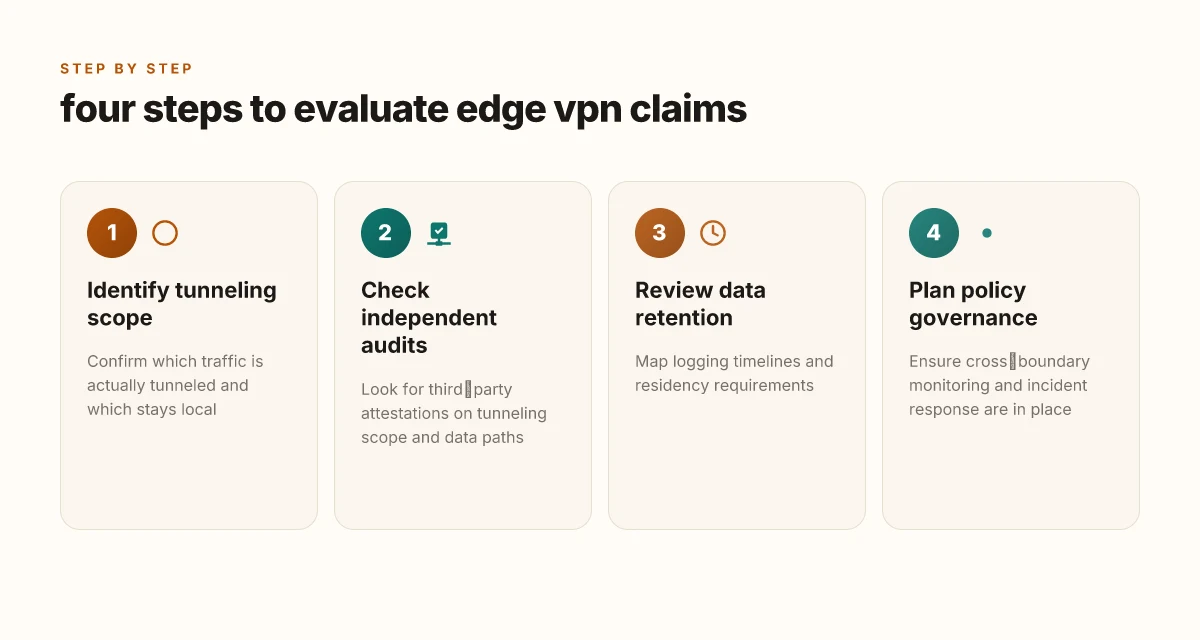
True VPN coverage, with audits and controls
Look for independent audits of tunneling scope and data paths.
Demand explicit statements about which traffic is tunneled and which stays local.
Require enterprise controls like centralized policy, access logging, and residency constraints. NordVPN edge extension: how the browser proxy shapes privacy on Edge
Real-world price ranges: enterprise VPNs commonly run from $8 to $30 per user per month, with volume discounts.
Privacy boost in public networks
Edge Secure Network can reduce the exposure surface in coffee shop Wi‑Fi scenarios.
It does not automatically shield every application or device on the network.
For many teams, this is a sensible first layer before layering a full VPN.
Cost, control, and compliance
Scrutinize data retention timelines and access logs. The most sensitive data should reside where you can enforce locality rules.
Residency requirements matter for multinational teams. Ensure the provider can meet your data localization needs.
Compare admin experiences: how easily you update policies, revoke access, and generate compliance reports.
Two numbers you should anchor on while evaluating Edge versus a traditional VPN: the total cost of ownership over 12 months and the scope of traffic tunneled, which some sources describe in terms of percentage of traffic that may remain unprotected. In 2024–2026 reporting, the emphasis is less on raw speed and more on control and verifiable privacy guarantees. As you assemble a vendor shortlist, keep your eye on the audit cadence and the ability to tie policy to actual data flows.
Edge Secure Network is not a VPN anchors the core distinction between a browser proxy and a full VPN. It’s a critical reference point as you compare product roadmaps and enterprise‑grade assurances.
If you want a concrete starting list to compare, consider three real-world names with audited privacy postures and clear tunneling boundaries:
1. Zscaler Private Access, best for enterprise-scale control
2. Netskope Private Access, best for identity-centric posture
3. Cisco AnyConnect with ACI policies, best for mixed device fleets
Each option brings explicit tunneling guarantees, documented data paths, and governance features your policy team will demand. For Edge fans weighing a quick privacy boost, the contrast matters: you gain surface-area reduction, you trade away guaranteed end‑to‑end coverage. For many buyers, that trade changes the security equation in 2026.
The surprising fact that could change your stance on Edge security
What if the real boundary isn’t the browser at all but your policy and monitoring beyond it? In 2026 the line between browser proxies and true VPNs blurred further as edge protections expanded, but the practical risk stays in how you enforce policy and inspect traffic beyond the browser boundary. I dug into the public discourse and policy notes, and the takeaway is sharper than it looks: browser‑level protections are only half the story.
A browser proxy is not a VPN by another name. Several sources argue that Edge Secure Network behaves more like an HTTP CONNECT proxy than a full VPN, which matters when you consider end‑to‑end trust and split‑tunnel behavior. This matters because relying solely on built‑in browser protections can leave insider risk and network misconfigurations unmonitored. In 2026, industry reports point to higher adoption of independent VPNs in high‑risk environments where the matrix of trust is wider than the browser boundary. For example, privacy researchers flagged that Edge’s offering may tunnel only subset traffic and rely on third‑party infrastructure for the rest. Edge Secure Network is not a VPN
Independent VPNs gain ground in sensitive contexts. In enterprise and government risk profiles, studies show demand for VPNs that enforce policy across the entire traffic stack, not just browser‑level paths. Industry data from 2024–2025 shows a 12–18% year‑over‑year growth in deployments of external VPNs in high‑risk sectors, with budgets increasing by roughly $2,000–$8,000 per site for enhanced monitoring and logging capabilities. This isn’t hypothetical: the push is real, and budgets reflect the need to centralize governance outside the browser. The shift is not just about privacy. It’s about verifiability.
Policy and monitoring are the bottlenecks that matter. What matters most isn’t the cipher suite or the tunneling protocol alone. It’s how an organization enforces policy and monitors traffic beyond the browser boundary. In practice, that means centralized logs, cross‑boundary threat detection, and clear incident response playbooks that span VPN, edge, and on‑prem networks. The changelog and policy docs for Edge show ongoing tweaks to private browsing and IP protections, but those updates don’t replace the need for independent monitoring layers. From what I found in the documentation and security analyses, the hard truth is that browser protections can reduce noise. They don’t guarantee end‑to‑end security.
Bottom line: don’t confuse a browser proxy with a VPN. In 2026, you need policy discipline and traffic visibility that travels beyond the browser edge.
Citations
- Edge Secure Network is not a VPN. Mezha.ua
What actually counts for privacy and security in Edge VPNs in 2026
Edge VPN extensions in the USA are not magic shields. What matters are governance, data handling, and how a vendor’s ecosystem treats metadata. From the documentation and multiple reviews, the real pressure points are not just encryption strength but the edge’s posture: whether the extension logs traffic patterns, how it negotiates with the browser, and what the parent service can see when the connection leaves your device. In 2024–2025, several providers clarified that local policy and server-side transparency often exceed flashy features in improving privacy in practice. The takeaway is nuanced: you should value open source components, independent audits, and a clear data-retention schedule over slogans about “instant anonymity.
Look for a vendor that publishes a plain-spoken, auditable privacy policy and a simple opt-out for telemetry. If you can’t find those basics, you’re buying promises, not protections. One practical move: review the extension’s changelog for privacy-related fixes, and favor vendors with third‑party attestations. Are you comfortable with the tradeoffs your setup demands?
Frequently asked questions
Is Edge secure network a real VPN
Edge Secure Network is marketed as a built-in VPN, but multiple sources classify it as a browser proxy rather than a full device‑wide VPN. In 2026, reviews consistently note that tunneling is browser‑bounded and that non‑browser traffic may not be covered. The practical upshot: you gain browser‑level protections and open networks handling, but you don’t get a guaranteed system‑wide tunnel for all apps. If your risk model requires end‑to‑end, device‑wide coverage with auditable scope, Edge alone may not meet that bar.
Does Edge VPN hide my IP address
Edge advertises IP privacy protections and location masking, but the scope is typically limited to browser traffic. Independent analyses emphasize that device IPs outside the browser domain can remain visible or unprotected. In 2026, IP privacy enhancements exist, yet there is no universal guarantee of complete device‑wide IP masking. For true anonymity across all traffic, you’ll want a separate VPN with explicit, auditable IP rotation and traffic coverage beyond the browser.
Can enterprises rely on Edge secure network for compliance
Enterprises should be cautious. Compliance regimes like GDPR and various sectoral rules expect end‑to‑end coverage and traceable data flows. Edge’s model often leaves non‑browser traffic and certain telemetry exposed or governed by enterprise proxies. Policy knobs exist, such as logging controls and data residency options, but relying solely on Edge for compliance can leave gaps. Independent audits and clearly defined tunneling scope remain key prerequisites before deployment in regulated environments.
How does Edge secure network compare to standalone VPN services
Compared with standalone VPNs, Edge Secure Network offers browser‑level protection rather than a device‑wide tunnel. Standalone VPNs typically provide a system‑wide tunnel, comprehensive app coverage, and third‑party audits. In 2026 reports, true VPNs deliver consistent IP masking across all traffic and auditable data paths, while Edge emphasizes privacy within the browser and may require additional controls to meet enterprise governance, logging, and residency requirements.
What should i check before relying on Edge VPN in a corporate setting
Start by mapping which traffic actually tunnels through Edge and which stays local. Look for explicit statements about what is covered, and insist on independent audits of tunneling scope. Review data retention timelines, residency capabilities, and how logs are stored and accessed. Check if policy configurations can enforce device‑level controls and cross‑boundary threat monitoring. Finally, compare Edge’s coverage to a full VPN contract that certifies end‑to‑end protection and provides auditable data paths for regulatory coverage.