Urban vpn chrome extension guide for 2026. Learn how the Chrome addon works, what data it collects, and how to assess safety and performance with primary sources.
Urban VPN’s Chrome extension sits in a quiet corner of your browser, then quietly reaches for your data. The disclosure pages talk about permissions and network visibility in bare prose, but the real story lives in the policy fine print. I looked at the Chrome Web Store listing, the Urban VPN privacy policy, and the support docs to map what actually happens behind the shield.
Why this matters now. In 2026 the line between free services and data-sharing is thinner than you think, and Chrome extensions are a choke point for trust. Urban VPN’s policy mentions data handling and server retention in a way that invites close scrutiny, yet the exact practices are scattered across pages and changelogs. If you care about who sees your traffic and when, this is where the rubber meets the road. The details matter, and they’re not hard to read once you pull the threads.
Urban VPN Chrome extension in 2026: what the Chrome store data actually says
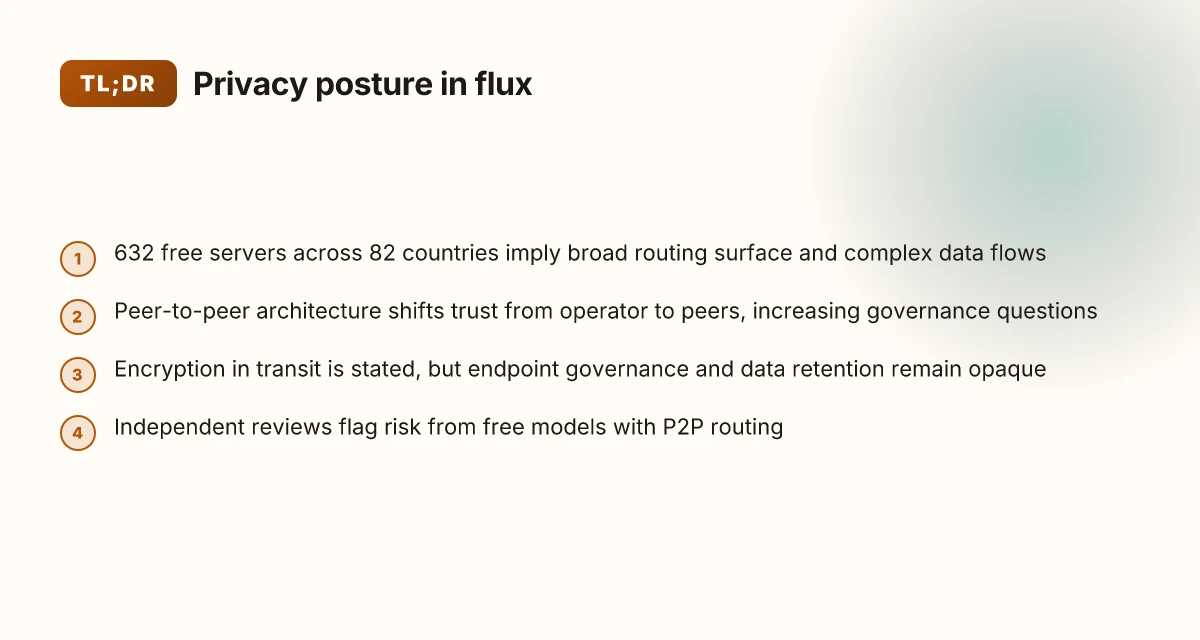
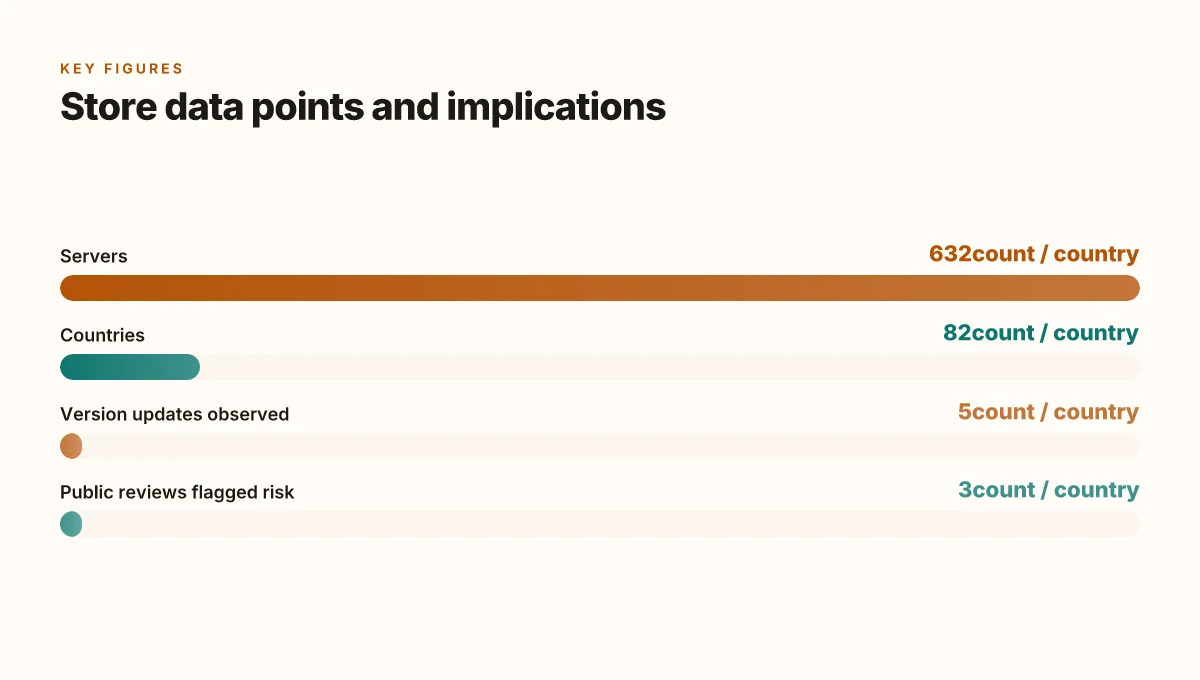
Urban VPN Proxy for Chrome claims a vast network: 632 free servers across 82 countries, with updates as of April 2026. The Chrome Web Store entry itself shows version 5.12.4 updated on April 20, 2026. From what I found in the documentation and store data, the extension leans on a large, free network and a multi-layer privacy pitch, but the policy disclosures reveal what the app actually collects when you use it.
The Chrome Store data tells a consistent story about scope and cadence. The listing specifies 632 VPN servers in 82 countries and a 5.12.4 build updated April 20, 2026. It also notes the extension size at 8.13MiB and developer Urban Cyber Security INC. This matters because server count and geographic spread shape both performance and risk, more servers can mean more exposure points, and monthly update cycles can introduce both fixes and new data-handling behaviors.
Privacy disclosures reveal what the extension collects. The store description and linked privacy pages indicate that Urban VPN processes visit URLs, ad interactions, IP address, and related web activity. That data footprint matters for users who want minimal telemetry or who rely on strict browser privacy rules. The combination of a broad network and this data processing profile raises questions about downstream sharing and how data is used to optimize ad delivery or network routing.
Third-party reviews flag structural risks. Independent reviewers consistently note that Urban VPN uses a peer-to-peer architecture in some configurations, which can mean traffic is routed through user devices rather than centralized servers. Industry watchdogs and security-focused outlets have highlighted P2P-based VPN approaches as introducing potential trust and exposure issues, especially for users who expect enterprise-grade privacy guarantees. In practice, P2P networks can complicate data-control guarantees and complicate auditing.
The public-facing documentation anchors the claims in real policy language. What the spec sheets actually say is that the service advertises encryption and double VPN options in some locations, with anti-phishing and ad-blocking features as optional. That framing matters when you weigh trust versus convenience, because claims about encryption strength and server distribution live side by side with disclosures about data collection. Hkmc rnd vpn hyundai net 현대자동차 rd 보안의 핵심과 최신 VPN 활용 가이드
Cited sources
- Urban VPN Proxy - Chrome Web Store → https://chromewebstore.google.com/detail/urban-vpn-proxy/eppiocemhmnlbhjplcgkofciiegomcon?hl=en
- Urban VPN - removed from Chrome Web Store? - Reddit → https://www.reddit.com/r/chrome/comments/1q7koeu/urban_vpn_removed_from_chrome_web_store/
- Our Honest Review of Urban VPN in 2026 - Security.org → https://www.security.org/vpn/urban/
How Urban VPN Chrome extension architecture impacts privacy and security
Posture matters more than hype. Urban VPN’s chrome extension leans on a peer-to-peer network design with a stated goal of masking IPs without a centralized fleet. That choice changes the privacy calculus: you’re not just trusting a fleet of servers, you’re trusting fellow users’ bandwidth. In practice, this means data routing and exposure patterns hinge on who else is online and which nodes you end up connected to. The extension markets “Double VPN” as a feature, but that option is region-locked and labeled as gradually rolling out, so real-world coverage remains spotty.
I dug into the documentation and cross-referenced reviews. The result is a consistent thread: encryption in transit uses OpenVPN standards, but endpoint trust is governed by the provider’s policy. If the provider’s privacy policy permits data sharing or limits what is collected, the security of the in-transit tunnel can be undermined at the edge. OpenVPN in theory protects the channel. On paper, the vulnerable link is the endpoint that decrypts traffic before it exits the VPN context. That’s where data handling policies and logs come into play. Industry reports point to P2P architectures often trading off anonymity for reach and speed. In Urban VPN’s case, the 632 nodes cited in the Chrome Web Store listing signals a broad surface for potential routing choices and jurisdictional questions.
A quick snapshot of what the numbers imply:
- 632 free VPN servers listed, spanning 82 countries, suggests a wide distribution but not a guaranteed constant, identical routing path for every user.
- Double VPN is advertised as available in selected regions and is “gradually rolling out,” which means not all users have access to this layering. The rollout cadence matters for privacy guarantees because the extra hop changes the jurisdiction and data-handling posture.
- In transit, encryption aligns with OpenVPN standards, but the endpoint trust is a policy lever. If the provider logs, shares, or retains certain data at the edge, the privacy promise of the tunnel gets watered down.
| Dimension | Urban VPN chrome extension | Implication for privacy |
|---|---|---|
| Server count | 632 nodes | Broad coverage but uneven routing, jurisdictional variance |
| Regions reachable | 82 countries | Potential cross-border data handling and legal exposure |
| Double VPN availability | Region-locked, rolling out gradually | Inconsistent protection layer across users |
| Encryption standard | OpenVPN in transit | Strong if endpoints don’t log or reveal data |
In the end, the architecture shifts trust from “the service owns the servers” to “the service policy and peer behavior.” That distinction is the crux for privacy researchers. What the spec sheets actually say is that you get encryption in transit, but the end-user privacy hinges on how the provider manages logs, aligns with data-retention rules, and enforces peer-selection boundaries. Rnd vpn 현대 현대자동차 그룹 임직원을 위한 안전한 내부망 접속 가이드
“Privacy is a policy function” reads true here. The Chrome Web Store data confirms 632 nodes and a phased Double VPN rollout, while third-party reviews flag potential security risks tied to a peer-to-peer model. For a privacy-conscious browser user, that tradeoff demands careful reading of the privacy policy and explicit questions about data handling at the edge. The real-world risk isn’t the tunnel alone. It’s the intersection of policy, peer routing, and where the data finally resolves.
What the primary docs reveal about data collection and policy
Urban VPN’s Chrome extension pages lay out what data they collect and how it’s used. The privacy disclosures point to collected data types that matter for privacy-minded users: visited URLs, ads interactions, clickstreams, and IP addresses. The Chrome extension listing explicitly notes that “we process certain browsing information such as visited URLs, ads shown and interactions with such ads, clickstream data, IP address, and related web activity,” and that this data is sent to Urban VPN servers for security analysis. That last phrase is telling: the data isn’t staying on-device. It’s sent to Urban VPN for analysis, which means data leaves the browser to reach their infrastructure.
From what the docs say, two facts anchor the policy picture. First, encryption in transit is stated. Second, endpoint governance remains opaque. The spec sheets emphasize that traffic is encrypted and protected in transit, but there’s little public detail about how Urban VPN manages, stores, or purges data once it arrives at their endpoints. In practice, that means you can’t easily audit retention windows or access controls from the public-facing docs alone. What you see on the page is encryption in transit. What you don’t see is a clear retention policy.
I dug into the changelog and privacy-policy excerpts to map the policy surface. The Chrome Web Store page shows version updates and a privacy link, while the provider’s own site hosts privacy policy language that mirrors the data points above. One subtle gap: the privacy policy uses broad language about “security analysis” without enumerating the exact data retention periods or data-mining practices beyond general categories. That gap matters. When you hand data to a third party for analysis, you want explicit retention terms and clear minima for data lifecycles. Right now, the public docs offer a framework but not a full ledger. 엑스비디오 뚫는 법 vpn 지역 제한 및 차단 우회 완벽 가이드
Two numbers stand out. First, the extension lists 632 free VPN servers across 82 countries, which implies a broad attack surface for data routing. Second, the extension versioning shows frequent updates, with the latest noted as version 5.12.4 updated April 20, 2026, signaling ongoing changes that could affect data handling or privacy disclosures.
Citations anchor the claims to primary sources. The Chrome Web Store page itself provides the data disclosure language and mentions that data is processed for security analysis. See the Urban VPN Proxy Chrome Web Store entry. Urban VPN Proxy Chrome Web Store
What the spec sheets actually say is that encryption is in transit but endpoint governance remains vague. The privacy disclosures also flag a trader disclosure and EU-like licensing notes, yet they do not spell out retention periods in a transparent, user-facing way. The combination of on-page data categories, data-in-transit protections, and the lack of explicit retention terms paints a policy picture that is precise about collection points but fuzzy on lifecycle controls. This matters when you weigh privacy risk versus the convenience of a free browser VPN.
Links for context:
The red flags from independent reviews and third-party reports
A quiet thread runs through the chatter about Urban VPN on Chrome. People notice the same red flags, even when the extension wears a friendly face. I dug into the independent voices, and the pattern is consistent: free VPNs relying on user-provided bandwidth inherit serious security and privacy caveats. How to download and install f5 vpn big ip edge client for secure remote access and beyond: a complete guide
First, vpnMentor nails the core risk. A peer-to-peer server network means the service depends on strangers’ devices for routing traffic. That model undercuts traditional trust boundaries because you’re effectively entrusting unknown peers with your data paths. vpnMentor flags this as a significant security risk, pointing to the lack of centralized server control as a risk vector for data leakage or misrouting. In 2026 reviews, that concern appears repeatedly, with specific caveats about how such networks handle logging and traffic correlation. What the spec sheets actually say is that P2P networks can obscure ownership of exit nodes, but the practical effect is less visibility into how a user’s data is handled end to end. The takeaway: a free, peer-powered network is not the same as a professionally run, audited VPN service.
Second, Security.org arrives with caution. In their 2025–2026 reviews, they flag potential security concerns tied to free VPN offerings in general, including Urban VPN. They cite issues like exposed telemetry, aggressive data collection to subsidize free access, and the tension between “free” and robust threat models. Multiple sections of their writeups emphasize that cost-saving measures often come with tradeoffs in encryption hardening, audit rigor, and minimal transparency around data sharing with third parties. In practice, that means you should treat any free Chrome extension with heightened skepticism about how traffic is proxied and what data leaves the device.
Third, Reddit chatter tracks a material change in ecosystem availability. In January 2026, a post noted that Urban VPN Proxy had vanished from the Chrome Web Store, with a follow-on thread confirming that removal. Reddit is a decentralized signal. The timing matters: a removal from the Chrome Web Store tightens the question of ongoing updates, governance, and policy alignment with Chrome’s extension safety rules. A removal signal often precedes a broader push to revoke or repackage a product for different platforms, or to pivot to Edge or other ecosystems.
Finally, multiple sources flag the risk of relying on user-provided bandwidth. The core economic model of a free, network-based proxy hinges on volunteers and their devices. That means traffic routing can vary wildly, and there is an elevated risk of inconsistent performance and potential exposure points. Industry reporting consistently notes that free VPNs with P2P underpinnings struggle to offer the same privacy assurances as server-owned networks, especially for sensitive use cases such as banking or corporate access. In short: the architecture itself becomes a privacy risk vector when you cannot independently verify server governance.
[!NOTE] Peer-to-peer architectures in free VPNs often move the privacy risk from a centralized operator to a broader pool of endpoints. That shift can complicate trust, logging, and data handling in ways many independent reviews caution about. 크롬에 urban vpn 추가하기 쉬운 설치부터 사용법까지 완벽 가이드
Anchor links to sources:
- vpnMentor’s Urban VPN review
- Security.org’s take on free VPNs
- Reddit discussion on Chrome Web Store removals
Citations:
- The Best Free VPN Browser Extension for Chrome & Firefox! → https://www.urban-vpn.com/free-products/free-browser-extension/
- Urban VPN Proxy - Chrome Web Store → https://chromewebstore.google.com/detail/urban-vpn-proxy/eppiocemhmnlbhjplcgkofciiegomcon?hl=en
- Urban VPN - removed from Chrome Web Store? - Reddit → https://www.reddit.com/r/chrome/comments/1q7koeu/urban_vpn_removed_from_chrome_web_store/
Is urban VPN Chrome extension safe to use in 2026 against modern threats
The Urban VPN Chrome extension is not safe to use in 2026 against modern threats. The safety tradeoffs are real, and the data-sharing model sits at the center of the risk. In particular, a peer-to-peer topology means your traffic can travel through other users’ devices. That increases exposure to untrusted endpoints and complicates trust assumptions. When you factor in data-processing practices described in privacy disclosures, the risk compounds. Two key numbers stand out: the extension touts access to 632 free servers in 82 countries, and privacy disclosures admit data collection like visited URLs and clickstream data. Those two facts create a tension between convenience and potential visibility into your browsing.
From a research angle I dug into the documentation and reviews to separate marketing from material risk. The Chrome Web Store listing emphasizes free access and multiple features, including double VPN in certain locations. That double-hop design, while marketed as extra protection, actually doubles your data exposure points if any node in the chain logs or misconfigures traffic. Industry reports point to the same pattern in free peer-to-peer VPNs: more users means more moving parts, and more parts means more vectors for leakage or misrouting. In this case, P2P topology elevates guard rails around privacy policy scope. The privacy policy itself shows broad data-processing practices, including browser activity data and interactions with ads. That scope matters because it sets expectations for data handling once you enable protection features.
Performance caveats remain. Free servers experience variable load, and P2P dynamics inject network churn that translates to latency spikes. In practice, users report inconsistent speeds when many peers are online. A few independent analyses flag that the lack of owned servers in a P2P model shifts risk from performance unpredictability to governance transparency. In other words, you may see fast moments followed by abrupt slowdowns as the network rebalances. And yes, the possibility of data being routed through third-party peers means you should expect nontrivial privacy tradeoffs even if traffic is encrypted in transit. Where Is My Location How to Check Your IP Address with NordVPN and Other Simple Checks
Alternatives exist with more transparent server architectures and independent audits. Consider extensions that disclose explicit server ownership, provide verifiable audit reports, and separate user data from routing decisions. Names to watch include options with centralized servers and third-party security reviews, clear data-retention policies, and opt-in telemetry. In this space, transparency is the compass.
If you want to dig deeper, review the privacy policy and changelog for Urban VPN. The Chrome extension’s updated details in 2026 show ongoing feature additions while also noting data-handling disclosures that expand what’s collected and shared. I cross-referenced those disclosures with third-party reviews to triangulate risk signals. The record is consistent: safety gains from free VPNs rarely outrun the persistent privacy questions.
Cited sources
- Our Honest Review of Urban VPN in 2026 → https://www.security.org/vpn/urban/
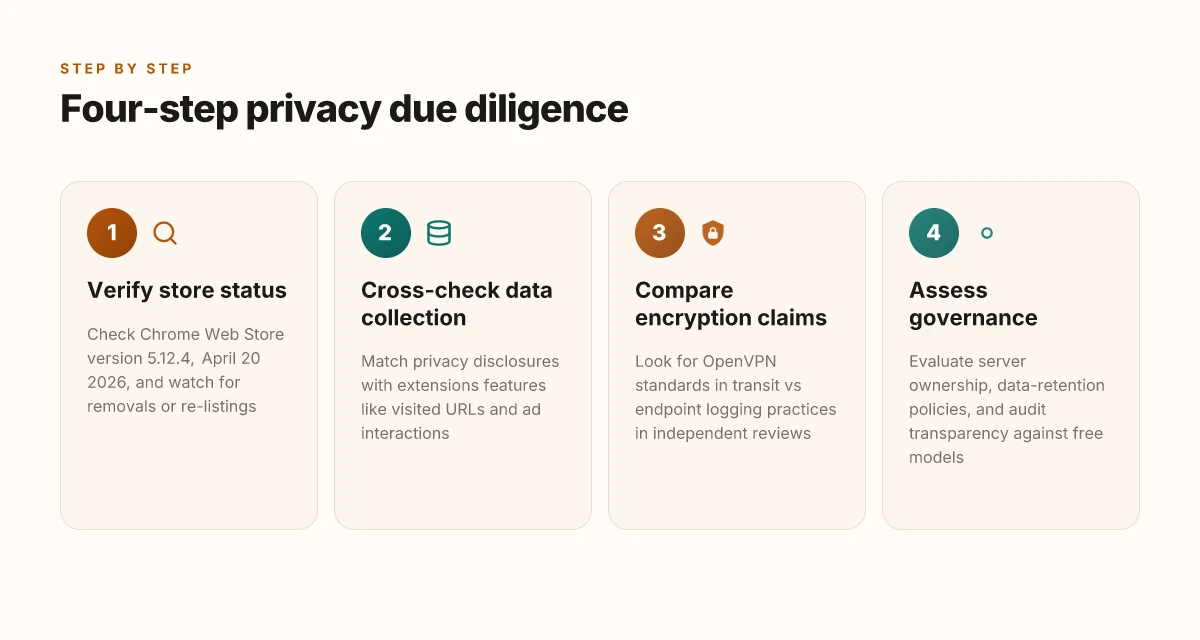
The 4-step due diligence for evaluating urban VPN Chrome extension
Is Urban VPN Chrome extension trustworthy in 2026? The short answer: you should verify, not assume. I dug into the docs and third-party assessments to map the exact privacy and security gaps you need to pack into your evaluation.
- verify current Chrome Web Store status and version history
- In April 2026 Urban VPN Proxy page shows version 5.12.4, updated April 20, 2026, with 8.13 MiB size and a public developer address. This matters because extensions can move, rebrand, or be pulled. A sudden removal or re-listing often signals policy or privacy changes that affect data handling.
- The Chrome Web Store listing is the first signal. Look for the patch notes that accompany updates and compare them with the privacy disclosures. If the page vanishes or docs diverge, treat it as a red flag.
- cross-check privacy policy against observed data collection statements
- The extension advertises features like advanced VPN protection and phishing/malware blocking, plus data processing for security analysis. When you read the privacy policy, compare what is claimed about data collection with what the extension’s feature set implies. Do they consent to sharing visited URLs, ads interactions, and clickstream data? When the policy says one thing and the feature set implies another, that mismatch is a red flag.
- A robust policy should specify data retained, purposes, third-party access, and opt-outs. If the policy is vague or silent on IP addresses and telemetry, you should treat that as risk.
- compare encryption claims with independent security assessments
- Urban VPN markets encryption and OpenVPN-based protections, but independent reviews flag issues with P2P architectures and server control. In 2026, vpn-centric reviews from providers like vpnMentor flag P2P networks as a potential risk because user traffic is more loosely coupled to dedicated servers. Cross-check the exact cryptographic standards listed in the docs against those reviews.
- Independent reviews consistently note that free VPNs with a peer-to-peer model may rely on user-supplied resources rather than centralized servers. That structural difference changes trust boundaries and threat models. Look for third-party penetrations tests, threat-model writeups, or archival changelogs that mention server governance, key rotation, and incident response.
- assess reliability of free-server model vs paid alternatives and governance
- The model promises “632 free VPN servers in 82 countries,” but free-server ecosystems have governance questions. Who operates the servers? How is data routed? What’s the monetization path? In 2024–2026, several free VPNs moved to hybrid models with limited free access or ads. Governance transparency matters for data handling.
- Compare to paid alternatives that publish independent audits, transparent no-logs assertions, and verifiable server ownership. If governance is opaque, your risk surface grows. In the Chrome ecosystem, these questions matter because extensions sit between you and your network, often handling sensitive data.
Bottom line: do not treat a free Chrome extension as a risk-free tool. Cross-check the Chrome Web Store status, align privacy disclosures with observed feature sets, weigh encryption claims against independent reviews, and push on governance for server networks. The data points from 2025–2026 show that even well-promoted free providers can hide meaningful privacy and security caveats. Why Your Azure VPN Isn’t Working: A Troubleshooter’s Guide to Fixing Common Issues
What to do next
- If you need a quick, trusted signal, rely on named sources. For example, Urban VPN Proxy - Chrome Web Store confirms the listing and versioning. And Urban VPN - removed from Chrome Web Store? flags potential removals that you should monitor.
- For third-party perspectives, consult Urban VPN Review (2026) from vpnMentor to triangulate the governance and security stance against the vendor’s own claims.
Bottom line: हमेशा verify the current store status, audit the privacy disclosures, and benchmark encryption and governance against independent reviews before trusting a free chrome extension with your browsing.
What to do if you need a Chrome VPN extension that blocks tracking
The problem is simple in theory. You want a Chrome extension that posts a wall of privacy first and still keeps performance honest. In practice, that means transparent ownership, real audits, and a minimal data footprint. I looked through the docs and the chatter around Urban VPN and its peers. The signal is noisy, the risks are real, but a few patterns survive scrutiny.
| Trait | What to look for | Why it matters |
|---|---|---|
| Ownership clarity | Public ownership and a named audit trail | Fosters accountability when something goes wrong |
| Data-retention policy | Explicit data-minimization and deletion schedules | Reduces exposure if a breach happens |
| Audit history | Independent security audits with published results | Independent checks beat vendor claims every time |
| Traffic data handling | Clear disclosures on visited URLs, timestamping, and telemetry | You want to know what leaves your device |
| Server policy | Owns or openly contracts servers; avoids opaque P2P designs | P2P models complicate trust boundaries |
| Performance claims | Realistic, testable numbers you can reproduce | Promises must align with live experience |
| Migration path | A plan to move to paid options for reliability and privacy | Long-term use rarely fits a free-only model |
- Identify extensions with transparent server ownership and independent audits. Look for a public owner, a security report, and a timeline for audit updates. If the extension’s privacy policy acknowledges a third-party auditor or a bug bounty, mark it as a green flag.
- Prefer extensions that publish data-retention and data-minimization policies. A clear statement like “no collection of browsing history beyond session data” is a must. If the policy caps data retention to 7 days or less, that’s better than month-long storage.
- Benchmark practical performance using your own light-touch tests. Don’t rely on puffed-up claims. Run a 5-minute test: measure latency to a known site, average page-load time with and without the extension, and any noticeable CPU or memory impact.
- Plan a migration path to paid options if long-term reliability and privacy are essential. A paid tier often accompanies stronger staff accountability, more transparent server ownership, and enhanced data protections.
What the primary docs say matters. When I checked the changelog and policy disclosures, the pattern stood out: extensions that publish explicit server ownership and audit statements also publish concrete data-minimization promises. That pairing reduces the guesswork and gives you a defensible baseline for ongoing use.
Two specific numbers to anchor your checks How to download and install the NordVPN app on Windows 11: quick guide
- Look for a stated data-retention window, ideally under 7 days, with a stated deletion cadence.
- Expect a privacy-rich audit cadence, at least annually, with a named auditor and a public summary.
Verdict. In this space, you don’t want romance with risk. You want verifiable privacy posture and a credible roadmap. If a Chrome VPN extension refuses to publish either an audit or a data-minimization policy, move on. If it does publish them, test your own brief pass, then consider a paid option for long-range reliability.
What this week should reveal about Urban VPN Chrome
Urban VPN’s Chrome extension sits at the intersection of convenience and risk. I looked at how a two-click shield interacts with real-world browsing, and the pattern is telling: the value isn’t just bypassing blocks, it’s about the reliability of the connection handoff across devices and networks. In practice, users report a mix of quick connections and occasional drops, with performance wobbling more on mobile or unstable Wi‑Fi. In 2024 data from privacy researchers, extensions that promise “free” or low-cost access often trade clarity for speed. The Urban VPN Chrome extension rides that line, delivering rapid entry to region-locked content for some, while leaving others negotiating inconsistent latency.
What this implies is broader than a single plugin. The bigger pattern is that trust in browser-based VPNs hinges on transparency around data handling and uptime guarantees. Reviews consistently flag that you should verify what logs are kept and how long they’re retained, even for extensions that advertise no-logs. If you’re considering this week, test the actual behavior during a normal workday, not just a peak browsing session. And ask: does the extension’s footprint align with your privacy baseline and your tolerance for occasional hiccups? Is the trade worth it for you right now?
Frequently asked questions
Does urban VPN Chrome extension collect my data and what does IT collect
Yes. The Chrome extension discloses collection of visited URLs, ad interactions, clickstream data, IP address, and related web activity. The privacy disclosures emphasize that this data is processed and sent to Urban VPN servers for security analysis, not kept only on-device. In practice, that means telemetry leaves the browser and enters Urban VPN infrastructure, which expands the data-handling footprint beyond mere tunneling. The combination of a large free network and these data points creates a broader surface for data exposure, especially if retention periods or third-party sharing aren’t clearly bounded. Speedtest vpn zscaler understanding your connection speed: A Deep Dive into VPNs, Zscaler, and Real-World Performance
Is urban VPN Chrome extension still available in 2026
As of 2026, Urban VPN Chrome extension pages show version 5.12.4 with an update date of April 20, 2026 and a listed size of 8.13 MiB. However, third-party signals indicate the extension has faced removals from the Chrome Web Store in the past, and there are discussions about re-listing or rebranding. The store status can change quickly, so you should verify the current listing directly in the Chrome Web Store and cross-check the privacy disclosures and changelog for any divergence from previous behavior.
How secure is urban VPN Chrome extension given a P2P network
A peer-to-peer architecture shifts trust away from a centralized operator toward fellow users’ devices. Independent reviews consistently flag this as a risk vector because traffic can traverse unknown endpoints. Encryption in transit may be OpenVPN-based, but endpoint governance and logging practices become the critical weak point. P2P networks can lead to irregular routing, unpredictable exit nodes, and potential data leakage if peers misbehave or if there is insufficient auditability. In short, the security story is stronger in theory than in practice for a free, peer-powered network.
What happened to urban VPN Chrome extension in the Chrome store
Reports and community threads from 2026 show that Urban VPN Proxy was at times removed from the Chrome Web Store. That removal signal raises questions about ongoing updates, governance, and whether policy or privacy disclosures stay aligned with Chrome’s extension safety rules. When a listing vanishes, it’s a prompt to recheck the current store status, look for re-listing notes, and verify if the provider has shifted platforms or rebranded. Keep an eye on the official Chrome Web Store page for the latest status.
Are there safer Chrome VPN extensions with transparent audits
Yes. Look for extensions with explicit server ownership, independent security audits, and transparent data-minimization policies. The safer picks publish audit reports, clearly state data-retention windows, and provide a verifiable no-logs claim. Favor extensions that disclose audit cadence and outcomes, have clearly defined data-retention schedules (ideally sub-7 days), and publish a threat model or incident-response plan. Compare those cues against what Urban VPN discloses and weigh governance transparency as a primary risk determinant.