
A practical comparison of ExpressVPN and Windscribe across privacy, speed, features, pricing, and user experience.
the article body in Markdown
In the crowded world of VPN services, ExpressVPN and Windscribe sit on opposite ends of the spectrum in several areas. ExpressVPN is often praised for reliability, broad device compatibility, and a robust privacy stance. Windscribe, meanwhile, is admired for its generous free tier, strong feature set, and flexible billing. This article breaks down how they compare across key dimensions so you can decide which fits your needs.

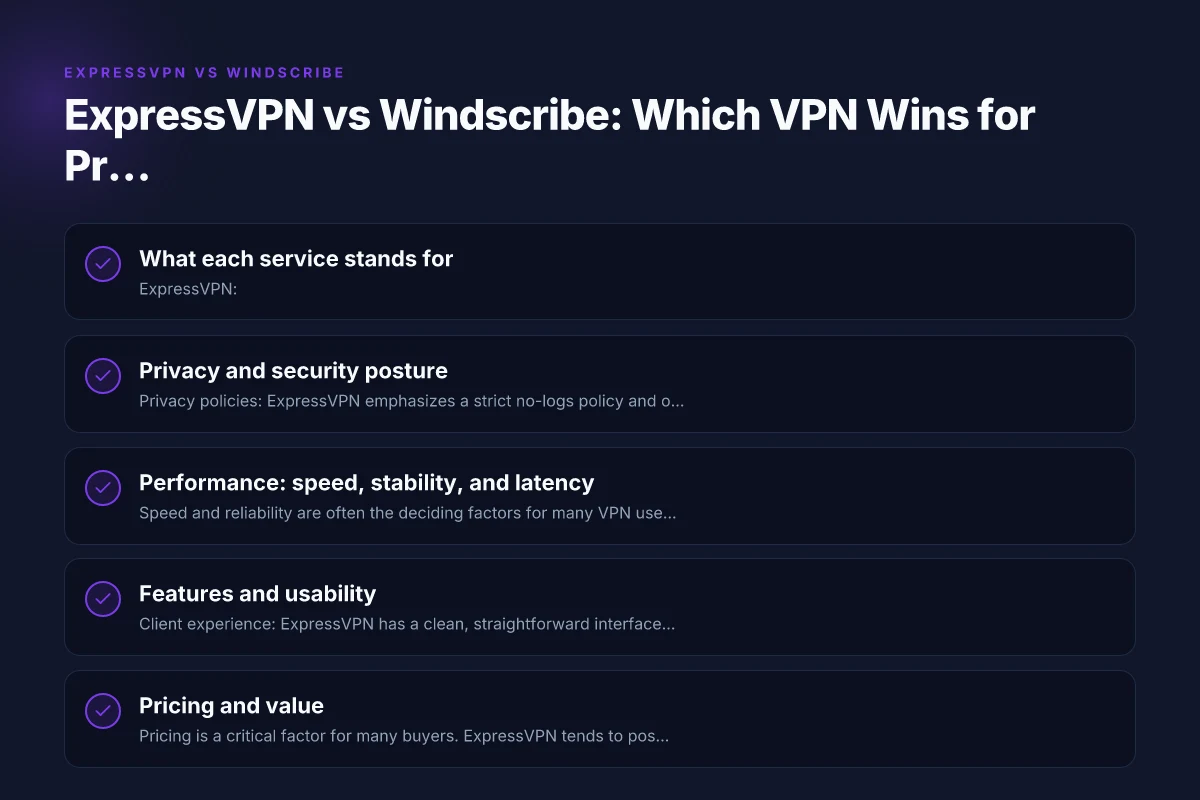
What each service stands for
ExpressVPN:
- Classic, uptime-focused VPN with a long-standing reputation for reliability.
- Wide network: servers in 90+ countries, strong performance in many regions.
- Strong emphasis on privacy, with a no-logs policy and independent audits.
Windscribe:
- A VPN service with a flexible pricing model, including a notable free plan.
- Mix of privacy protection and data-light features designed for budget-conscious users.
- Built-in privacy tools beyond the basic VPN, such as a firewall and ad/tracker blocking.
Privacy and security posture
- Privacy policies: ExpressVPN emphasizes a strict no-logs policy and operates under privacy-conscious jurisdictions, often highlighting audits and transparency reports.
- Encryption and protocols: Both services typically offer modern encryption (AES-256) and secure protocols. ExpressVPN is known for its proprietary Lightway protocol, plus OpenVPN and IKEv2. Windscribe uses WireGuard (via its own implementation) and OpenVPN, with standard protections like DNS leak protection.
- Jurisdiction and data requests: ExpressVPN is based in the British Virgin Islands (a privacy-friendly environment relative to some other jurisdictions). Windscribe is headquartered in Canada, which can bring different legal considerations, though Windscribe maintains a focus on privacy and user control.
- Privacy extras: Windscribe provides a built-in firewall and ad/tracker blocking as part of its platform, which can appeal to users who want an all-in-one privacy toolkit.
In short: ExpressVPN tends to lean on a stricter privacy narrative with independent audits and a region considered privacy-friendly, while Windscribe blends VPN functionality with additional privacy features, sometimes appealing to users who want extra tools bundled in.
Performance: speed, stability, and latency
Speed and reliability are often the deciding factors for many VPN users. Here’s how ExpressVPN and Windscribe stack up:
- Server network and coverage: ExpressVPN has a very large, globally distributed server fleet. Windscribe’s network is solid but smaller in comparison.
- Consistency: ExpressVPN generally delivers stable speeds across long-distance routes and has a reputation for reliable connections. Windscribe can be very fast on favorable routes but may vary more by location and server load.
- Protocols: ExpressVPN’s Lightway is designed for faster handshakes and lower battery/CPU usage on mobile, with OpenVPN and IKEv2 as solid fallback options. Windscribe supports WireGuard by default on many platforms, which can offer excellent speeds on supported devices.
- P2P and streaming: ExpressVPN is widely recognized for good streaming performance and broad P2P compatibility. Windscribe supports P2P on certain servers, but streaming success can depend on the server and region.
A practical takeaway: If you need consistently high-speed, streaming-friendly performance across many devices, ExpressVPN often has the edge. If you’re testing a few locations and want strong performance at a lower price, Windscribe can be competitive. ExpressVPN vs PureVPN: Which VPN Wins for Privacy, Speed, and Value?
Features and usability
- Client experience: ExpressVPN has a clean, straightforward interface focused on one-click connectivity and reliable performance. Windscribe provides a more feature-rich client with additional privacy tools, including a built-in firewall, tracker/advertisement blocking, and configurable options.
- Platform support: ExpressVPN supports a broad array of devices including routers and consoles via native apps or manual configurations. Windscribe also supports major platforms and has browser extensions, but its router support tends to be more manual or via third-party methods.
- Extra tools: Windscribe’s standout extras include its R.O.B.E.R.T. feature (a customizable DNS/URL blocking service) and a free plan with a monthly data cap. ExpressVPN emphasizes core VPN protections, split tunneling (where available), and device-to-device compatibility without offering a free tier.
- Edge cases: If you rely on a lot of configuration options, Windscribe’s feature set can be appealing. If you want straightforward protection with minimal tinkering, ExpressVPN’s simpler approach may be preferable.
Here is a quick feature comparison in a compact table:
| Feature | ExpressVPN | Windscribe |
|---|---|---|
| Core philosophy | Simplicity, reliability, broad reach | Feature-rich, flexible pricing |
| Free plan | No free plan | Generous free plan with data cap |
| Protocols | Lightway, OpenVPN, IKEv2 | WireGuard, OpenVPN |
| Device support | Massive compatibility, routers included | Broad support, some advanced features |
| P2P/Streaming | Strong support, reliable performance | Good on select servers, varies by region |
| Privacy tools | No-logs policy, audits (depending on year) | Firewall, ad/tracker blocking, R.O.B.E.R.T |
| Pricing philosophy | Premium, value-focused | Flexible, value-driven, tiers and add-ons |
Pricing and value
Pricing is a critical factor for many buyers. ExpressVPN tends to position itself as a premium option with a straightforward annual plan and occasional promotional discounts. It usually doesn’t offer a free tier, which means you’re paying for consistent performance and support from day one.
Windscribe adopts a more accessible pricing ladder:
- A notable free plan with monthly data allowances, which makes it appealing for users who want to test VPN basics or cover light usage.
- Paid plans that scale with data caps or fixed monthly fees, plus a yearly option. Windscribe’s pricing is often more flexible, with add-ons like R.O.B.E.R.T. and configurable privacy features sometimes affecting the total cost.
If you compare cost per usable month, Windscribe can win on value for light or moderate users, especially those who want a no-risk entry via the free tier. However, for heavy users or those who require uninterrupted streaming, ExpressVPN’s performance consistency can justify the higher price.
Privacy and policy nuances you should know
- Logging: Both services advertise minimal or no-logs policies, but the exact scopes and audit histories differ. ExpressVPN has undergone third-party audits and publishes transparency reports. Windscribe’s privacy approach emphasizes user controls and features that reduce tracking, including built-in ad blocking and firewall.
- Jurisdiction implications: The British Virgin Islands (ExpressVPN) is generally seen as privacy-friendly for a VPN service. Canada (Windscribe) offers strong consumer protections but involves different data retention and legal frameworks. Consider how much you value national privacy laws versus corporate governance and transparency.
- Data collection during trial vs. use: Windscribe’s free plan often includes some data collection related to service use, as does many free-tier offerings. ExpressVPN typically emphasizes minimizing data collection across all plans, but users should review the current privacy policy for specifics.
Bottom line on privacy: Both services take privacy seriously, but your comfort level may hinge on where you’re located, how much you trust audits, and how you weigh free-tier access against independent verification. ExpressVPN vs IPVanish: Which VPN Wins for Speed, Privacy, and Value?
Which one should you pick?
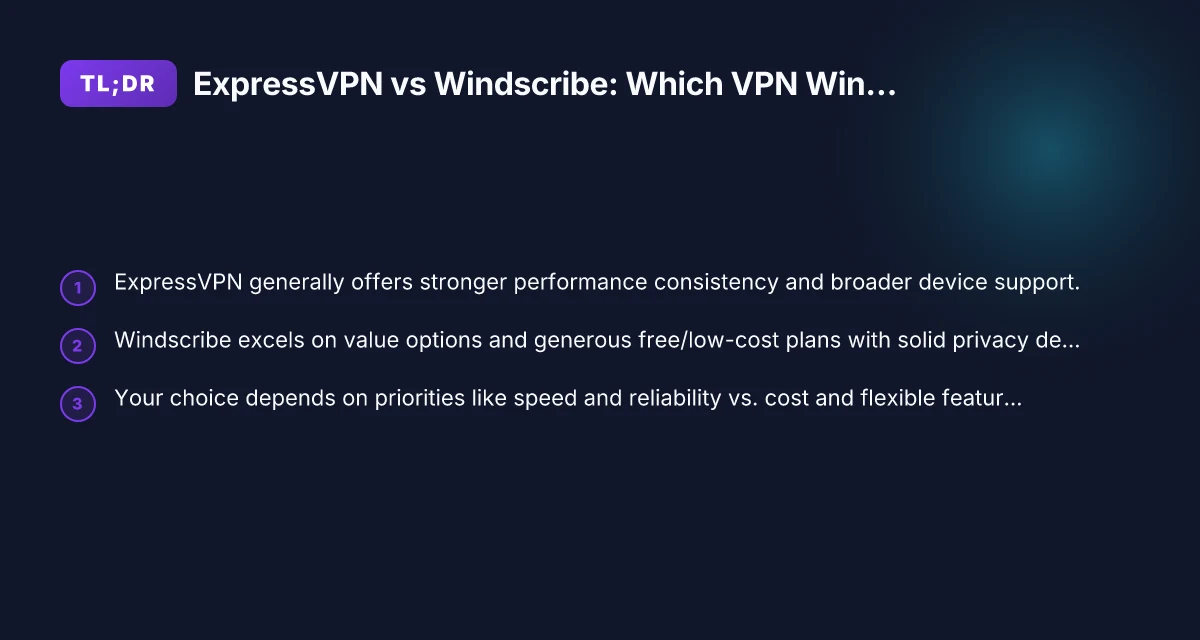
- If your top priorities are speed, reliability, broad device compatibility, and robust streaming performance, go with ExpressVPN. It’s a mature option that tends to deliver consistent results across many scenarios and devices.
- If you’re budget-conscious, value a flexible pricing model, and want extra built-in privacy tools (like a firewall and ad blocking) plus a compelling free plan to start, Windscribe is a strong choice. It may also be better if you enjoy experimenting with configurations and you don’t mind the variance in performance depending on server load and route.
- For mixed needs (privacy features plus cost efficiency) you might even consider using Windscribe as a complement to another VPN for specific tasks (e.g., using Windscribe’s firewall or ad blocking on certain devices) while relying on ExpressVPN for secure browsing and streaming on primary devices.
How to decide quickly
- If you need a VPN for streaming and broad device coverage with minimal setup, pick ExpressVPN.
- If you want a low-cost entry point or free testing with optional paid upgrades, start with Windscribe.
- If privacy audits and a privacy-forward narrative matter most, review the latest audit disclosures and transparency reports from ExpressVPN, and compare them to Windscribe’s privacy tools and policies.
Final takeaway: There’s no one-size-fits-all winner between ExpressVPN and Windscribe. Your use case should drive the decision. For most users who prize consistency and simplicity, ExpressVPN is often the safer bet. For those who want exceptional value, flexible pricing, and a toolkit of privacy features, Windscribe offers meaningful benefits that can suit lighter or more budget-conscious usage patterns.
Recommendation: Start with your primary needs in mind. If you’re undecided, take advantage of Windscribe’s free plan to explore the interface and features, then test ExpressVPN with a short-term membership during a promotional period to gauge real-world speed and reliability on your devices. If streaming or gaming latency is your main pain point, run side-by-side tests in your typical locations to see which service consistently performs best for you.